Heidegg Castle: A Medieval Residential Tower Transformed into a Baroque Castle


Site at a Glance
- Rating
- 4.7
- Popularity
- Low
- Country
- Switzerland
- Primary era
- Early Modern
- External website
- Open
- Eras represented
- Medieval, Early Modern, Modern
- Civilizations
- Swiss
- Site type
- Domestic
- Remains
- Castle
On this page9 sections
History
Heidegg Castle is a historic castle in Gelfingen, Switzerland, whose origins lie in the twelfth and thirteenth centuries and whose present character includes a Baroque transformation. It stands above Lake Baldegg in the Seetal of the Canton of Lucerne, and the castle, its residence, chapel, park, and cultural landscape are regarded as nationally significant.
Medieval Origins and Lordship
The first surviving reference to the Lords of Heidegg dates from 1185. The family were ministeriales, medieval service nobles who held administrative, military, or court positions for higher-ranking territorial lords. They probably first served the Counts of Lenzburg, followed by the Counts of Kyburg and the Habsburgs.
Heidegg’s castle and lordship emerged during the twelfth- and thirteenth-century expansion of towns and castles. During the thirteenth century, the Seetal briefly became an important regional land route connecting the Gotthard Pass, Lucerne, and Basel. The lordship included rights over dependent rural land and its inhabitants, lesser civil and criminal jurisdiction over Gelfingen and Altwis, and authority over most of Lake Baldegg. It also included vineyards and woodland. Between 1431 and 1437, the Büsinger family acquired the Lordship of Lieli, with jurisdiction over Lieli, Sulz, and Mosen.
Changing Owners
Ownership changed repeatedly as noble control gave way to the influence of Lucerne’s political elite. The Lords of Heidegg held the property in 1185, while the Büsinger family held it from 1421 to 1429. The Hasfurter family acquired it in 1482 or 1483, followed by the Tammann family in 1522 to 1528, the Kündig family in 1561, and the Fleckenstein family in 1618. The Pfyffer von Heidegg family took possession in 1664 or 1665, and the city of Lucerne acquired the castle in 1700.
From 1678, Johann Heinrich Franz Pfyffer von Altishofen, a member of Lucerne’s patrician elite, reshaped the medieval residence as a Baroque castle. The Baroque period was a European architectural era known for formal planning, dramatic massing, and elaborate decoration. His branch of the family adopted the name Pfyffer von Heidegg, and the city of Lucerne completed the interior after acquiring the property.
State Domain and Private Ownership
The judicial lordship ended in 1798. Heidegg became a state domain of the Canton of Baden, then belonged to the Canton of Lucerne from 1803 to 1848. After Lucerne’s defeat in the Sonderbund War, the 1847 Swiss civil war between the predominantly Catholic Sonderbund alliance and federal forces, the canton auctioned the property. The Gelfingen farmer Joseph Heggli purchased it in 1849.
Ludwig and Caroline Pfyffer von Heidegg-Slidell, a wealthy Lucerne-American couple, reacquired the castle in 1875. They remodeled its exterior in a romanticized medieval style, established a park with a chestnut avenue, and made the castle tower habitable again in 1912. In 1950, the last descendants, the childless widows Mathilde von Glutz and Marie-Louise de Chambrier, donated Heidegg to the Canton of Lucerne.
Public Institution and Museum
The canton opened the castle to the public, while the Association Pro Heidegg has operated the castle and museum since then. During the early 1950s, several projects expanded Heidegg’s importance beyond the region. Gottfried Boesch, a Swiss historian associated with the site, created a rose garden at the suggestion of West German Chancellor Konrad Adenauer. Vines were replanted on the castle hill for Lucerne’s cantonal wine, and the Swiss Hunting Museum was established at Heidegg.
The Canton of Lucerne undertook a comprehensive renovation between 1995 and 1998. The museum presents more than 800 years of Heidegg’s history and the history of its region, including a permanent exhibition and a residential museum devoted to the Pfyffer von Heidegg family.
Remains
Castle Tower and Main Buildings
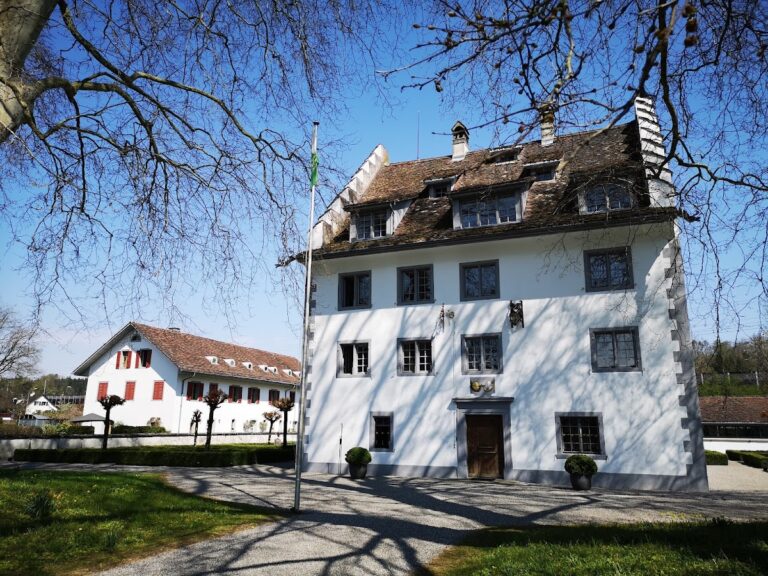
The complex occupies a castle hill above Lake Baldegg and consists of a residential tower, chapel, residence, farm, park, and cultivated landscape. The tower incorporates a stone house dated by tree-ring analysis to 1192. Tree-ring analysis, also called dendrochronology, dates timber by comparing its annual growth rings with established chronological sequences. The stone house was enlarged and raised in 1229 to 1230 and again in 1236 to 1237, forming a Romanesque residential tower, a massive stone dwelling from the Romanesque architectural period. In the fifteenth and sixteenth centuries, it became an intermittently occupied country residence.
From 1678, the tower and associated buildings were expanded into a Baroque castle. The original design included four projecting enclosed window bays, or oriels, which were soon removed. Between 1688 and 1698, the tower acquired its characteristic hipped roof, which slopes upward from all sides, and uniform yellow plaster. The residence, including a vaulted cellar and granary, dates from 1704. The farm buildings range from the eighteenth to the twentieth centuries.
Chapel and Exterior Alterations
The chapel is dedicated to Saint Charles Borromeo and dates from the sixteenth or seventeenth century. During the nineteenth century, the exterior of the castle was remodeled in a romanticized medieval style, with crenellations and portals added to the buildings. These alterations form part of the complex’s present appearance alongside the earlier tower and Baroque work.
Park, Vineyard, and Cultivated Landscape
The castle grounds include a chestnut avenue, a rose garden, the Seven-Bridges Path through the castle ravine, and an avenue with resting places and a play area. The rose garden was renewed in 2004 and 2005. Vines were replanted on the castle hill in the early 1950s, and the associated vineyard produced Lucerne’s cantonal wine. Together with the buildings, these cultivated areas form part of the castle’s surrounding park and cultural landscape.
Nearby sites