Lambeth Palace: The Archbishop of Canterbury’s London Residence


Site at a Glance
- Rating
- 4.5
- Popularity
- Low
- Country
- United Kingdom
- Primary era
- Medieval
- External website
- Open
- Eras represented
- Medieval, Early Modern, Modern
- Civilizations
- British, English
- Site type
- Religious
- Remains
- Palace
On this page22 sections
History
Lambeth Palace is the official London residence of the Archbishop of Canterbury in the United Kingdom. The archbishopric acquired the estate, then known as the Manor of Lambeth or Lambeth House, around 1200, although Archbishop Anselm may have maintained a house there a century earlier. The site has continued to serve as the archbishop’s London residence, while Canterbury remains the archbishop’s episcopal see, the jurisdiction and institutional centre of the office.
A residence beside Westminster
The estate was chosen for its position across the River Thames from Westminster, the royal palace and governmental centre. The south bank developed slowly because it was low, wet, and part of Lambeth Marsh. Archbishops and other visitors historically reached the palace by water, making the river an important part of its connection with London’s political centre.
Lambeth became a place of ecclesiastical and political confrontation. In 1378, the theologian and reformer John Wycliffe was tried there for heresy. During the Peasants’ Revolt of 1381, rebels attacked the palace, seized Archbishop Simon Sudbury, and later executed him. In 1558, Cardinal Reginald Pole, the last Roman Catholic Archbishop of Canterbury before the Elizabethan religious settlement, lay in state at Lambeth for 40 days after his death.
Seventeenth-century upheaval and rebuilding
The palace was attacked again in May 1640 during popular opposition to Archbishop William Laud’s Arminian theology. Arminianism was a theological tradition that stressed human freedom and conditional election. During the English Civil War of the 1640s, Parliamentarian forces ransacked and partially demolished the palace.
After the Restoration of the monarchy, Archbishop William Juxon directed the rebuilding of the Great Hall in 1663. Its late Gothic design and hammerbeam roof, a timber structure in which projecting horizontal beams support the roof trusses, expressed continuity with High-Church Anglicanism and historic religious practice while also marking the end of the Interregnum, the period of republican government between 1649 and 1660. The hall’s unusual character has been debated as either a survival of late Gothic design or an early form of the Gothic Revival. Samuel Pepys called it a “new old-fashioned hall.”
Nineteenth-century transformation and wartime damage
Between 1829 and 1834, the architect Edward Blore carried out major rebuilding and extension. He restored and incorporated medieval fabric and added a substantial eastern wing in the Gothic Revival style, the nineteenth-century revival and reinterpretation of medieval Gothic architecture. Earlier parts of the palace were then available for the archdiocesan library, record office, and secretariat, while the new range provided the principal modern archiepiscopal accommodation.
Bombing during the Blitz damaged Lambeth Palace in 1941. The chapel was restored in 1954–55 and again in 1986–88. Lambeth Palace is a Grade I listed building, and its garden is a listed historic park and garden. The building received its designation in 1951 and the garden in 1987.
Institutional and religious life
The Archbishop of Canterbury is the senior bishop of the Church of England and the symbolic spiritual leader of the worldwide Anglican Communion, a fellowship of churches historically connected with the Church of England. The archbishop is regarded as first among equals within that communion and is ex officio, meaning that membership is attached to the office, a member of the House of Lords. The Community of Saint Anselm, an Anglican religious order under the archbishop’s patronage, is also based at Lambeth Palace.
Archbishop Richard Bancroft founded Lambeth Palace Library in 1610 as a public library. It became the official library of the Archbishop of Canterbury and the principal repository for records of the Church of England. Its holdings include the archives of Canterbury’s archbishops from the twelfth century, records of other church bodies, Anglican missionary and charitable societies, manuscripts dating from the ninth century, and more than 120,000 printed books.
The collections also support research into art, architecture, colonial and Commonwealth history, English social, political, and economic history, local history, and genealogy. A purpose-built repository, reading room, and conservation centre designed by Wright & Wright opened in the palace gardens in 2021. The library incorporated archival collections formerly kept at the Church of England Record Centre in Bermondsey and holdings acquired from Sion College after its closure in 1996.
St Mary-at-Lambeth
The former parish church of St Mary-at-Lambeth stood immediately outside the palace gatehouse. Its parish was absorbed into North Lambeth, and the church was deconsecrated in 1972. In 1977, the building became the Museum of Garden History, now the Garden Museum, partly because of its associations with the gardeners and plant collectors John Tradescant the elder and John Tradescant the younger.
Renovation work in 2016 revealed a previously unknown crypt containing 30 coffins. Among them were the coffins of five Archbishops of Canterbury, Richard Bancroft, Thomas Tenison, Matthew Hutton, Frederick Cornwallis, and John Moore, together with that of John Bettesworth, Dean of the Arches.
Remains
Lambeth Palace occupies the south bank of the Thames in north Lambeth, about 400 yards, or 370 metres, south-east of the Palace of Westminster. Lambeth Palace Road bounds the estate on the west and Lambeth Road on the south. The surviving complex centres on a historic residence arranged around a cloister, with Morton’s Tower at the principal entrance and nineteenth-century extensions to the east. Three medieval courtyards and the former surrounding moat have given way to the present arrangement.
Medieval and early modern core
Chapel
The chapel, built around 1230 in the Early English Gothic style, is the oldest surviving part of the palace. It stands above a vaulted undercroft with a central line of columns. Second World War bombing left the chapel walls standing. The 1986–88 restoration reconstructed the vault and added paintings by Leonard Rosoman. An elaborate classical screen made in 1633 by the master carpenter Adam Brown was taken from storage and re-erected across the west end.
Great Hall
The Great Hall was rebuilt in 1663 on the site of the medieval hall. Its south end connected with the kitchen and offices, while a stair at the north end led to the archbishop’s apartments. The rebuilt hall combines Gothic and classical details beneath a late Gothic hammerbeam roof, giving the interior the architectural character that prompted Samuel Pepys’s description of a “new old-fashioned hall.”
Guard Chamber
The Guard Chamber is a fourteenth-century room within the archbishop’s apartments. It survives in heavily restored form, retaining its original elaborate roof.
Towers and entrance buildings
Water Tower and Lollards’ Tower
The Water Tower, also called Lollards’ Tower, stands at the north-west corner of the palace. It was built in 1434–35 from Kentish ragstone with ashlar quoins, carefully dressed masonry blocks that strengthen and define the corners. The tower was later extended and heightened, and Laud’s Tower was built beside it in the early sixteenth century. A room at the top of the Water Tower’s stair served as the Archbishop’s Prison.
Morton’s Tower
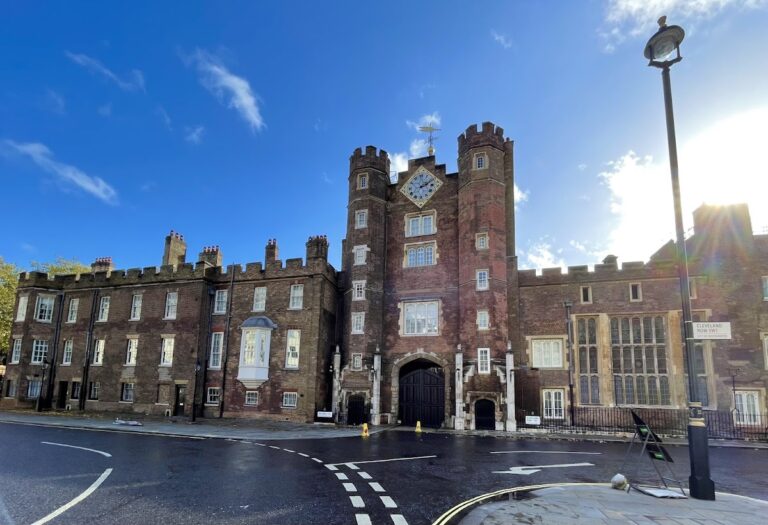
Morton’s Tower is a massive five-storey brick gatehouse built by Cardinal John Morton and completed in 1495. It contained eight lodgings for members of the archbishop’s household and remains the principal entrance to the palace.
Cranmer’s Tower
In the sixteenth century, Archbishop Thomas Cranmer built a brick tower north-east of the chapel to contain his study.
Nineteenth-century range and garden
Eastern wing
Blore’s nineteenth-century work produced a large eastern wing in Gothic Revival style and extensively rebuilt and restored medieval fabric. The range fronts a spacious quadrangle and contains the principal modern archiepiscopal accommodation.
Garden
Lambeth Palace Garden is described as London’s oldest continuously cultivated garden, although most of its visible layout and planting date from the nineteenth and twentieth centuries. The medieval orchard was largely replaced by the adjoining Archbishop’s Park, which is now a public park under local-authority ownership.
A fig tree in the palace courtyard may have grown from a cutting of one of the White Marseille fig trees traditionally associated with Cardinal Pole. Three old fig trees were recorded in 1786, including two trained against a wall. In 1826, two were still described as exceptionally fine and traditionally planted by Pole. By 1882, substantial offshoots had replaced them.
St Mary-at-Lambeth and its burials
Church and monuments
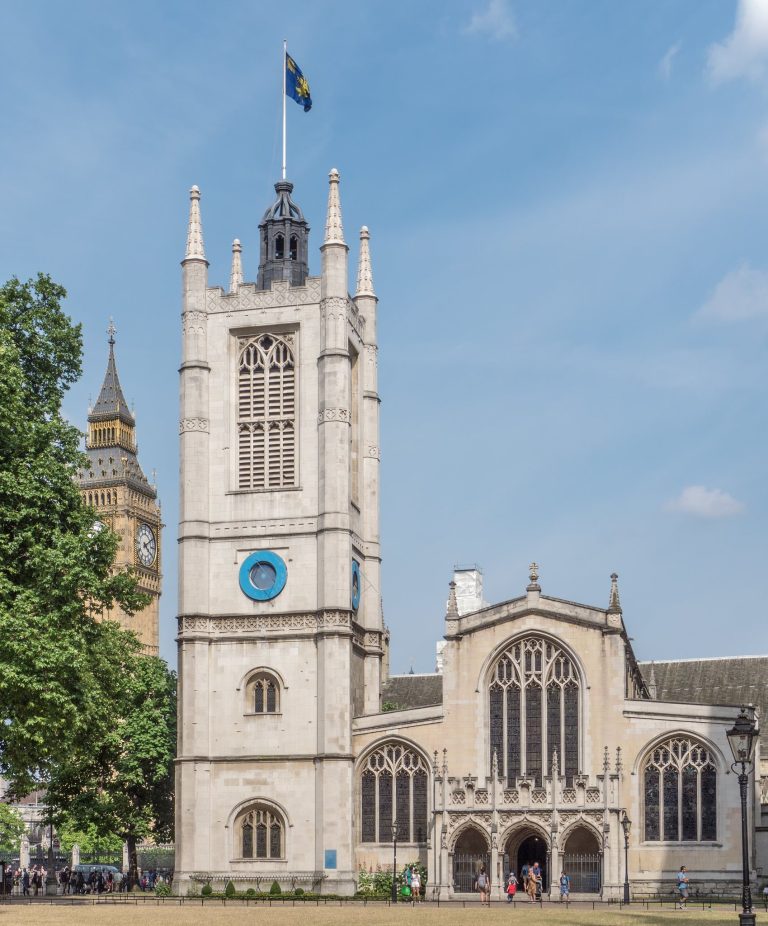
St Mary-at-Lambeth stands immediately outside the palace gatehouse. Its tower dates from 1377 and was repaired in 1834, while the body of the church was rebuilt in 1851 to designs by Philip Hardwick. Older monuments include the tombs of John Tradescant the elder, John Tradescant the younger, and Admiral William Bligh, the British naval officer associated with the voyage of HMS Bounty.
Crypt
The crypt uncovered during renovation in 2016 contains 30 coffins, including those of Richard Bancroft, Thomas Tenison, Matthew Hutton, Frederick Cornwallis, and John Moore, five Archbishops of Canterbury. John Bettesworth, Dean of the Arches, is also buried there.
Library collections
Lambeth Palace Library preserves manuscripts, books, and archives that span more than a thousand years of ecclesiastical history. Among its notable holdings are the Mac Durnan Gospels from the late ninth or early tenth century; the eleventh-century manuscripts Minuscule 473 and Minuscule 559; the twelfth-century Lambeth Apocalypse and Romanesque Lambeth Bible; and the Lambeth Homilies of around 1200.
Later treasures include the mid-fifteenth-century Book of Hours of King Richard III, A Short English Chronicle, a rare copy of the Gutenberg Bible dating from the 1450s, the sixteenth-century Lambeth Choirbook, and the late-sixteenth-century Book of Howth. The library also holds archives of the Commission for Building Fifty New Churches and the Incorporated Church Building Society, extending its collections beyond episcopal records to the history of church building and religious institutions.
The palace preserves portraits of Archbishops of Canterbury attributed to Hans Holbein, Anthony van Dyck, William Hogarth, and Sir Joshua Reynolds. Together with its buildings, garden, burials, and library, these collections give Lambeth Palace a physical record of the changing religious, political, and cultural life associated with the archbishopric.