San Anton Palace: A Grand-Masterial Residence in Malta


Site at a Glance
- Rating
- 4.5
- Popularity
- Low
- Country
- Malta
- Primary era
- Early Modern
- Eras represented
- Early Modern, Modern
- Civilizations
- British, Knights Hospitaller
- Site type
- Domestic
- Remains
- Palace
On this page13 sections
History
San Anton Palace is a historic residence in Attard, Malta, built and enlarged under the Order of St John during the seventeenth century. It originated around 1600 as a country or summer villa for Antoine de Paule, a knight from the Order’s Langue of Provence, a regional division that organized members according to their place of origin. After de Paule became Grand Master in 1623, the villa was expanded into a palace, probably around 1625 and possibly as late as 1635. The residence was named San Anton after his patron saint, Anthony of Padua.
From villa to grand-masterial palace
De Paule had acquired land near Attard for a country residence because the location was closer to Valletta than Verdala Palace, the Order’s other residence. Once elected Grand Master, he chose to enlarge the villa rather than proceed with plans to build a trireme, a galley propelled by three banks of oars. He planned the palace on a generous scale, with space for guests and a large household staff that included cooks, food tasters, torch bearers, pantry boys, wig makers, a clock winder, physicians, and a baker who prepared black bread for the hunting dogs.
The enlargement continued from de Paule’s election until his death in 1636. San Anton then remained a residence for successive Grand Masters of the Order of St John, a Catholic religious and military order that governed Malta from 1530 to 1798. During this period, the building was repeatedly enlarged, and its plan developed from a T-shape into a Latin-cross form.
On 12 September 1776, Grand Master Emmanuel de Rohan-Polduc held a large celebration at San Anton instead of the customary hand-kissing ceremony. The event included a water joust and performances by French comedians. The palace and gardens probably also influenced later Grand Masters who established residences and gardens of their own, including Giovanni Paolo Lascaris’s garden in Valletta and António Manoel de Vilhena’s Casa Leoni in Santa Venera.
Revolution, British rule, and political residence
During the French occupation and the Maltese uprising, San Anton Palace became the meeting place and headquarters of the rebel National Assembly. The assembly first met there on 11 February 1799 and remained associated with the palace until the French capitulation in September 1800.
From 1800, San Anton became the residence of Malta’s first British civil commissioner, Admiral Sir Alexander Ball, who died there in October 1809. The palace later served as the official residence of Malta’s governors and governors-general, while Verdala Palace was used as their summer residence. Ball opened parts of the gardens to the public in the early nineteenth century. The second governor, the 1st Marquess of Hastings, further enriched the gardens during the 1820s, and they were reopened to the public in 1882.
Several structural changes took place during British rule. Lightning struck the tower in 1819, after which its height was reduced. During Ball’s residence, loggias were built around the drawing room, a circular walkway was added around the outer court, and a balustraded walk was constructed around the main courtyard.
Royal associations and the presidency
Princess Victoria Melita of Saxe-Coburg and Gotha was born at San Anton Palace on 25 November 1876 while her father, Alfred, Duke of Saxe-Coburg and Gotha, was stationed in Malta as a Royal Navy officer. Queen Elizabeth II stayed at the palace during royal visits in 1954, 1967, and 2005.
San Anton Palace has been the official residence of the president of Malta since the office was created in December 1974, after Malta became a republic. The palace and gardens were included on Malta’s Antiquities List in 1925. The complex is now a Grade 1 national monument and is listed in the National Inventory of the Cultural Property of the Maltese Islands under number 1152.
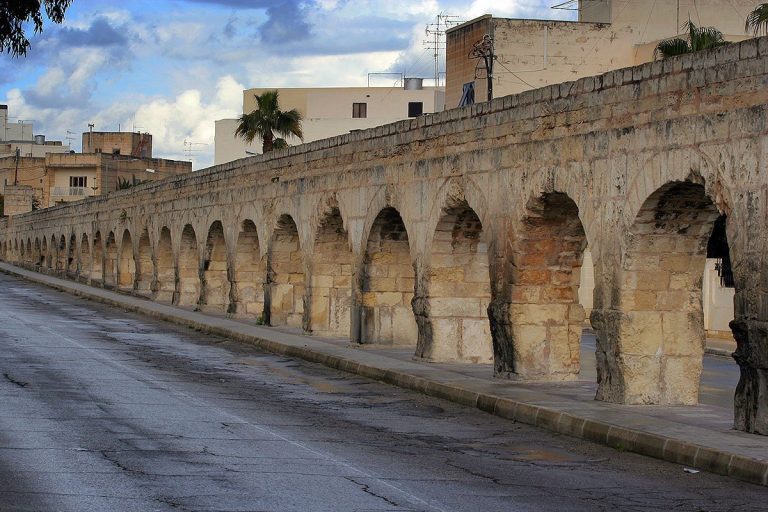
On 17 October 2018, a 50-metre section of a historic palace wall collapsed without causing injuries. Emergency conservation work was carried out on the remaining wall, which had been restored several months earlier.
Remains
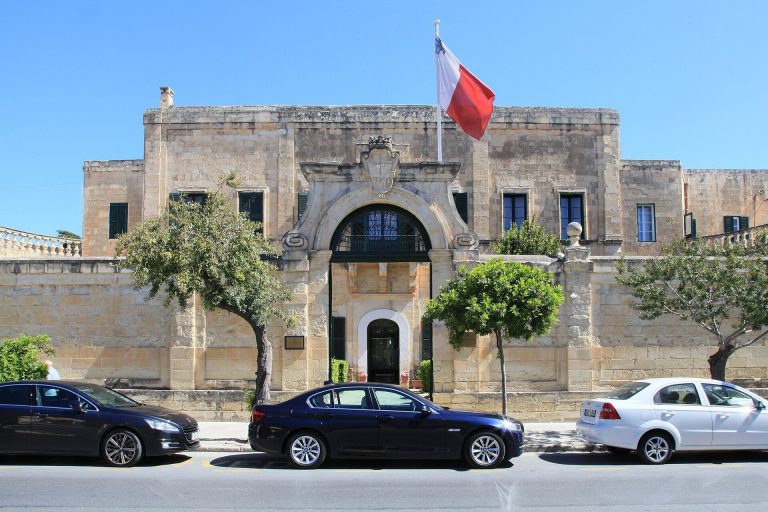
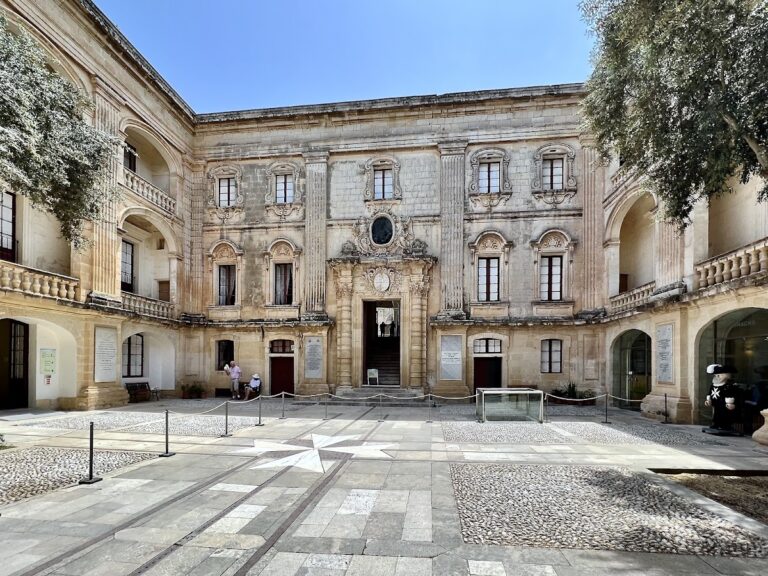
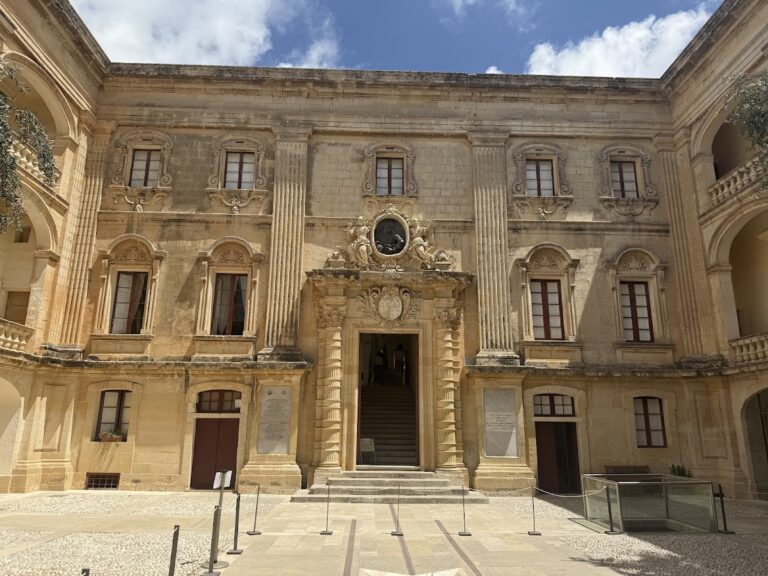
San Anton Palace is a two-storey limestone building surrounded by private and public gardens. Its surviving layout reflects repeated enlargement from the original villa, while the grounds combine formal Baroque design with water features, planted areas, and smaller structures connected with the palace property.
Palace and tower
Main building
The palace developed from a T-shaped plan into a Latin-cross form during its period as a grand-masterial residence. It remains a substantial limestone building with two storeys, incorporating the successive enlargements that followed its conversion from a country villa into a residence for the Grand Masters of the Order of St John.
Square tower
A high square tower rises above the palace and provides views across the surrounding area. It was originally more substantial, but lightning damaged its upper levels and they were removed, reducing its height. A cornice, balustrade, and ornamental waterspouts at the corners soften the tower’s rectangular form.
Chapels
Chapel of Our Lady of Pilar
The Chapel of Our Lady of Pilar was built in the eighteenth century by Grand Master António Manoel de Vilhena. Its nave has a barrel vault divided by ribs into six bays. The vault is decorated with the coats of arms of Vilhena, Manuel Pinto da Fonseca, and Emmanuel de Rohan-Polduc. At the end of the nave, an altar occupies a chancel separated from the main space by pilasters.
Chapel of St Anthony
The Chapel of St Anthony, also known as the Russian Chapel, was built in the nineteenth century as a Protestant chapel. It was later converted into a Russian Orthodox chapel for Grand Duchess Maria Alexandrovna of Russia, the wife of Alfred, Duke of Saxe-Coburg and Gotha. Larger than the Chapel of Our Lady of Pilar, it is now Roman Catholic and was restored in 2013.
San Anton Gardens
San Anton Gardens are formally laid out in the Baroque style. Walkways connect sculptures, ornamental ponds, fountains, and a small aviary, while ducks, swans, and turtles live in the ponds. One fountain is decorated with a statue relocated from Argotti Gardens.
The planting includes palms, cypresses, jacarandas, araucarias, orange trees, and other species from around the world. Some trees and plants are more than three centuries old. The gardens also contain an orangery, where oranges grown on the palace grounds were traditionally gathered into baskets and given by incumbent governors as Christmas gifts. Visiting heads of state have traditionally planted trees there to commemorate their stays in Malta.
President’s Kitchen Garden
The President’s Kitchen Garden lies across the street from the palace near Villa Bologna. It is part of the palace property and is under the president of Malta, although it is not physically included within the palace complex.