Fort Madalena: A British Coastal Defence Fort in Malta


Site at a Glance
- Rating
- 4.6
- Popularity
- Low
- Country
- Malta
- Primary era
- Modern
- External website
- Open
- Eras represented
- Modern
- Civilizations
- British
- Site type
- Military
- Remains
- Fort
On this page7 sections
History
Fort Madalena, also known as Fort Madliena, is a British fort in Is-Swieqi, Malta, built between 1878 and 1880 as part of the Victoria Lines. The fort formed the eastern end of this nineteenth-century defensive system, which followed Malta’s Great Fault and separated the more densely populated south from the north.
From the Great Fault to the Victoria Lines
The Victoria Lines were originally called the North West Front. In 1897, they received their later name in connection with the sixtieth birthday of Queen Victoria. The defensive system extended for approximately 12 kilometres, from the area of Baħar iċ-Ċagħaq near Swieqi to Fomm ir-Riħ Bay, following the natural escarpment of the Great Fault. It included forts, batteries, defensive walls, fortified infantry positions, and searchlights.
The defensive value of the Great Fault had already been recognized in 1722, during the rule of Grand Master Marc Zondadari. Under his successor, Grand Master Antonio Manoel de Vilhena, stone buildings and fortifications were placed at key points along the fault to help defend the then-capital from attacks approaching from the more accessible northern side. The British revived this defensive principle during the second half of the nineteenth century, when Malta’s strategic importance increased after the opening of the Suez Canal in 1869.
Construction and early military use
Fort Madalena was built in two principal phases. The first, from 1878 to 1880, created the pentagonal fortification at a cost of £9,400. A sea-facing artillery battery was subsequently added, with its installation completed in 1885. The fort occupied the site of a fifteenth-century chapel dedicated to Mary Magdalene. After an agreement between army and church authorities, the chapel was moved approximately 250 metres, while the new fort retained the saint’s name.
The Victoria Lines were abandoned in 1907, but Fort Madalena and Fort Binġemma continued to serve in coastal defence. The fort’s original guns were removed during the interwar period. Two 6-inch guns had been added during the First World War, while changes to the heavier artillery had already taken place in 1906.
Radar station and continuing military use
The Royal Air Force later used Fort Madalena first as a communications post and then as a radar station during the Second World War. It became Malta’s principal radar station during the war and the postwar period. NATO continued to use the station after the war, until British forces left Malta in 1979 and the fort was handed over to the Armed Forces of Malta.
Since 1979, the fort has fallen under the responsibility of the 4th Regiment of the Armed Forces of Malta. The St John Rescue Corps, a volunteer civil-defence organization, uses it as its headquarters and training school, so the site has remained in active use from 1880 to the present. In 1998, the Maltese government submitted the Victoria Lines for inscription on the UNESCO World Heritage List. A radar belonging to the European Vessel Traffic Monitoring and Information System, a maritime system for monitoring and managing ship movements, was installed at the fort in 2006.
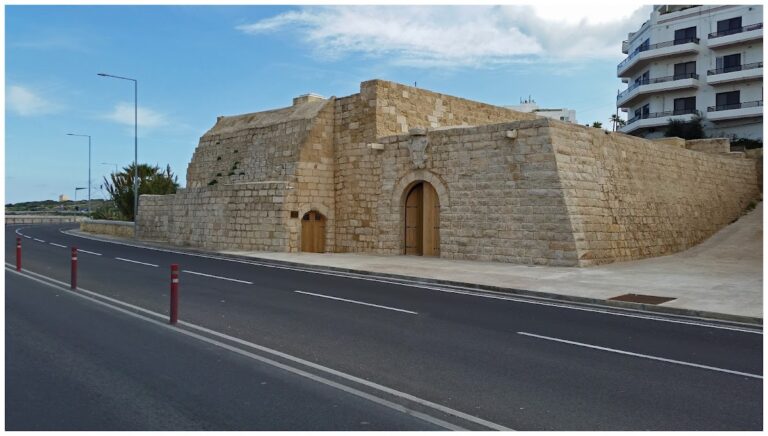
Heavy rain caused part of the wall near the entrance to collapse in April 2019. Restoration began in June of that year, addressing damage to the fort’s surviving fabric.
Remains
Pentagonal fortification
Fort Madalena is a small polygonal fort and artillery battery built from limestone and concrete. Its principal fortification has a pentagonal plan, with its short sides measuring approximately 30 metres. A ditch surrounds the entire pentagonal structure, reaching about 6 metres in depth and 4 metres in width. The fort stands on a hill approximately 132 metres above sea level above Baħar iċ-Ċagħaq, a position that provided observation and defensive coverage toward the sea and the areas around Salina, Saint Paul’s Bay, and Mellieħa.
Sea-facing artillery battery
A later artillery battery was built around the original fort for coastal defence. The initial armament consisted of one RML 11-inch gun, four 64-pounder guns, two 40-pounder guns, and two field guns. RML guns were rifled muzzle-loading artillery pieces, loaded from the front of the barrel. The later battery carried two BL 9.2-inch guns, which were breech-loading weapons loaded from the rear.
In 1906, the RML 11-inch gun was replaced by BL 9.2-inch Mk X guns with an effective range of approximately 8,000 yards. The two earlier sea-facing 9.2-inch guns were also replaced by BL 9.2-inch Mk IX to Mk X guns, representing successive British weapon models. The fort is described as intact and in good condition, although some sections require restoration. The partially collapsed entrance wall subsequently entered restoration after the 2019 rainfall damage.