Schloss Goseck: A Former Benedictine Monastery and Palace in Germany


Site at a Glance
- Rating
- 4.4
- Popularity
- Low
- Country
- Germany
- Primary era
- Early Modern
- External website
- Open
- Eras represented
- Medieval, Early Modern
- Civilizations
- Electorate of Saxony, Holy Roman Empire
- Site type
- Domestic
- Remains
- Elite Residence
On this page8 sections
History
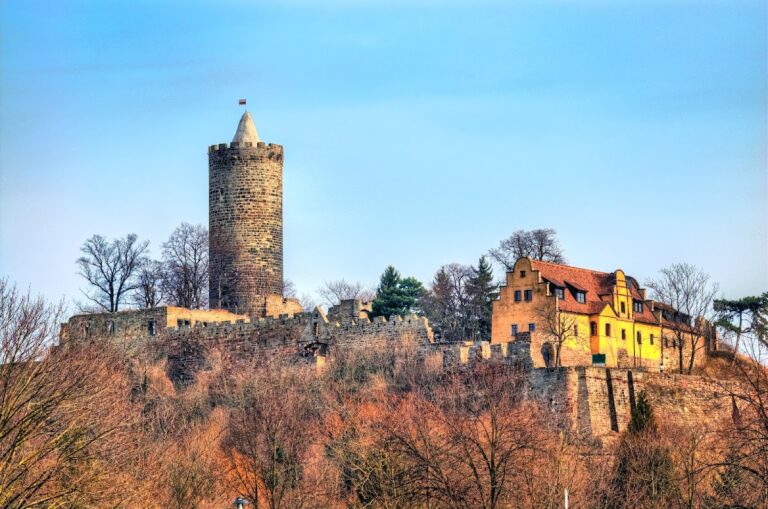
Schloss Goseck is a former Benedictine monastery and later palace in Germany, standing at Goseck in Saxony-Anhalt on a hill about 50 metres above the Saale valley. An early medieval castle occupied the site before the present complex, which became a monastery in the eleventh century and was transformed into a noble estate after the Reformation.
The early medieval castle and monastery
The earlier castle is named in the Hersfeld tithe register, a late ninth-century record of ecclesiastical dues, under forms corresponding to Gozacha civitas, Gozzesburg, and castellum Gozcoburch. It served as the ancestral seat of the Counts Palatine of Saxony. A Count Palatine was a high-ranking noble officeholder who could exercise authority for a ruler, while the title could also belong to a ruling noble family.
In 1041, Adalbert, later Archbishop of Hamburg-Bremen, and his brothers Dedo and Friedrich II, the sons of Count Palatine Friedrich I, had the castle demolished. They established a Benedictine monastery on the site. Benedictines followed the Rule of Saint Benedict and combined worship with communal religious duties. Adalbert of Bremen consecrated the monastery in 1053, while its crypt had already been consecrated in 1046.
The monastery was extensively rebuilt and enlarged during the first half of the thirteenth century. This phase gave the religious complex a substantial medieval form before later political and religious changes altered its purpose.
Secularization and the noble estate
The sixteenth-century Reformation, a religious movement that brought major changes to Western Christianity, led to the monastery’s secularization around 1540. Secularization transferred the institution and its property from ecclesiastical control to secular ownership. The former monastery became a landed estate, or Rittergut, and its principal building came to be called a Schloss, meaning a palace or castle.
The estate belonged to the Amt of Freyburg in the Thuringian District of the Electorate of Saxony. An Amt was a territorial administrative district in the early modern German states. Goseck’s lordship included Goseck, Dobichau, Kleingräfendorf, Pettstädt, parts of Markröhlitz and Eulau, and the parish of Lobitzsch.
The earliest documented owners of the secularized estate were the brothers Georg von Altensee, also recorded as Altensehe, and Lamprecht von Altensee. Georg, who died in 1565, received the former monastery from Elector Moritz of Saxony for military service. Lamprecht died in 1581.
Franz von Königsmarck was formally enfeoffed with Goseck in 1594. To be enfeoffed meant to receive an estate as a fief under a feudal legal arrangement. After his death, his widow Katharina, née von Hoym, married Chancellor Bernhard von Pölnitz, and both were enfeoffed with Goseck in 1609. The former monastery church was converted into a palace chapel during this period.
Bernhard von Pölnitz was followed by his sons Christian Julius, who died in 1662, and Hans Christoph von Pölnitz, who died in 1680. In 1684, Amalie von Pöllnitz, née von Hunigk, administered the estate as guardian for her sons Christoph Bernhard and Christian Julius Heinrich. After both sons were declared dead following a sea voyage in 1698, ownership passed among several heirs.
Goseck was transferred to Chief Tax Councillor Gottfried Pfitzner, who died in 1732. His son, Court Councillor Jakob Heinrich Pfitzner, died in 1737, and his grandson Gottfried Heinrich Pfitzner died in 1758. After the grandson’s early death, his mother Charlotte Sophie, née Lampe, retained the estate until 1776. She then passed it to her son from a second marriage, Ludwig Wilhelm von Eckhardt.
Renaissance rebuilding and later ownership
From 1808, Carolina Christiane von Schönberg, née von Brandenstein, and her three siblings were recorded as owners. Goseck remained with the Barons von Brandenstein until 1840, when Julius Count von Zech-Burkersroda acquired Goseck and Uichteritz. He later also acquired Schloss Börln. The Zech-Burkersroda family retained Schloss Goseck until the land reform of 1945.
The former estate then passed through several institutional uses. It temporarily served as a grain store, followed by use as the Arthur Weisbrodt youth hostel and a Polytechnic Secondary School. Between 1989 and 1997, the administrator’s building housed a primary school and after-school centre.
Preservation and cultural use
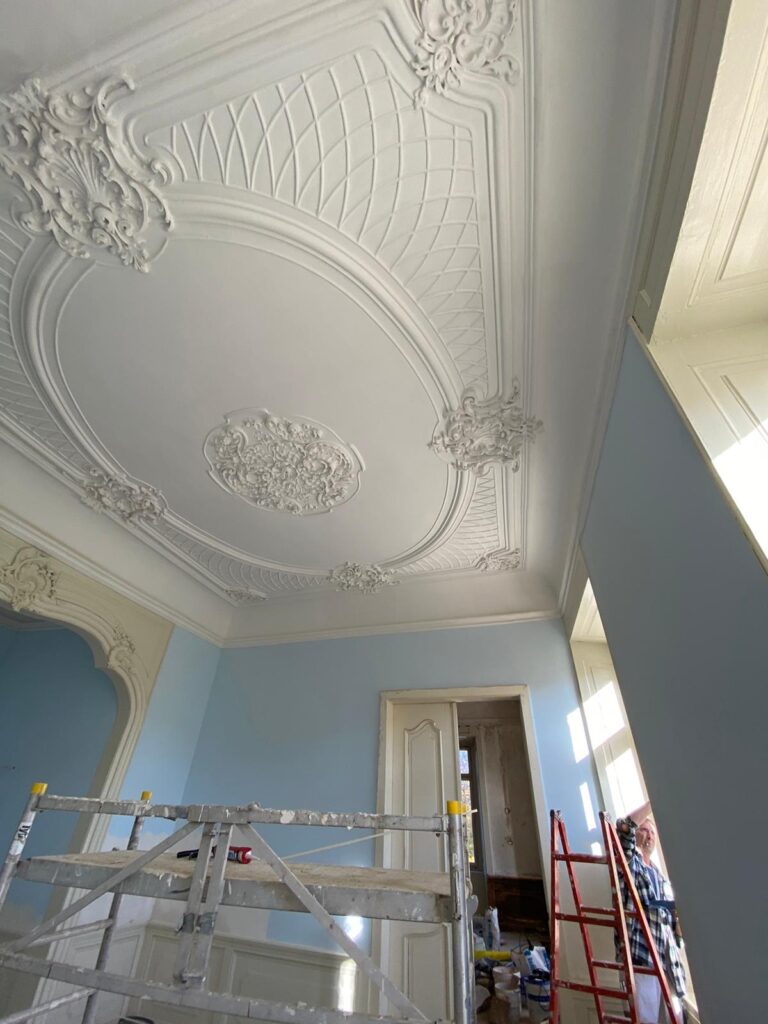
The Palaces, Castles and Gardens Foundation of Saxony-Anhalt took over Schloss Goseck in 1997 and began securing and preserving the buildings. The Schloss Goseck association was founded in the vacant complex in autumn 1998. It progressively developed the site as a European music and cultural centre, with particular attention to concerts of early music. Guest rooms and a castle tavern are also operated there.
Information rooms concerning the Goseck solar observatory opened in 2006. A solar observatory is a structure or archaeological monument designed or interpreted as helping track the Sun’s movements or seasonal positions. Schloss Goseck is a listed monument on Saxony-Anhalt’s Romanesque Road, a cultural-heritage route linking monuments and ensembles associated especially with Romanesque architecture.
Remains
The former abbey church and palace church
The surviving eastern part of the former abbey church includes the transept, the crossing, and the choir. A transept is the crosswise part of a church, while the crossing is the space where it meets the main axis of the building. The crypt, a partly or wholly underground chamber associated with a church and commonly used for burial or religious purposes, survives from the early monastery and was consecrated in 1046. The abbey church itself was consecrated in 1053.
The thirteenth-century nave was replaced by the present Renaissance palace, built under Bernhard von Pölnitz between 1609 and 1635. Renaissance architecture used forms associated with the European revival of classical styles from roughly the fifteenth to seventeenth centuries. The present palace church was consecrated in 1620. Its surviving and documented spaces include the choir, transept, crossing, crypt, and the west wall visible from the crossing.
The palace church contains the Alvensleben and Pölnitz epitaphs. An epitaph is a memorial inscription or monument commemorating a deceased person, often placed in a church. The figures on the Pölnitz epitaph suffered damage during twentieth-century vandalism, when their heads were knocked off. The church was initially unused after 1945, and its organ mechanism was destroyed, particularly during the vandalism of the 1970s. Extensive renovation from 2011 to 2014 left the church in restored condition.
Palace buildings and courtyard
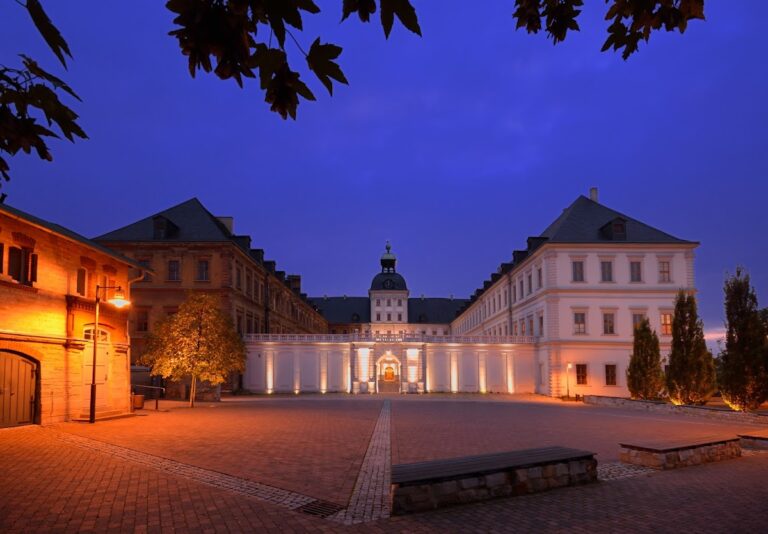
The complex includes a castle courtyard and a main building on the hilltop above the Saale valley. The main building incorporates the Renaissance palace that replaced the medieval nave. A ginkgo planted in the courtyard in 1840 forms an explicitly associated landscape feature within the surviving ensemble.