Burg Schönburg: A Medieval Hilltop Castle in Germany


Site at a Glance
- Rating
- 4.6
- Popularity
- Low
- Country
- Germany
- Primary era
- Medieval
- External website
- Open
- Eras represented
- Medieval, Early Modern
- Civilizations
- Holy Roman Empire
- Site type
- Military
- Remains
- Castle
On this page15 sections
History
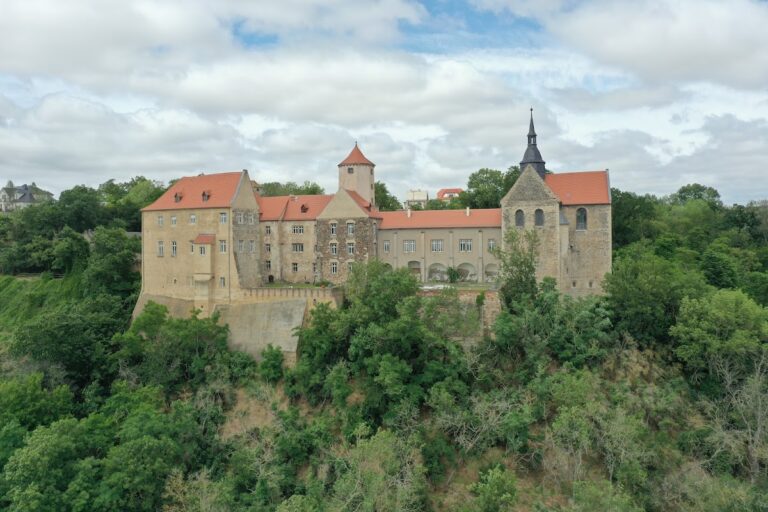
Burg Schönburg is a medieval hilltop castle above Schönburg village near Naumburg in Germany. Built during the medieval period, probably with a foundation date around 1130, it occupies a sandstone cliff above the Saale and preserves substantial elements of a fortified residence shaped by Romanesque architecture. Its earliest history remains uncertain, but the castle later became an important centre of the Naumburg bishops’ territorial administration and summer residence.
Origins and Episcopal Rule
The noble Lords of Schönburg may have held the site as an imperial fief before the Schönburg castle district passed from the Empire to the Bishopric of Naumburg, probably around 1060 to 1065. The tradition that Ludwig the Springer, a medieval nobleman of the Ludovingian dynasty, founded the castle is unverified and belongs to regional legend. A supposed first reference from 1137 resulted from a mistaken reading of a document.
The first reliable references appear in 1157 and on 1 May 1161, when the noblemen Ulricus and Sigifridus of Schönburg witnessed documents issued by Bishop Berthold I of Naumburg. These men belonged to the noble family associated with the castle. From 1174, documents also mention a separate ministerial family of Schönburg, meaning dependent military and administrative retainers of the bishops. The two families were not the same. The ministerial family later used Schönburg and Rudelsburg as names and seems to have died out by the end of the fourteenth century.
From about the thirteenth century until the Reformation, Schönburg belonged directly to the bishops of Naumburg and later Naumburg-Zeitz, without an intervening feudal lord. The bishops used it as a summer residence. In 1355, the castle was temporarily pledged to the Naumburg cathedral chapter. The surrounding castle district, which developed from the twelfth century, comprised the fortress and twelve nearby villages. In the late Middle Ages it became an ecclesiastical administrative office, a territorial unit governed by the bishopric, before being incorporated into the Naumburg office in 1544.
War, Reformation, and Decline
During the Saxon Brother’s War, a fifteenth-century conflict within the Wettin dynasty, Apel von Vitzthum, serving Landgrave Wilhelm III, captured Schönburg and the castle burned. The Reformation subsequently dissolved the Bishopric of Naumburg. In 1564, Schönburg passed to the Albertine electors of Saxony, the Wettin branch that ruled Electoral Saxony after the dynastic division of 1485, and an electoral Saxon official administered the property.
The castle was leased in 1570, initially once again to the Naumburg cathedral chapter. Around 1650, a forester’s office was established in the Renaissance building of the outer castle, while other unused structures began to decay. In 1668, the administrative estates attached to the castle were sold to farmers from Schönburg and Possenhain. Well-cut stones were repeatedly taken from the castle buildings for use on local farms. Inventories and building accounts from the sixteenth and seventeenth centuries describe both deteriorated sections and continuing repairs.
Restoration and Cultural Use
The Congress of Vienna transferred Schönburg to Prussia in 1815. Interest in medieval ruins during the Romantic era had already encouraged restoration from around 1800, with the aim of preserving the castle’s appearance in the Saale valley. The keep was repaired in 1825 for use as a viewing point, and work to secure the ring walls continued through the nineteenth century. After extensive restoration in 1884, a restaurant opened in the inner castle and later moved to the outer castle after 1927.
On 25 July 1860, Friedrich Nietzsche, the German philosopher and writer, Wilhelm Pinder, and Gustav Krug founded Germania at Schönburg. This literary and artistic association met at the castle every quarter to discuss literature, philosophy, music, and language until 1863. In 1924, the city of Naumburg and the Naumburg Delegierten-Convent, an association of student corporations, took over the castle from Prussia. The association held annual meetings there until 1935.
After the Second World War, Schönburg again hosted local cultural activities. The village ensemble, including a choir, dance group, and brass group, used the site, and the first large singers’ gathering took place in 1952. Schönburg festivals have continued as a local tradition initiated by the poet Hartwig Stützer. A major reconstruction and restoration campaign followed from 1991 to 1994. In 1994, local residents founded the Schönburg/Saale Heritage Association to support preservation and cultural events.
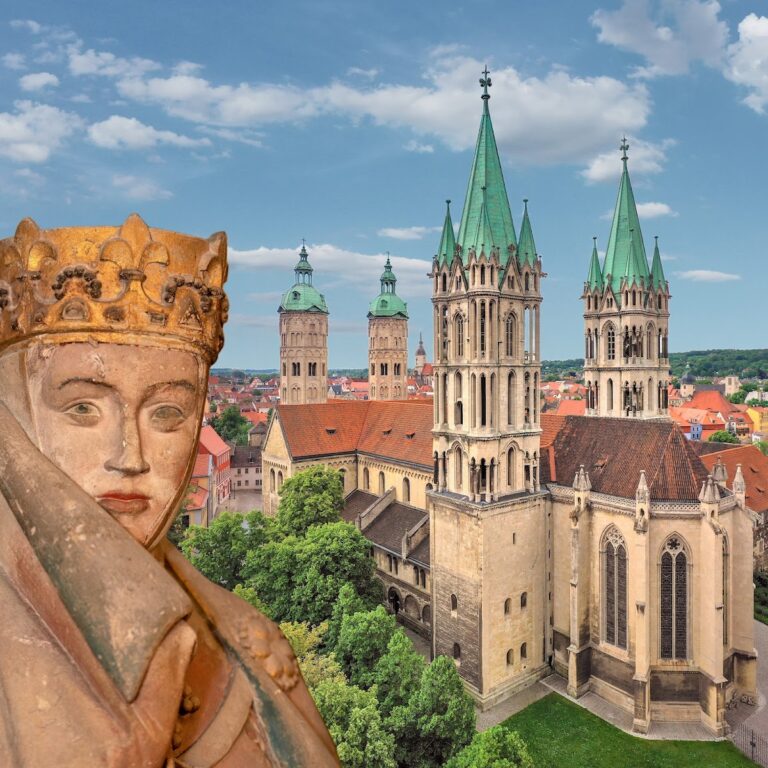
Schönburg is a protected cultural monument in Saxony-Anhalt. It is also one of eleven components in the proposed “Naumburg Cathedral and the High Medieval Cultural Landscape of the Saale and Unstrut Rivers” World Heritage nomination, where the castle is identified as an important element in the landscape’s visual connections. Three memorial plaques in the outer-castle wall commemorate Hartwig Stützer and two other people associated with the Schönburg community. A separate monument outside the outer-castle gate commemorates members of the Naumburg Senior Convent who died in the First World War.
Remains
Burg Schönburg occupies a sandstone cliff about 40 metres above the Saale. The ground falls sharply on the western side, and sandstone forms much of the castle’s construction. The complex follows an almost trapezoidal plan, divided into an outer castle and an inner castle. A narrow zwinger, or fortified intermediate passage, separates them, and a chamber gate provides the connection. Large stretches of the defensive walls survive, together with gates, wall-walks, interior features, and restored elements.
Defensive Structures
Keep
The bergfried, or principal defensive tower, dates from around 1230. It rises approximately 32 metres and has walls about 3.60 metres thick. Its original high entrance remains around 8 metres above ground level. Inside, a latrine is built into the masonry near the entrance, with its shaft and chamber contained within the wall. A guardroom occupies the top of the tower, which can be climbed. The viewing platform is enclosed by crenellations and topped by a masonry conical pinnacle with an exit door.
One tower room retains a fireplace dated stylistically to around 1220, although its relationship to the tower’s construction has also been discussed. A smoke outlet rises high on the keep’s northern exterior. An undecorated projecting defensive feature with a gabled roof has also been described, though it may instead refer to this smoke outlet.
Gates and Wall-Walks
The chamber gate between the outer and inner castles has Romanesque edge columns set into the sides of its passage. On the western ring wall of the outer castle, a stone wall-walk incorporates a staircase, crenellations, and projecting corbels. A portal from the wall-walk leads to an altan, or elevated viewing balcony, through a Romanesque portal. The low wall of the zwinger and its access portal were still present in 2024.
Outer Castle
Forester’s Office
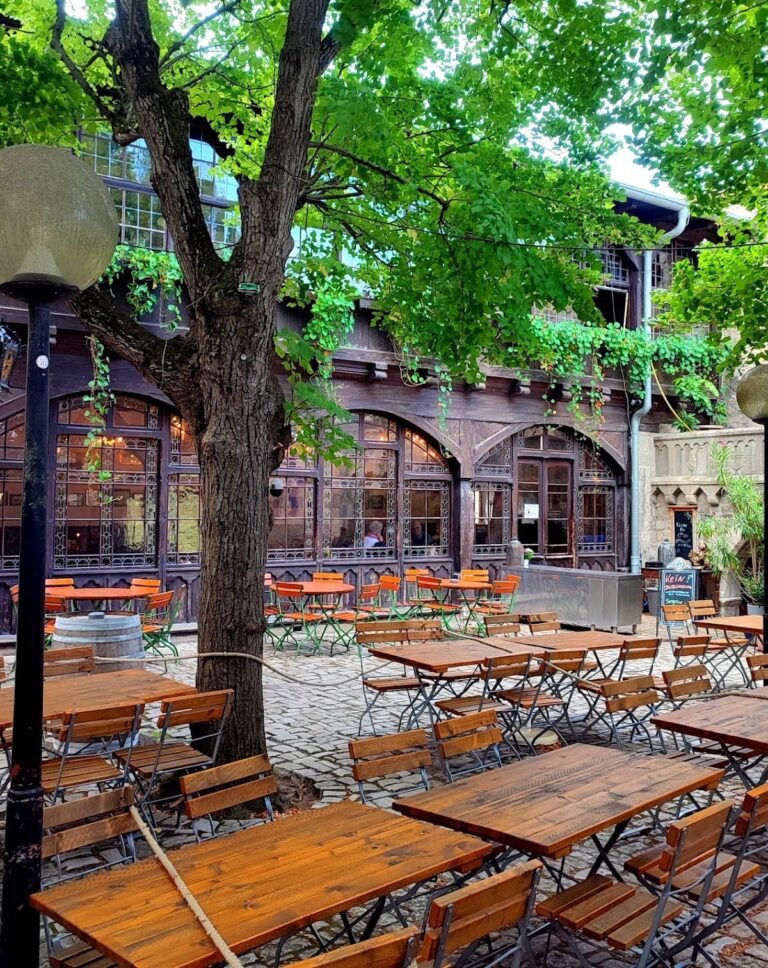
The former forester’s office beside the outer-castle gate was built in 1539 and 1540 in the Renaissance style. It stands directly alongside the outer defensive wall and now serves as a restaurant. Its construction reflects the castle’s continued administrative use after the medieval episcopal period.
Well and Courtyard
A well was situated in a very narrow building or passage between the outer and inner castles, apparently within the zwinger. A well house still stood over it when Friedrich Nietzsche described the castle in the nineteenth century. Nietzsche also described part of the outer-castle courtyard as a garden, separated from the remainder by a wall and linked to it by a small portal.
Administrative Prison
A historic prison belonging to the Schönburg administrative office stands on the approach to the outer castle. It is built directly against the rock and forms part of the surviving evidence for the site’s later governmental function.
Inner Castle
Knights’ Hall
The last surviving building in the inner castle is traditionally known as the courthouse. It is now used as a Knights’ Hall and occasionally serves for wedding ceremonies. The building preserves one of the inner castle’s continuing interior uses after the complex’s administrative and residential functions changed.
Former Palas
Walls of the former palas, the principal residential or representative building of a medieval castle, survive in the inner castle. Window columns were installed there during the restoration campaign of 1991 to 1994. Together with the surviving fireplace and decorated window elements, these remains preserve parts of the castle’s medieval interior fabric.