Lateran Palace: The Historic Papal Residence in Rome


Site at a Glance
- Rating
- 4.7
- Popularity
- Medium
- Country
- Italy
- Primary era
- Early Modern
- External website
- Open
- Eras represented
- Early Modern
- Civilizations
- Papal States
- Site type
- Religious
- Remains
- Palace
On this page16 sections
History
Lateran Palace is a historic papal complex in Rome, Italy, built and developed by Roman emperors and the Christian Church from the fourth century onward. Its transformation began after Constantine I defeated Maxentius in AD 312, and the present building belongs to the Renaissance period. For approximately a thousand years, the Lateran served as the principal residence and official seat of the popes, as well as a center of papal government and ceremony.
From the Laterani Estate to a Christian Center
The estate was originally associated with the Roman Laterani family. After Plautius Lateranus was accused of taking part in the Pisonian conspiracy against Nero around AD 66, the family’s property was confiscated. Marcus Aurelius built another palace in the area in AD 161, while Septimius Severus restored part of the Laterani possessions in AD 226.
In the early fourth century, the estate passed to Constantine through his marriage to Fausta, the sister of Maxentius. Following Constantine’s victory in AD 312, the adjoining barracks of the equites singulares Augusti, an elite mounted guard that had supported Maxentius, were demolished. A monumental Christian basilica and baptistery were then established in the area.
In AD 313, Fausta granted the Domus Faustae to Pope Miltiades for a synod, or formal church assembly, held against Donatism. This Christian schismatic movement disputed the legitimacy of clergy who had compromised during persecution, and the Lateran synod condemned it as heresy. The exact date when the bishop of Rome’s residence moved to the Lateran remains uncertain. The palace and basilica were formally consecrated in AD 324 by Pope Sylvester I and declared the Domus Dei, or “House of God.”
The Medieval Papal Residence
From the fourth century, the Lateran became the main residence of the popes and the official seat of the Roman pontiff. It housed papal government and was associated with papal consecrations and coronations. Its political and religious importance grew during the late eighth and early ninth centuries, when the papacy became more independent of Byzantium, the Eastern Roman Empire governed from Constantinople, and required a base for both spiritual and temporal authority.
Pope Hadrian I enlarged the entrance portico and added a residential tower. Around AD 800, Pope Leo III built two ceremonial banqueting halls, known as triclinia. Pope Paschal I continued work on the private chapel and its reliquaries. The palace suffered damage from raids and invasions in the fifth century and from an earthquake in AD 896, after which it was repaired.
In AD 897, the Lateran hosted the Cadaver Synod. Pope Stephen VI posthumously tried and condemned his predecessor, Formosus, in a notorious episode of papal history. After a disastrous fire in the tenth century, Pope Sergius III restored the palace, and Pope Innocent III later embellished it. The complex reached a period of exceptional magnificence during this medieval phase.
Sergius III rededicated the palace and basilica to Saint John the Baptist in the tenth century in connection with the new baptistery. In the twelfth century, Pope Lucius II added Saint John the Evangelist to the dedication. A Benedictine monastery was later established to serve the basilica. Five councils held at the Lateran are recognized by the Catholic Church as ecumenical councils: the First in 1123, the Second in 1139, the Third in 1179, the Fourth in 1215, and the Fifth from 1512 to 1517.
Decline and Renaissance Reconstruction
The Lateran’s importance declined as the Vatican increasingly became the papacy’s principal center. Pope Clement V transferred the official papal seat to Avignon in 1309, beginning the Avignon Papacy, the period when the popes resided outside Rome. Fires in 1307 and 1361 caused irreparable damage, and funds sent from Avignon did not restore the complex to its former condition.
After the papacy returned to Rome, the Lateran was considered unsuitable as a residence. The popes temporarily stayed at Santa Maria in Trastevere and Santa Maria Maggiore before establishing their residence at the Vatican in 1377. The move reflected the damaged state of the Lateran and the papacy’s wish to emphasize its universal authority through proximity to Saint Peter’s tomb.
In 1586, Sixtus V demolished most of the remaining medieval palace and commissioned a much smaller building from Domenico Fontana. The rebuilt palace again served as a papal summer residence from that year. Its construction was announced as complete on 29 August 1589. Papal coronations continued at the Lateran Basilica until the nineteenth century.
Modern Institutional History
In the late seventeenth century, Innocent XII established a hospice for orphans in part of the complex, where the children worked in a small silk manufactory. During the nineteenth century, Gregory XVI and Pius IX founded museums of religious art and pagan culture at the Lateran for collections that exceeded the capacity of the Vatican galleries. In 1925, Pius XI established an ethnographic museum there for objects sent by missionaries.
On 11 February 1929, the Lateran Treaty was signed in the palace. The agreement regulated relations between the Holy See and the Italian state, recognized the sovereignty of Vatican City, and placed the palace, the adjoining basilica, and other specified properties under the exclusive jurisdiction of the Holy See through extraterritorial status.
During the Second World War, the Lateran and associated buildings sheltered Jews and other refugees from the Nazis and Italian Fascists. Italian soldiers were also housed in the complex. Fathers Vincenzo Fagiolo and Pietro Palazzini were later recognized by Yad Vashem, Israel’s Holocaust remembrance center, for their assistance to Jews.
Pope John XXIII restored pastoral functions to the palace by making it the seat of the Vicariate of Rome and the offices of the Diocese of Rome. The Lateran Museum collections were transferred to the Vatican. Since 1987, the palace has housed the Vatican Historical Museum, which opened in 1991 and presents the history of the Papal States.
On the night of 27 to 28 July 1993, a bomb severely damaged the facade of the Rome Vicariate and adjoining parts of the complex. The attack was widely regarded as a Mafia warning connected with Pope John Paul II’s statements against the Mafia. Repairs were completed in January 1996. The palace remains owned by the Holy See and under its extraterritorial jurisdiction. It houses the Vicariate of Rome, the residential apartment of the Cardinal Vicar, and the Vatican Historical Museum.
Remains
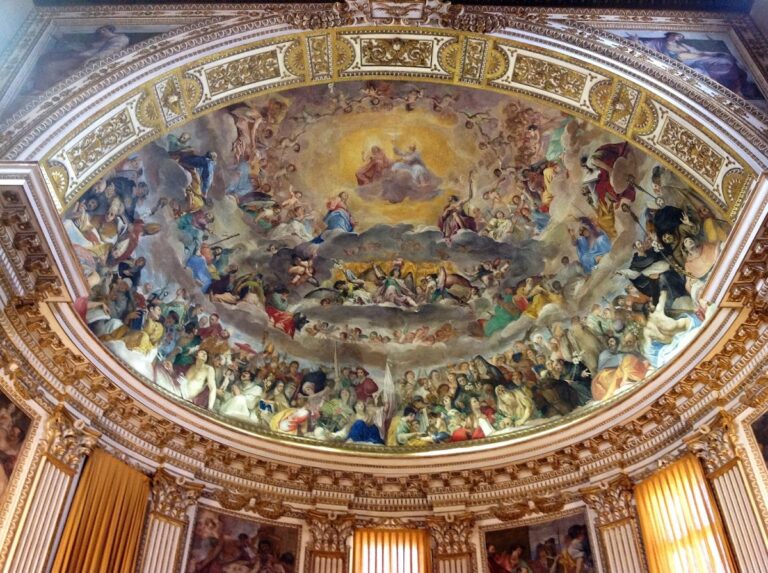
The present Lateran Palace is a rectangular Renaissance building with three floors and a central courtyard. It stands on the site of the medieval Patriarchium, the former papal residential and administrative complex. Fontana gave the rebuilding a regular and restrained architectural character, partly modeled on the Palazzo Farnese. The new palace was higher but less extensive than its medieval predecessor. Its halls contain mainly late-sixteenth-century frescoes and numerous tapestries, including works associated with the Gobelins manufactory. The eastern front was completed under Clement XII, who added his coat of arms in 1735. Later alterations, including work during the pontificate of Paul VI, remain visible in the apartments and ceremonial rooms.
Medieval Palace and Ceremonial Halls
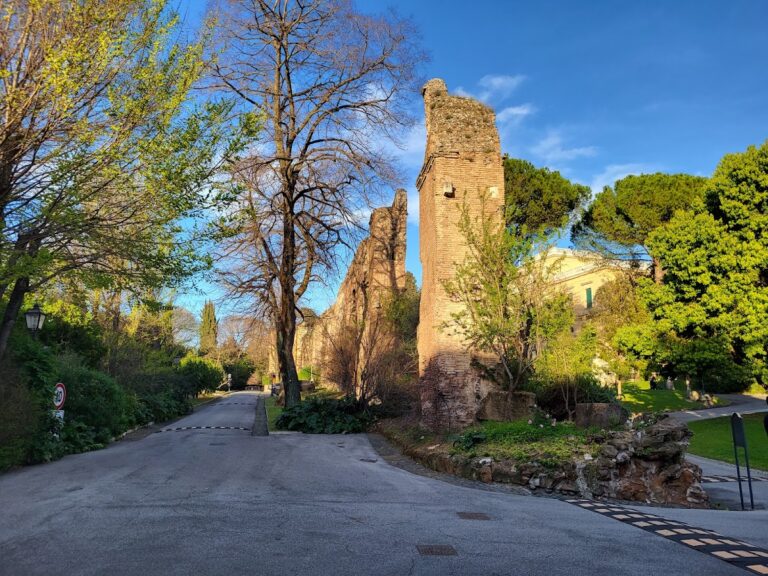
The medieval palace formed a fortified citadel around the papal residence. It incorporated the basilica and baptistery and extended from the Porta Asinaria and the Aurelian Walls toward the castrum of the Four Crowned Saints. This arrangement provided the popes with a refuge during periods of danger. The private apartments lay between the ceremonial halls and the city walls.
Zaccaria’s Portico
Hadrian I restructured the entrance portico, known as Zaccaria’s Portico, and added a residential tower beside it. The portico was used for distributing alms. It also contained the Capitoline Wolf and tablets bearing the Lex de imperio Vespasiani, a Roman legal text concerning the powers granted to the emperor Vespasian.
Leonian Triclinium
The Leonian Triclinium, or triclinium maius, was a two-storey state banqueting hall approximately 50 metres long. Its upper floor contained a main chamber about 26 metres in length, with a principal apse, two lateral apses, and an entrance antechamber. Frescoes decorated the secondary apses, while the principal apse contained a mosaic and the papal throne. The original hall no longer survives, but a structure built opposite the palace in 1589 preserves a three-part representation of its mosaic decoration, based on drawings and copies made in 1743.
Aula Concilii
Leo III’s second triclinium, the Aula Concilii, or Hall of the Council, stood beside and perpendicular to the basilica. The oblong hall measured approximately 53 metres long and 13 metres wide. It had eleven apses, consisting of one principal apse and five lateral apses on each side. The lateral apses were about 6.7 metres in diameter and 2.34 metres apart.
A large red porphyry fountain shaped like a shell stood in the hall and was supplied by pressurized pipes from the restored Aqua Claudia. The ten lateral apses contained banquet couches, or accubita, for reclining during meals. Columns, pilasters, and an opus sectile floor, made from fitted pieces of stone and other hard materials, enriched the interior. A mosaic of Christ and Mary with Saints Peter and Paul and three other figures occupied the principal apse, while frescoes of Apostles preaching to the gentiles filled the lateral apses. A staircase beside the principal apse led to the basilica. The hall later served as a meeting room, and Boniface VIII added the Loggia delle Benedizioni along its northern side.
Chapel, Triclinium Apse, and Relics
Sancta Sanctorum
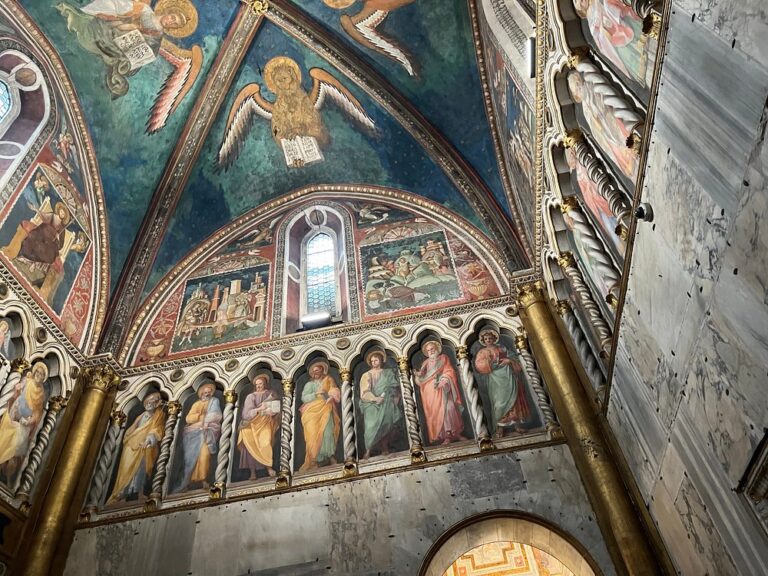
The medieval palace’s Sancta Sanctorum, or Chapel of the Holy of Holies, was decorated under Leo III and Paschal I with jeweled reliquaries. It also contained a reliquary chest modeled on the Ark of the Covenant. The chapel was among the medieval structures preserved during the demolition of the old palace. The Scala Santa and the chapel survive in a separate building erected by Fontana opposite the Lateran Basilica.
Open-Air Leonian Triclinium Apse
The preserved remains of the old palace include an open-air mosaic apse beside San Salvatore della Scala Santa. The structure was built in 1589 and is not ancient, although parts of the original mosaic may survive. Its tripartite composition shows Christ commissioning the Apostles in the center. The right-hand scene shows Saint Peter giving the stole to Leo III and the standard to Charlemagne, while the left-hand scene shows the delivery of the keys to Saint Peter and the imperial standard to Constantine.
The Lateran complex was associated with relics identified with both the Old and New Testaments, including the Ark of the Covenant, the tablets of the Law, the blood of Christ, and an altar associated with Saint Peter. These associations formed part of the religious meaning attached to the palace and its chapel.
Monuments and Present Collections
Marcus Aurelius Statue
An equestrian statue of Marcus Aurelius once stood between the palace and the Lateran Basilica. During the medieval period it was mistakenly thought to represent Constantine, an association that probably helped preserve it. Known as the caballus Constantini, it functioned as a symbol of power and as a site of executions. Paul III later ordered its transfer to the Piazza del Campidoglio. The original is preserved in the Capitoline Museums, while a copy stands in the Capitoline Square.
Lateran Obelisk
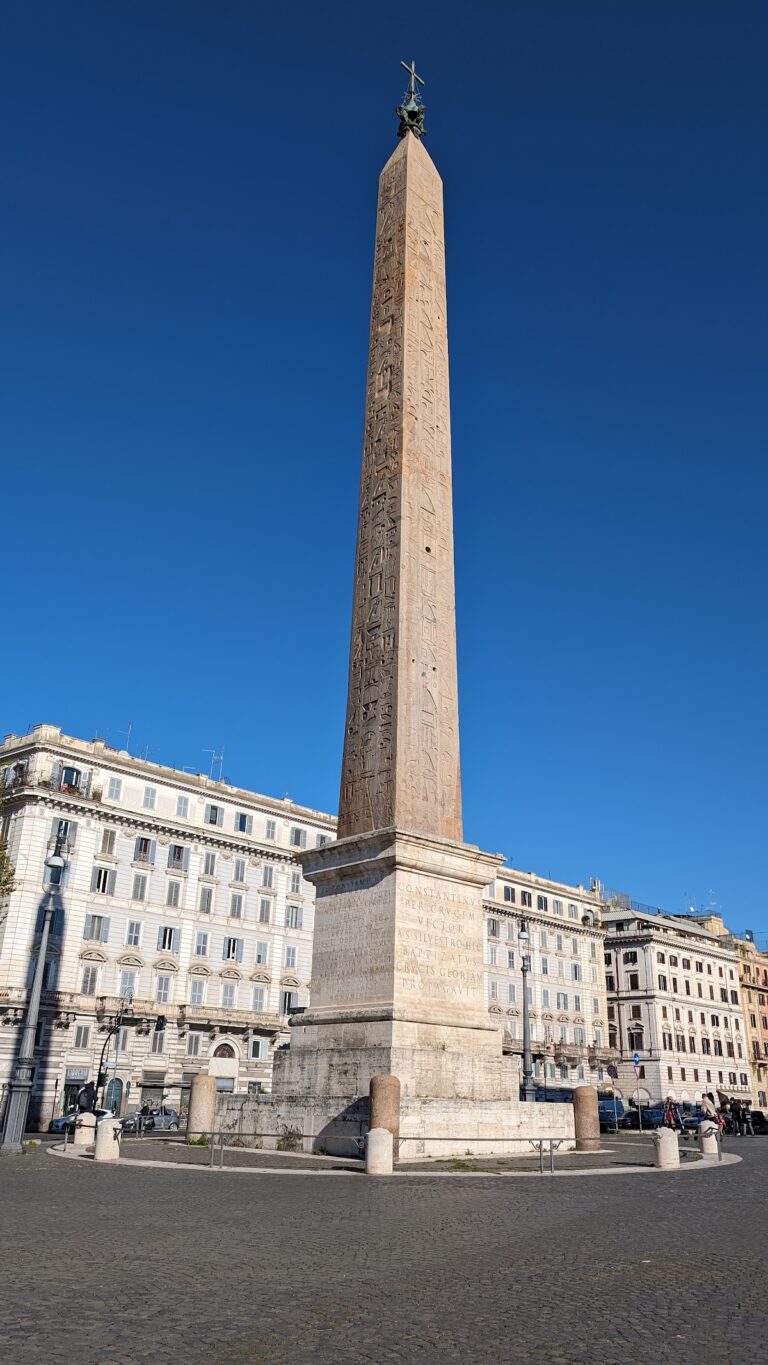
The Lateran Obelisk stands in the square before the palace. Made of red granite, it is more than 30 metres high and is described as the tallest obelisk in Rome and the largest standing ancient Egyptian obelisk in the world. Its stated measurements are 32.18 metres, or 45.70 metres including its base, and its weight exceeds 230 tons.
The obelisk was commissioned during Egypt’s Eighteenth Dynasty by Thutmose III and completed by Thutmose IV. It originally stood at the temple of Amun at Karnak, was transported to Alexandria, and was brought to Rome by Constantius II in AD 357 for the spine of the Circus Maximus. Found broken into three pieces in 1587, it was re-erected in the Lateran square by Fontana in 1588 at the order of Sixtus V.
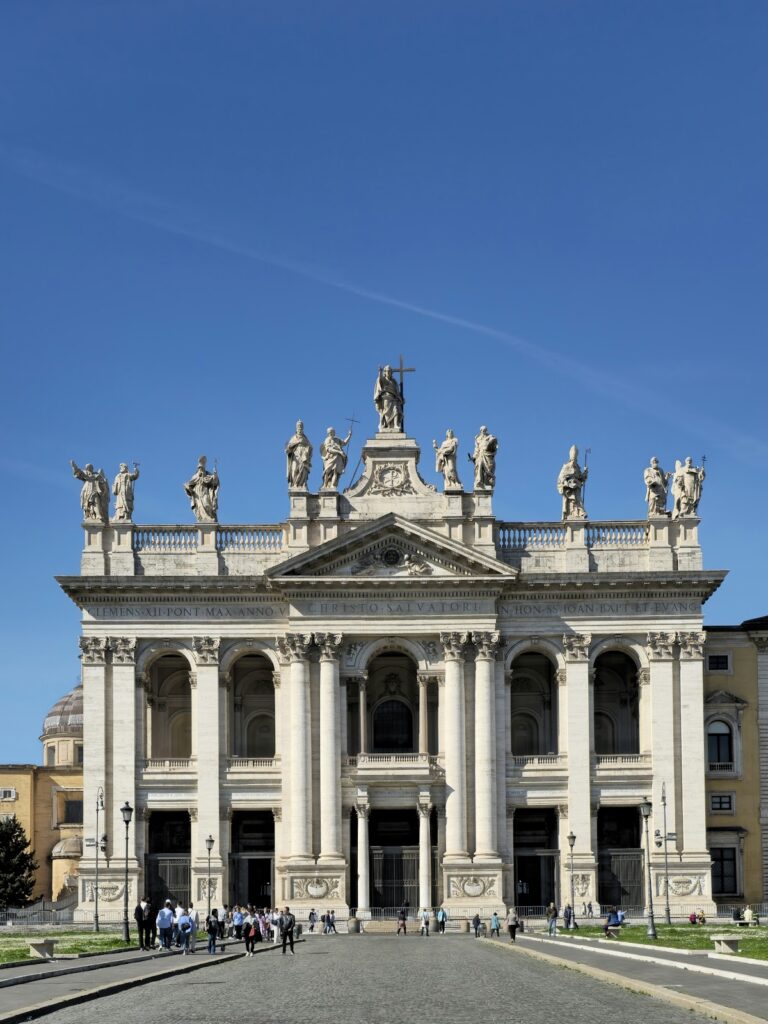
The Vatican Historical Museum occupies parts of the present palace. Its displays include frescoes relating to Constantine and Sylvester, along with biblical and Christian subjects, emperors, and popes. The wider Lateran complex also includes the Lateran Basilica, the baptistery, remains of the medieval papal palace, the Scala Santa, the Sancta Sanctorum, and the Leonian Triclinium.