Schloss Trautenfels: A Medieval Castle and Baroque Palace in Austria


Site at a Glance
- Rating
- 4.6
- Popularity
- Medium
- Country
- Austria
- Primary era
- Early Modern
- External website
- Open
- Eras represented
- Medieval, Early Modern
- Civilizations
- Habsburg, Holy Roman Empire
- Site type
- Domestic
- Remains
- Castle
On this page14 sections
History
Schloss Trautenfels is a medieval castle and later Baroque palace complex in Austria, located at Stainach-Pürgg in Styria. A fortification at the site was first documented in 1260–1262, when it belonged to the Prince-Archbishopric of Salzburg and guarded the crossing of the Salzstraße, the historic salt route, and the passage through the Enns Valley. Its position at a narrow point in the valley allowed it to block or control movement through the route.
Medieval fortress and territorial control
In 1289, Abbot Heinrich of Admont seized the castle with help from peasants dependent on Admont Abbey. The attack caused extensive destruction, after which the fortifications were rebuilt. Control later passed to the territorial sovereign, who placed the castle under a castellan. This official also administered Wolkenstein Castle.
Until the sixteenth century, the castle was known as Neuhaus. In the middle of the fifteenth century, its administrator Wolfgang Praun obtained it as a hereditary freehold. His possession ended in 1490, when the lordship was confiscated because he had supported Matthias Corvinus, the king of Hungary. The castle then returned to the authority of the territorial ruler.
From fortress to aristocratic residence
The Habsburgs subsequently entrusted Neuhaus to the Hofmann von Grünbühel family. Under their tenure, the medieval stronghold was extensively altered and developed into an aristocratic palace complex with substantial fortifications. By the end of the sixteenth century, it belonged to the barons von Praunfalk zu Neuhaus.
Religious conflict brought another major change. In 1628, Emperor Ferdinand II, who also ruled Styria territorially, prohibited Protestant nobles from living in or owning property in his hereditary lands. Hanns Adam Baron von Praunfalk zu Neuhaus refused to convert, left for Nuremberg, and was followed by many other Lutheran landowners from Styria. The Protestant church of Neuhaus, founded by the lords of Trautenfels during the Reformation, became the principal Lutheran religious center in the upper Enns Valley. It was later destroyed during the Counter-Reformation, the Catholic response to the spread of Protestantism and an effort to restore Catholic control.
Alexander Schifer Baron von Feyling acquired the castle in 1652 and established a large arms manufactory beside it. In 1664, Styrian governor Count Siegmund Friedrich von Trauttmansdorff purchased the property and began a radical reconstruction in the Baroque style. Between 1670 and 1672, the complex received the name Trautenfels and the palace form that defines it today. Trauttmansdorff combined the estate with properties in what is now Slovenia, creating a family entail, an inherited arrangement intended to keep an estate together within a lineage.
Trauttmansdorff and Lamberg ownership
After Trauttmansdorff’s son died childless in battle against the Turks in 1684, the estate passed to Field Marshal Lieutenant Siegmund Joachim Count Trauttmansdorff of the family’s Lower Austrian branch. His descendants retained it throughout the eighteenth century. Heavy expenditure, however, created substantial debts, while inadequate maintenance allowed the residence to deteriorate.
The indebted property was auctioned in 1815 and changed hands several times. Josef Count Lamberg purchased it in 1878 and financed a major reconstruction with wealth associated with his marriage to Anna Werndl, daughter of the Steyr arms manufacturer Josef Werndl. The Lamberg family retained Trautenfels through the First World War, the collapse of the Austro-Hungarian Empire, the expulsion of the Habsburgs, and the abolition of aristocratic privileges.
Public ownership and museum use
In 1942, after the Anschluss and the Nazi takeover of Austria, the Lamberg-Werndl heirs were compelled to sell Trautenfels to the German Imperial Postal Service. The service intended to establish a staff recreation home there. The castle suffered little damage during the Second World War and afterward lay in the American occupation zone. The Austrian Republic succeeded to the property of the German Imperial Postal Service, bringing the complex into federal ownership.
A district museum of Styria was established in the representative rooms in 1951. The Austrian Republic donated the castle to the Styrian Youth Hostel Association in 1959. In 1983, the municipality acquired the complex and leased it to the Schloss Trautenfels Association, which has since maintained the buildings and operated the museum.
Between 1988 and 1992, the palace was renovated and adapted for museum use according to plans by architect Manfred Wolff-Plottegg. The work included careful restoration of the interiors. The Styrian Provincial Exhibition was held at Trautenfels in 1992, and the Landscape Museum reopened in 1998 with a focus on forests and wood. The complex is now part of the Universalmuseum Joanneum, the museum organization responsible for a group of museums and collections in Styria, and houses the Regional Landscape Museum alongside exhibitions on the castle and surrounding regions.
The ruins of the Protestant Neuhaus church were cleared and archaeologically investigated in 1991, then arranged as a memorial site. In 1975, the Bremen shipping company Deutsche Dampfschifffahrts-Gesellschaft “Hansa” named a newly acquired heavy-lift cargo ship Trautenfels in honor of the castle.
Remains
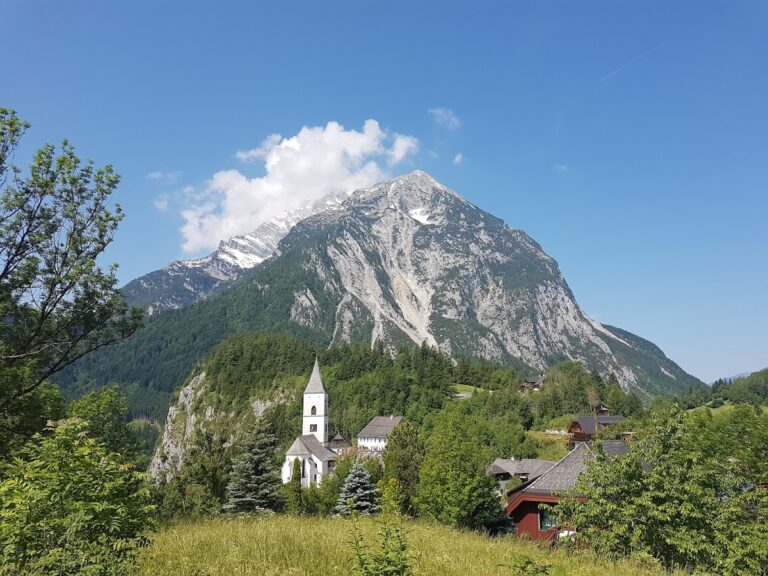
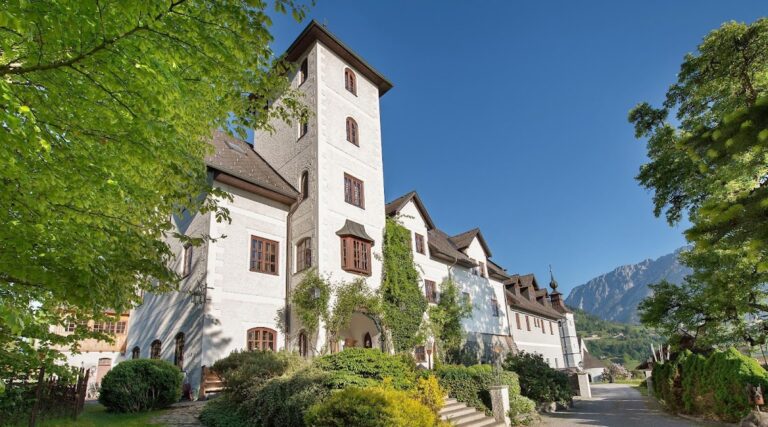
Trautenfels stands 673 metres above sea level on a rocky projection at the foot of Mount Grimming, directly beside the Enns River. The complex combines medieval and Baroque architecture. Its principal elements include a large palace, a fortified tower, a separate chapel, defensive works with five bastions, and the former Protestant church site on the same ridge.
Palace and principal interiors
Baroque palace
The principal palace is a massive rectangular building with projecting wings. Courtyards that were formerly open are now roofed over, giving the complex its present enclosed form. Important Baroque interior decoration dates from 1670–1673, the period in which the palace acquired its current form and name. The surviving interiors include Count Lamberg’s Antler Room, the Marble Hall, richly decorated state rooms, and a viewing tower.
Former main tower
The former main tower, or bergfried, is the principal fortified tower of a medieval castle and served primarily as a strong defensive refuge. Its first upper floor contains a spacious ballroom that formerly served as the Knights’ Hall. The room preserves seventeenth-century decoration, including frescoes by Carpoforo Tencalla and stucco work by Alexander Serenio.
The palace also retains Renaissance frescoes depicting fantastical landscapes. They were probably created in 1563 by a northern Italian artist for the wedding of Ferdinand Hoffmann and Margarete von Harrach. These paintings belong to the earlier aristocratic residence that preceded the Baroque reconstruction.
Fortifications and religious buildings
Defensive works and west gate
Substantial defensive works surround the palace, including five bastions. The principal gate lies on the western side of the complex, where entry formerly required crossing a drawbridge. These surviving works reflect the transformation of the medieval fortress into a heavily fortified aristocratic residence.
Castle chapel
A separate castle chapel stands on the western side of the complex. Its position and independent form distinguish it from the main palace buildings within the fortified enclosure.
Protestant Neuhaus church
The ruins of the Protestant Neuhaus church lie a few metres west of the palace on the same ridge. Archaeological excavation in 1991 established the building’s exact dimensions, and the site now contains a memorial marker. The remains preserve the location of the church that served as the most important Lutheran religious center in the upper Enns Valley before its destruction during the Counter-Reformation.
Museum collections
The permanent display of the Landscape Museum contains approximately 1,000 exhibits concerning the natural and cultural history of the Enns Valley and the Ausseerland. The wider holdings comprise more than 40,000 individual objects and include a specialist folklore library. These collections occupy the historic palace and connect its surviving rooms with the regional history presented there.