Schaezlerpalais: A Rococo Palace and Art Gallery in Augsburg



Site at a Glance
- Rating
- 4.5
- Popularity
- Medium
- Country
- Germany
- Primary era
- Early Modern
- External website
- Open
- Eras represented
- Early Modern
- Civilizations
- Holy Roman Empire
- Site type
- Domestic
- Remains
- Elite Residence
On this page10 sections
History
Schaezlerpalais is an eighteenth-century Rococo palace in Augsburg, Germany, constructed between 1765 and 1770 for the banker Benedikt Adam Freiherr von Liebert. Designed by the Munich court architect Carl Albert von Lespilliez, it became a prestigious residence, hosted notable guests, and now serves as a cultural center for Augsburg’s art collections.
From medieval house to Welser property
A building on the site was recorded in 1346. In 1499, Imperial Councillor Philipp Adler, an official serving in the imperial political administration, commissioned a new house with an oriel, or projecting window, and a loggia, an open-sided gallery. The building hosted several stays by the future Emperor Maximilian I, the Habsburg ruler who became Holy Roman Emperor in 1508.
After Adler’s death, the property passed to his daughter Anna. Her marriage to Franz Welser made the house the birthplace of their daughter Philippine Welser in 1527. Philippine came from Augsburg’s prominent Welser merchant family and later became the morganatic wife of Archduke Ferdinand II of Austria, a marriage between a person of unequal social rank and a member of a ruling dynasty. The property subsequently passed through the Augsburg families Welser, Rehlingen, Sulzer, and Stetten.
The Liebert palace
In 1764, Benedikt Adam Freiherr von Liebert, Edler von Liebenhofen, acquired the property from David von Stetten. The Liebert family had moved to Augsburg in 1733 and gained its wealth through the silver trade. Benedikt’s father, Johann Adam Liebert, had been raised to the hereditary imperial nobility and Augsburg patriciate in 1763, creating the need for a residence suited to the family’s new status.
From 1765, the existing house was replaced by a new Rococo palace. Construction lasted four and a half years, and the building was inaugurated on 28 April 1770. The ceremony was attended by the 14-year-old Marie Antoinette during her journey to Versailles for her marriage to the French dauphin, the future King Louis XVI. A legend associated with the occasion says that she danced through the ballroom in red shoes.
In 1808, King Maximilian I Joseph of Bavaria attended a formal ball at the Liebert palace while travelling to Munich. Benedikt Adam Liebert also opened the ballroom on occasion for public concerts. A Liebert daughter, Marianna Barbara, married the Ansbach-born entrepreneur Johann Lorenz Schaezler. Schaezler was raised to baronial rank in 1821 and acquired all remaining shares in the property from his wife’s relatives. The Augsburg banking family von Schaezler then occupied and maintained the palace for four generations.
Transfer to the city and cultural use
The palace survived the Second World War without major damage. On 4 October 1958, Wolfgang Freiherr von Schaezler gave it to the City of Augsburg in memory of his sons who had been killed in the war. The gift required that the palace never be sold and be used exclusively for cultural purposes. He also transferred 138 hectares of forest to the city to help secure the building’s long-term maintenance.
Augsburg’s municipal art collections had already been housed at the palace since 1951, initially as tenants. Extensive renovation began in early 2004, and the palace reopened on 4 February 2006. The Free State of Bavaria has designated Schaezlerpalais a registered historic monument. The palace now houses the Deutsche Barockgalerie, the Karl und Magdalene Haberstock-Stiftung, and the city’s graphic collection, while the Staatsgalerie Altdeutsche Meister occupies rooms in the former Katharinenkloster.
Remains
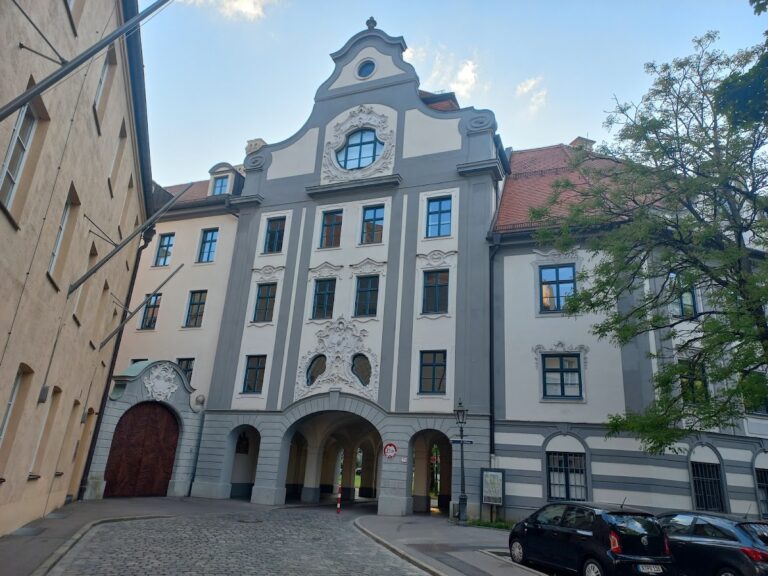
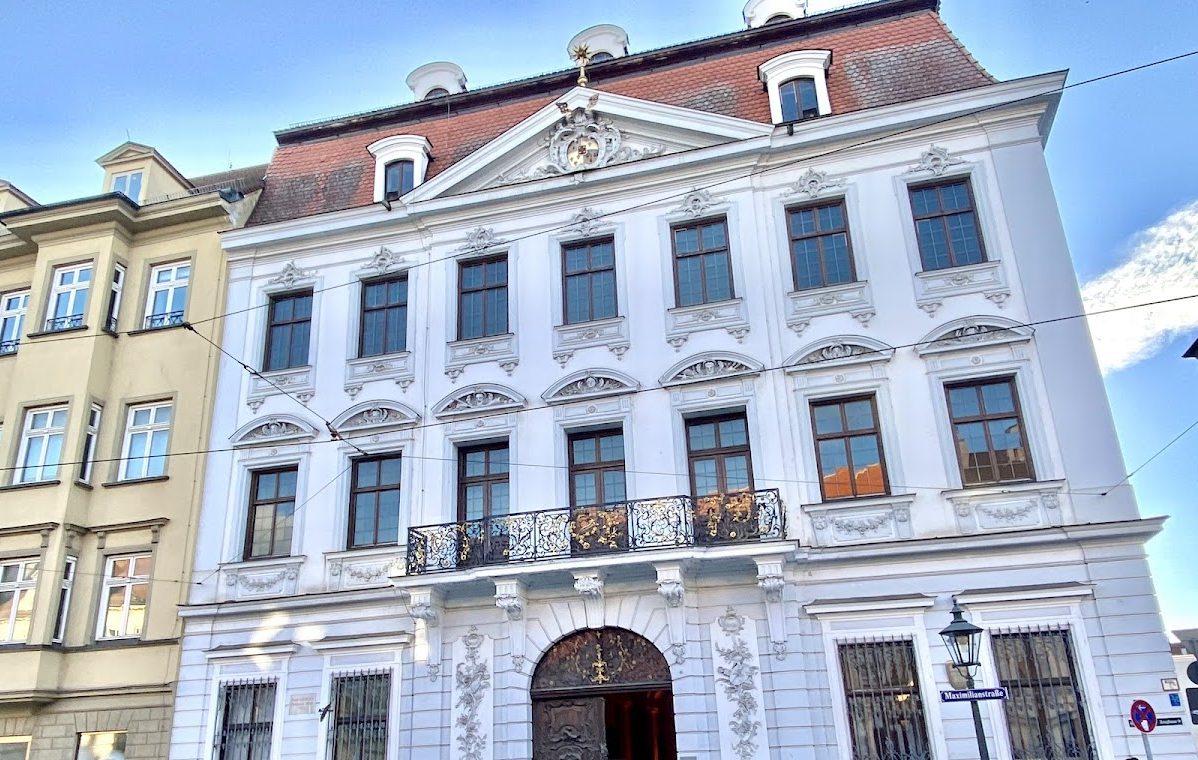
Schaezlerpalais stands beside the Herkulesbrunnen on Augsburg’s Maximilianstraße. Its street-facing facade is approximately 19 metres wide, while the facade extending along Katharinengasse measures about 107 metres. The Rococo principal building reaches deeply back from the street and contains dozens of rooms, courtyards, and gardens. An adjacent Baroque garden forms part of the surviving complex and is open to the public.
Palace interiors
The principal building was erected between 1765 and 1770 according to Lespilliez’s designs. Its most prominent interior is a two-storey ballroom with richly carved wall panelling by Placidus Verhelst. Franz Xaver Feichtmayr the Younger created the elaborate stucco decoration, using white and gold against light green and pink surfaces. The gilded mirrors and decorative scheme have survived intact. Gregorio Guglielmi painted the ceiling fresco in 1767, showing Mercury and world trade, and also decorated the palace staircase.
Art collections
Deutsche Barockgalerie
The Deutsche Barockgalerie occupies the first floor. Its collection presents southern German paintings from the seventeenth and eighteenth centuries, within the Baroque period known for dramatic composition, movement, and rich ornament.
Karl und Magdalene Haberstock-Stiftung
The Karl und Magdalene Haberstock-Stiftung occupies the second floor. It contains Baroque paintings by artists including Paolo Veronese, Canaletto, Anthony van Dyck, and Giovanni Battista Tiepolo, together with rooms for temporary exhibitions.
Staatsgalerie Altdeutsche Meister
The Staatsgalerie Altdeutsche Meister is installed in the former Katharinenkloster. This state gallery of Old German Masters associated with the Bavarian State Picture Collection contains works by Swabian and southern German masters of the fifteenth and sixteenth centuries, including Albrecht Dürer’s portrait of Jakob Fugger.
Nearby sites