Artstetten Castle: Habsburg Residence and Hohenberg Memorial in Austria


Site at a Glance
- Rating
- 4.6
- Popularity
- Medium
- Country
- Austria
- Primary era
- Early Modern
- External website
- Open
- Eras represented
- Early Modern, Modern
- Civilizations
- Habsburg, Holy Roman Empire
- Site type
- Domestic
- Remains
- Castle
On this page11 sections
History
Artstetten Castle is a Renaissance-based castle complex in Austria, near the Wachau valley in Lower Austria. Its present form combines rebuilding carried out between 1560 and 1592 with later Baroque extensions and early twentieth-century Historicist alterations. The estate became associated with the Habsburg and Hohenberg families, and its church crypt is the burial place of Archduke Franz Ferdinand and Sophie, Duchess of Hohenberg, whose assassination in 1914 helped trigger the First World War.
Medieval origins and Renaissance rebuilding
An earlier castle or predecessor building at Artstetten was first documented in 1263. It remained in the possession of the von Aerendorf family until the fifteenth century. Matthäus Gundreching replaced the earlier structure with a Renaissance building between 1560 and 1592, while the south facade was rebuilt in 1570.
The complex was enlarged between 1691 and 1698, when two wings were added and the adjacent parish church was extended. The village and castle suffered major fires in 1730 and again in 1760, events that affected the later history of the buildings.
Habsburg ownership and Franz Ferdinand
Emperor Francis I acquired Artstetten Castle for the Habsburg crown in 1823. The Habsburg dynasty was the ruling house of the Austrian lands and, at different times, of the Holy Roman Empire and the Austro-Hungarian monarchy. Francis intended the castle as a widow’s residence for his wife, Caroline Augusta, although she made little use of it after his death in 1835.
After 1835 the property passed to Archduke Franz Karl and, in 1861, to his third son, Archduke Karl Ludwig. Archduke Ferdinand Maximilian, later Emperor of Mexico, appeared as the purchaser in 1866, but he never paid the agreed price, leaving Karl Ludwig as the owner. Karl Ludwig transferred Artstetten to his son, Archduke Franz Ferdinand, in 1889.
Franz Ferdinand considered Artstetten his principal inherited family property. He commissioned extensive modernization of the castle and park, including work by the cathedral architect Ludwig Simon. The residence was eventually intended to serve as a widow’s home for his wife, Sophie, Duchess of Hohenberg. Franz Ferdinand was heir presumptive to the Austro-Hungarian throne when he and Sophie were assassinated in Sarajevo on 28 June 1914.
Their marriage was morganatic, meaning that the spouse and children of a dynastic member did not receive the ruling family’s full status or succession rights. Because of this arrangement, Emperor Franz Joseph I did not permit their burial in Vienna’s Imperial Crypt. Franz Ferdinand and Sophie were instead interred at Artstetten, establishing the castle and church as a lasting Hohenberg memorial.
The Hohenberg estate in the twentieth century
Following Franz Ferdinand’s death, Artstetten was inherited by his twelve-year-old eldest son, Maximilian von Hohenberg, and administered by a guardian until he came of age. After Habsburg properties in Czechoslovakia were confiscated in 1921, Artstetten became one of the Hohenberg family’s principal residences.
The political annexation of Austria by Nazi Germany in 1938 brought another forced change in ownership. Maximilian Hohenberg was expropriated and deported with his brother Ernst to Dachau, a Nazi concentration camp near Munich established in 1933 for political opponents and other groups persecuted by the regime. The castle was confiscated, and its interior was intended for the planned Reich Museum in Linz. The Republic of Austria returned the property to the Hohenberg family in 1949.
Maximilian Hohenberg died in 1962, and the estate passed to his eldest son, Franz Ferdinand Hohenberg. After Franz Ferdinand’s death in 1977, his widow Elisabeth transferred Artstetten, together with its forests and agricultural land, to their eldest daughter, Anita Hohenberg. Anita married Count Romée de La Poëze d’Harambure in 1978. In 1982 they founded the Archduke Franz Ferdinand Museum and began renovating the castle.
The museum’s first exhibition, From Mayerling to Sarajevo, was replaced in 1991 by Throne or Love. Later temporary exhibitions continued to explore subjects connected with the Habsburg and Hohenberg families. In 2003 Anita Hohenberg placed the castle and its lands in the Anita Hohenberg Foundation, whose purposes included preserving the archives, preventing division of the estate, and maintaining its historical character. Since December 2015, her daughter Alix de La Poeze d’Harambure-Fraye has directed the castle as a museum and tourism enterprise.
The privately owned castle archive has been preserved continuously as a lordship and estate archive since the 1823 purchase. It contains material relating to Austrian history and the private life of the imperial family, supports temporary exhibitions, and was comprehensively adapted and modernized in 2011. Artstetten Castle and its park are protected monuments, and the park is recognized as one of Austria’s important historic garden monuments. A ceremony and requiem held in 2014 commemorated the centenary of the Sarajevo assassination. The crypt continues to host official ceremonies on 28 June.
Remains
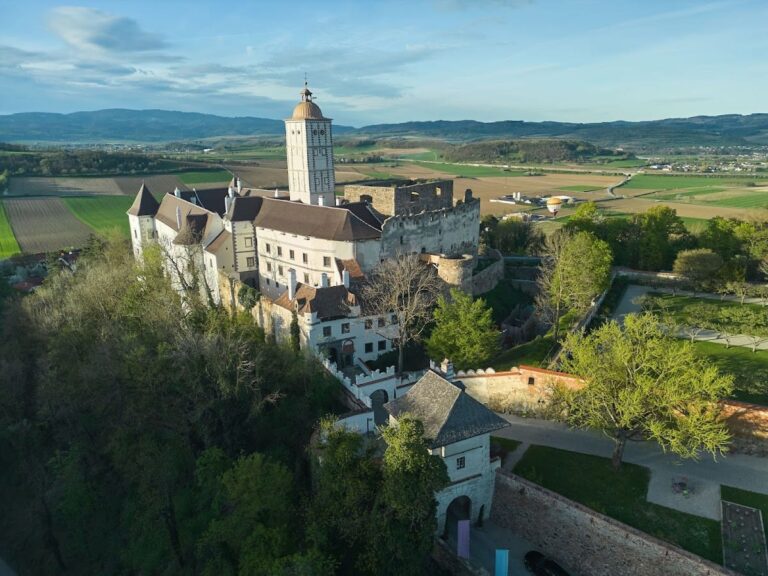
Artstetten’s surviving complex brings together a Renaissance-based castle, a parish church joined to its eastern side, burial crypts beneath the church, and a historic park. A staircase connects the church and castle with the lower-lying settlement of Artstetten-Pöbring. The present appearance reflects the Renaissance rebuilding, the late seventeenth-century extensions, and Franz Ferdinand’s early twentieth-century modernization.
Castle and parish church
Castle complex
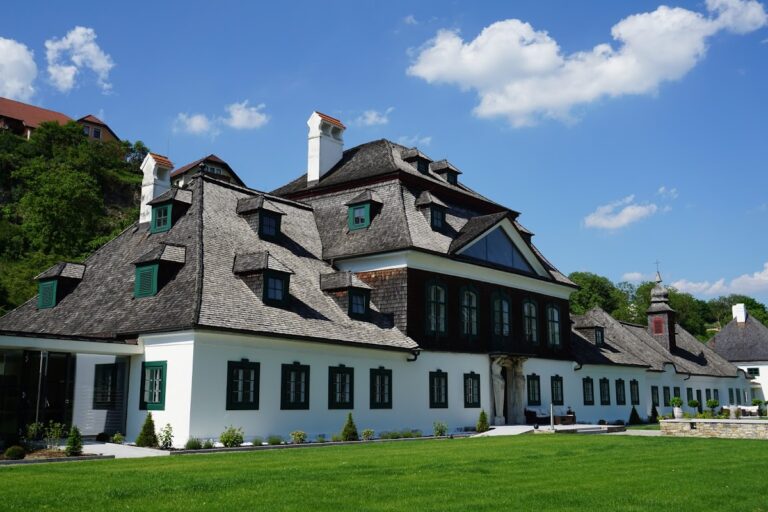
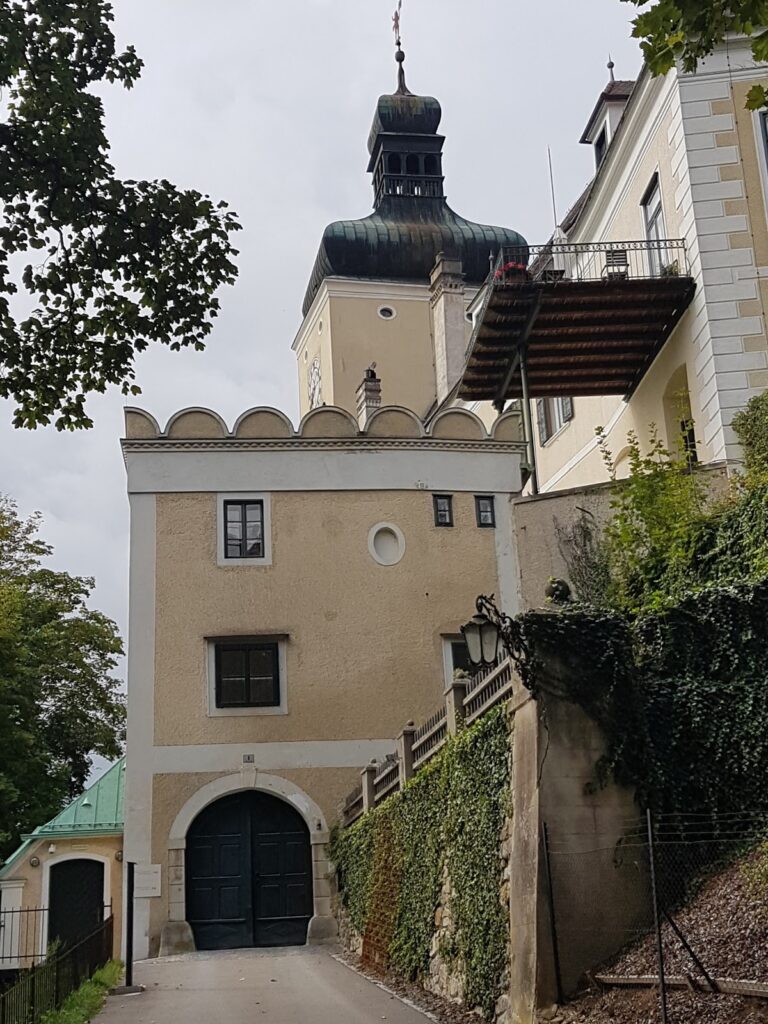
The castle incorporates the Renaissance rebuilding undertaken between 1560 and 1592, including the reconstruction of the south facade in 1570. Two wings were added between 1691 and 1698, extending the complex around the earlier core. Its most recognizable upper elements, the onion domes and the lower section with two towers, date from 1912 and were commissioned by Franz Ferdinand during his modernization of the residence.
The building is connected to the parish church of Saint James the Greater on its eastern side. A museum was installed in an added part of the complex in 1982, and specially arranged rooms contain exhibitions drawn from the private archive. These spaces form part of the castle’s present museum use while remaining within the historic building complex.
Parish church and family crypts
The parish church began as a free-standing Gothic building. Between 1691 and 1698 it was enlarged into a Baroque hall adjoining the castle. Shortly before the First World War, Franz Ferdinand reorganized its interior and external appearance in the Historicist style. Historicism revived and combined forms from earlier periods, including Gothic, Renaissance, and Baroque architecture.
Two crypts lie beneath the church: the Hohenberg family crypt and the crypt of the castle owners. The family crypt includes an older chamber beneath the church, a connecting passage, and a newer section reached from the north side of the castle and church. In 1909 Franz Ferdinand signed a contract for a twelve-place family crypt beneath the church for himself, Sophie, and their children. After the death of Prince Ernst of Hohenberg, the crypt was enlarged in 1955 beneath the square in front of the church.
The older crypt was later adapted for descendants of Anita Hohenberg and Romée de La Poëze d’Harambure. The crypt complex contains the sarcophagi of Franz Ferdinand and Sophie, together with the remains of their children and later Hohenberg descendants. It also serves as the family crypt of the ducal and princely Hohenberg family, including spouses of family members.
Historic park and approaches
The park was laid out as a Historicist landscape garden under Karl Ludwig from 1861. A landscape garden uses lawns, trees, paths, water features, and views to create a naturalistic composition rather than a strictly geometric plan. The park’s principal surviving form derives from the nineteenth-century phase, although later additions and alterations incorporated some of its higher sections into adjoining woodland.
Garden house and water features
An octagonal garden house stands within the park. It has a drum-like upper storey, a tent-shaped roof, and a spiral staircase. A stone-lined water basin lies in front of the building, while two fountain figures date from the nineteenth century. Together these features belong to the designed garden landscape associated with the castle estate.
Drives and formal terraces
Franz Ferdinand created two approach drives around 1900. The southern route was a formal entrance drive, while the northern one was built for automobiles. In 1914 the architect Rudolf Frass and the Czech garden designer Jaroslav Molnár created more modern formal terraces near the castle. The park also contains a collection of botanical rarities and varied garden areas, with some sections incorporated into private parts of the estate.
Nearby sites