Schlosshotel Kronberg: An Imperial Residence and Historic Hotel in Germany


Site at a Glance
- Rating
- 4.6
- Popularity
- Medium
- Country
- Germany
- Primary era
- Modern
- External website
- Open
- Eras represented
- Modern
- Civilizations
- German
- Site type
- Domestic
- Remains
- Palace
On this page7 sections
History
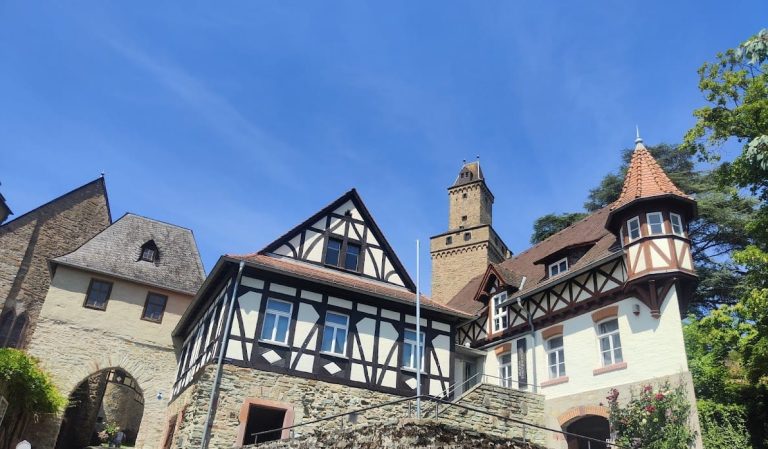
Schlosshotel Kronberg in Kronberg im Taunus, Germany, is the former Friedrichshof, an imperial residence built between 1889 and 1894 for Victoria, the dowager German Empress. Its eclectic historicist design combines English Tudor Gothic, German and Italian Renaissance forms, and Hessian-Franconian half-timbering. The building became Victoria’s principal home during the last years of her life and remains associated with the House of Hesse.
Victoria and the creation of Friedrichshof
On 28 September 1888, Victoria acquired an estate of approximately 100 Morgen, a traditional German land measure whose size varied by region. The property included Villa Schönbusch, completed twelve years earlier for the heirs of Jacques Reiß, a Frankfurt banker, tea merchant, and honorary citizen of Kronberg who died in 1887. Victoria expanded the estate through further purchases, financed largely by an inheritance of five million French francs received in 1888 from Maria Brignole Sale De Ferrari, Duchess of Galliera, a Genoese and Parisian patron.
Victoria commissioned Ernst von Ihne, the German imperial court architect in Berlin, to prepare the plans. In developing the design, he studied German and British country houses, including Neu-Potsdam at Rauischholzhausen near Marburg and Sandringham House in Norfolk. Construction followed from 1889 to 1894. Victoria named the new residence Friedrichshof in memory of her deceased husband, Emperor Frederick III.
Victoria was born in Britain as the eldest daughter of Queen Victoria and Prince Albert of Saxe-Coburg and Gotha. She was the widow of Frederick III and the mother of Emperor Wilhelm II. As a dowager empress, she retained imperial rank after her husband’s death. In Germany she was commonly known as Empress Frederick, a designation that distinguished her from her mother, the British queen.
She spent most of her remaining years at Friedrichshof and died of cancer in 1901. Her will left the residence, its contents, art collections, and correspondence to her youngest daughter, Princess Margaret of Prussia, Landgravine of Hesse, on the condition that the castle and park remain unchanged. Victoria also played a major part in promoting a monument to Frederick III in the neighboring municipal park at Kronberg. She died before its inauguration in 1902, which her son Wilhelm II attended.
Dynastic ownership and the Second World War
In 1928 Friedrichshof passed to the Kurhessische Hausstiftung, an institution established to prevent the nationalization of princely property. Ownership returned to the Hessian House Foundation in 1953. The House of Hesse is the princely dynasty historically associated with Hesse, while the foundation administers property and collections connected with that dynasty.
The United States Army occupied Kronberg on 29 March 1945. Friedrichshof was confiscated and first used for troop accommodation, then as an officers’ club. For a time it also served as the residence of General Dwight D. Eisenhower, the American commander in Europe during the Second World War.
The occupation brought about the theft of the Hessian crown jewels, dynastic regalia and jewelry belonging to the Hessian princely family. Members of the family had concealed the treasure, valued at several million dollars, in a zinc-lined box or a side cellar beneath the castle. Club manager Captain Kathleen Nash discovered it on 5 November 1945 and removed it from Germany with Colonel Jack W. Durant and Major David Watson. Many pieces were dismantled and sold separately in Switzerland.
The theft came to light in early 1946. The three perpetrators were imprisoned in 1951. Durant received a fifteen-year sentence, Nash a five-year sentence, and Watson a three-year sentence. About ten percent of the stolen treasure was recovered, while much of the remainder remained lost. During the American occupation, the later equestrian champion Hans Günter Winkler also worked at the castle as a stable boy and riding instructor.
Royal papers, fire, and the hotel
In March 1945, King George VI sent Sir Owen Morshead, the Royal Librarian, to Friedrichshof with Anthony Blunt to secure papers relating to Empress Victoria. Those papers, together with material later returned by American authorities from Chicago, were deposited in the Royal Archives. Blunt’s later reputation as an art historian and intelligence officer who had spied for the Soviet Union gave additional attention to a separate claim by Charles Higham that Blunt had made a secret wartime visit to retrieve politically sensitive correspondence. That claim is distinct from the documented 1945 mission.
After repairs and alterations connected with the occupation, Friedrichshof opened as Schlosshotel Kronberg in 1954. The House of Hesse operates the hotel, which is categorized as a five-star establishment and belongs to the Small Luxury Hotels of the World. The castle and its park continue to be associated with the House of Hesse.
A major fire began at about 6 a.m. on 8 March 1967 in the service wing and spread toward the roof. The destruction of part of the slate roof allowed outside air to enter, causing the fire to expand explosively. The upper floor and roof structure were destroyed. The damaged sections were rebuilt and extensively altered so that the rooms could serve hotel purposes.
Friedrichshof later became a setting for international political and economic meetings. In 1970, a conversation on the golf course between Soviet foreign minister Andrei Gromyko and West German foreign minister Walter Scheel contributed to agreement on the Four-Power settlement concerning Berlin and enabled ratification procedures for the Moscow and Warsaw Treaties. A meeting of G5 finance ministers was held at the hotel on 8 and 9 December 1982.
Remains
Friedrichshof is a long, asymmetrical castle composed of several wings. Its two principal wings meet at an angle of 135 degrees, producing two- and three-part angular divisions. The main tower stands at the transition between the residential and service wings. Dressed stone covers the facades of the residential wing, while the upper story and cross-gable sections of the service wing combine Lower Saxon and Hessian-Franconian half-timbering. The surviving and restored interiors retain furnishings, artworks, and much of Empress Victoria’s library, although parts of the interior were adapted for hotel operation after the 1967 fire.
Residential and service wings
The residential wing follows the English country-house distinction between the principal family rooms and a separate service area. Its entrance is formed by the single-story English Hall, a richly designed space used for communication and distribution within the residence. From the left side, a long corridor extends toward the other reception rooms on the ground floor. On the right, a broad open ceremonial staircase rises to the former private rooms used by the dowager empress and her guests. Historical photographs of the English Hall and other interiors were made by the Berlin court photographer Hermann Rückwardt.
The service wing was more simply decorated and supported the domestic operation of the residence. Its ground floor contained kitchens and storerooms, while servants’ living and sleeping quarters occupied the level above. Female and male servants had separate sections. The fire of 1967 destroyed the upper floor and roof structure in this part of the castle, and the rebuilt areas were modified for the hotel’s later use.
Park buildings and wider grounds
The castle park contains a cottage-style residence for the court marshal and a large stable complex. At least the gatekeeper’s house shares the facade treatment of the service wing. Gardening, dairy, and administrative buildings once stood outside the park in the area of present-day Schönberg. The Kaiserin-Friedrich-Weg and Kaiserin-Friedrich-Brücke were constructed as a direct connection from the north gate of Friedrichshof toward Bad Homburg.
An 18-hole golf course occupies parts of the castle park and adjoining land beyond Hainstrasse. The grounds therefore retain elements associated with the residence’s estate as well as later hotel use. Furniture and artworks from Victoria’s collection remain in the hotel, and her extensive library is largely preserved within the complex.
Nearby sites