Château de Pourtalès: A Historic Manor and Cultural Estate in Strasbourg
Site at a Glance
- Rating
- 4.5
- Popularity
- Medium
- Country
- France
- Primary era
- Early Modern
- External website
- Open
- Eras represented
- Early Modern, Modern
- Civilizations
- French, German
- Site type
- Domestic
- Remains
- Castle
On this page8 sections
History
Château de Pourtalès is an eighteenth-century Baroque manor house in Strasbourg, France, established around 1750 by Joseph Guérault, a royal works contractor associated with the city’s fortifications. Located in the Robertsau district northeast of Strasbourg, the estate later became a residence of the Pourtalès family and a meeting place for European political, aristocratic, and artistic circles.
From manor house to family estate
Baron de Coehorn made the property his principal residence in 1784. In 1802, Athanase Paul Renouard de Bussière, a banker and politician, acquired the estate. His son Alfred Renouard de Bussière altered the house in 1844, beginning a period of architectural change that continued under the next generation.
Alfred’s daughter Mélanie inherited the estate. Following her marriage to the banker Count Edmond de Pourtalès-Gorgier, it became known as Château de Pourtalès. Between 1887 and 1902, Mélanie commissioned an extensive transformation by the architect Charles-Jules Breffendille. The interiors were reorganized, a Louis XV-style wing was attached to the right wing, and numerous service and ancillary buildings were added. A mansard second floor was created in 1897, while Gustave Krafft and Jules Berninger added a library turret in 1907.
A salon of French and European culture
Mélanie de Pourtalès was a prominent French salonnière, a society hostess who organized influential cultural and political gatherings, and also served as a lady-in-waiting to Empress Eugénie. During the period of German annexation that followed the Franco-Prussian War, she made the château a center of French cultural life and European diplomacy. Guests included Napoléon III, Empress Eugénie, Wilhelm II, Ludwig II of Bavaria, Leopold II of Belgium, the Prince of Wales, Klemens von Metternich, Franz Liszt, Albert Schweitzer, and Léon Bakst.
The château suffered fire damage during the Franco-Prussian War of 1870. Its English-style park later hosted cultural events, including a performance of Jean-François Regnard’s The Amorous Follies in 1911. Mélanie died in 1914, and the estate passed to her younger daughter, Agnès, Marquise de Loÿs-Chandieu. Agnès continued to receive notable literary and political figures before the property passed in 1929 to her younger daughter, Mme Maurice Bérard, who closed it permanently in 1939.
War, Cold War, and renewal
During the First World War, German forces occupied the château before American troops liberated it. In the Second World War, German authorities requisitioned the estate for several purposes, including accommodation for senior officers, a hospital, soldiers’ quarters, and a refugee home. Allied forces occupied it briefly after the war.
From 1951, the château housed the Free Europe College, a Cold War educational institution established by the American Central Intelligence Agency to train personnel for political work concerning Eastern Europe. The college later closed as the division between Eastern and Western Europe tightened, and the estate fell into neglect.
Walter Leibrecht and his wife Lydia acquired the deteriorating complex in 1972 and undertook extensive renovation. Walter Leibrecht, the founder of Schiller International University, subsequently established the university’s French campus at the château. The estate continued to accommodate international students, while parts of it were adapted for hotel use. In 2009, the château itself became a hotel, and a later building added further rooms and conference spaces from October 2019.
The city of Strasbourg acquired the park, while the château and associated buildings remained the property of the Leibrecht family. The complex continues to host concerts and symposia. In July 2001, an accidentally falling plane tree killed 13 spectators during an open-air performance in the park. Château de Pourtalès has been protected as a French historic monument since 21 December 1984, with protection covering the entrance portal, façades, roofs, separating wall and grille, entrance vestibule, staircase, and several decorated reception rooms.
Remains
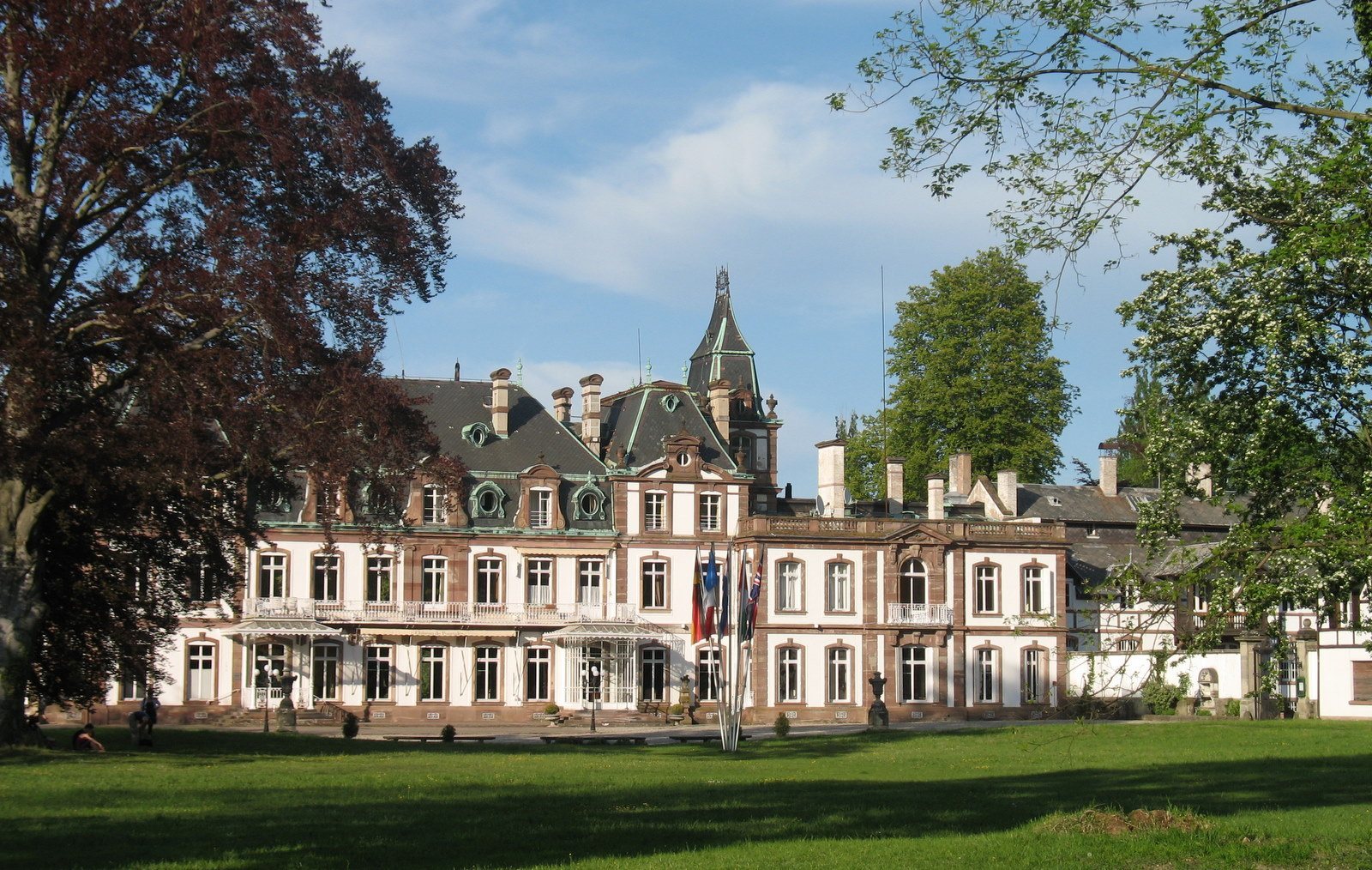
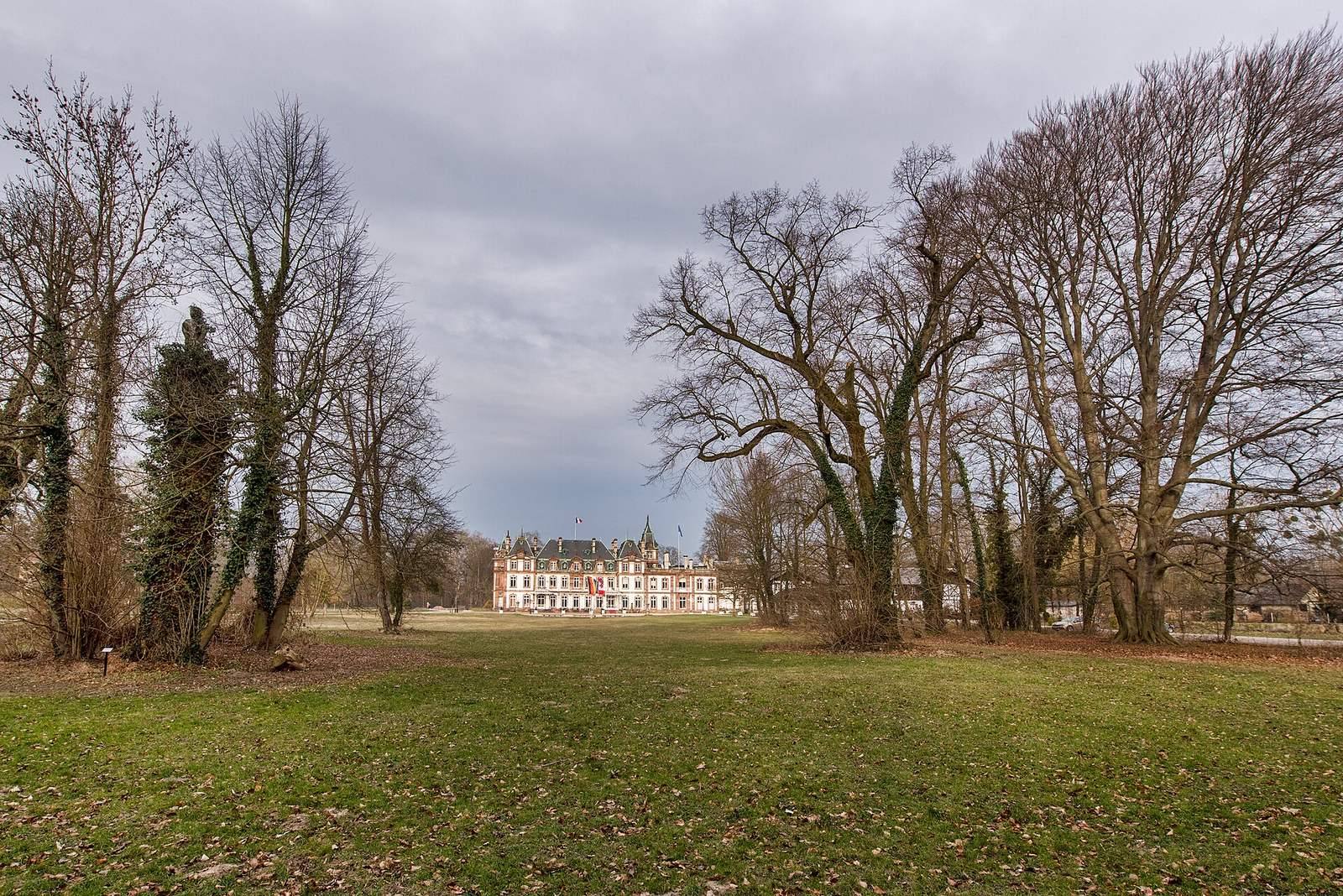
The estate combines a compact historic château with service buildings, gardens, and an approximately 24-hectare English-style landscape park. The main house retains the form of an expanded Baroque manor, while later additions create a varied group of towers, pavilions, wings, and ancillary structures.
The château and its additions
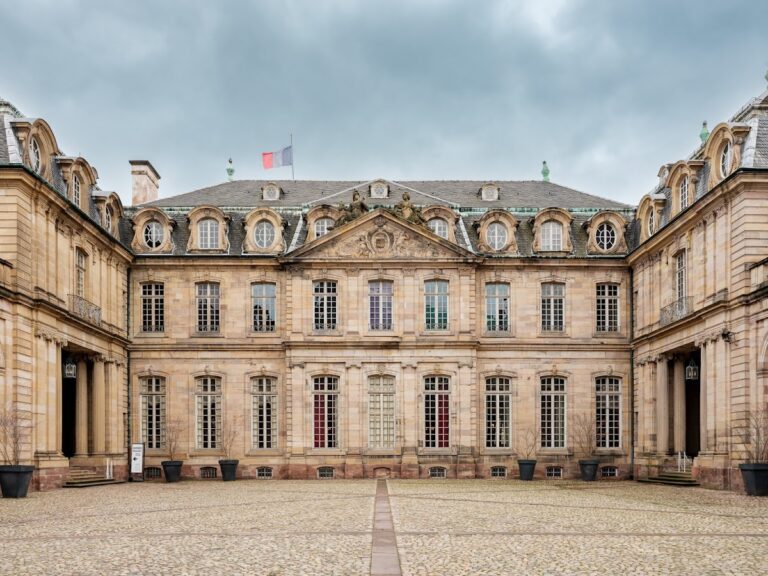
The oldest section is a small two-storey Baroque manor house covered by a mansard hipped roof, whose steep lower slopes create an additional usable storey. Projecting central sections and two iron pavilions enrich its original form. At the narrow western end, two square projecting bays rise through four storeys, with an octagonal three-storey structure between them. A square tower marks the narrow eastern end.
East of the square tower stands a flat-roofed pavilion in the Napoleon III style, a French decorative and architectural language associated with the Second Empire under Napoleon III. This pavilion connects with a service courtyard containing ancillary buildings and another pavilion. The nineteenth-century remodelling introduced Louis XVI and Napoleon III interiors, while the 1907 addition contains a large library with wood-panelled walls.
The landscape park
The grounds form an English-style landscape park containing a garden bridge, house, farm, garden fence, greenhouse, gate lodge, dovecote, fountain, avenue, entrance portal, footbridge, and two former ponds. Additional ancillary buildings, sculptures, a water tower, and ponds are distributed through the estate, preserving the broad relationship between the residence and its landscaped setting.
Farm, stables, and later buildings
The Bussierre farm was a dependency of the château. It now accommodates Strasbourg’s municipal green-space services and the Bussierre Nature and Environmental Education Centre. The former stables are occupied by a hotel, while a later building on the estate provides additional hotel accommodation and meeting rooms.