Palazzo d’Accursio: Bologna’s Historic Municipal Palace


Site at a Glance
- Rating
- 4.7
- Popularity
- Medium
- Country
- Italy
- Primary era
- Medieval
- External website
- Open
- Eras represented
- Medieval, Early Modern, Modern
- Civilizations
- Papal States
- Site type
- Civic
- Remains
- Palace
On this page15 sections
History
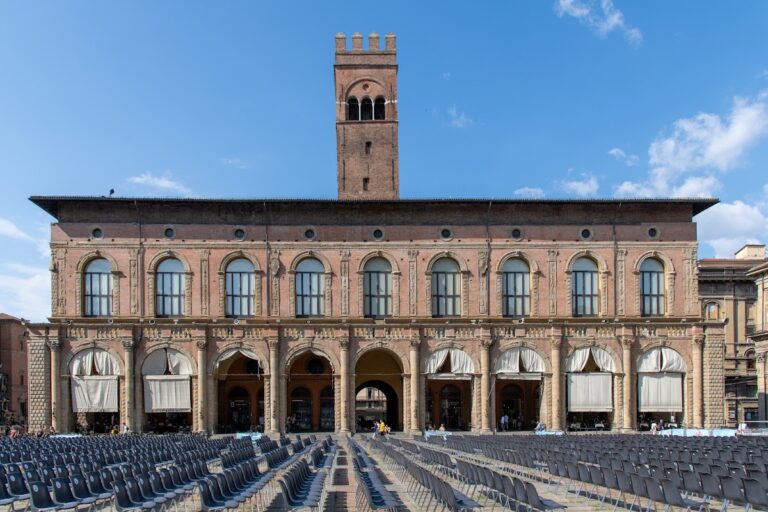
Palazzo d’Accursio is a historic municipal palace in Bologna, Italy, built and enlarged by the civic government of Bologna from the thirteenth century onward. It has served as the city’s municipal seat since the Middle Ages, developing from the residence of the jurist Accursius into a complex of government buildings, fortified spaces, and ceremonial rooms.
From private residence to civic seat
The palace’s first documented transaction took place on 14 February 1287, when Francesco d’Accursio, son of the prominent jurist and law teacher Accursius, sold his father’s residence to Bologna’s Comune, the city’s municipal government. The Comune then acquired the surrounding block, demolished its other buildings, and retained the Torre di Accursio. The first nucleus of the present palace was probably used as a public grain store, which led to the name Palazzo della Biada.
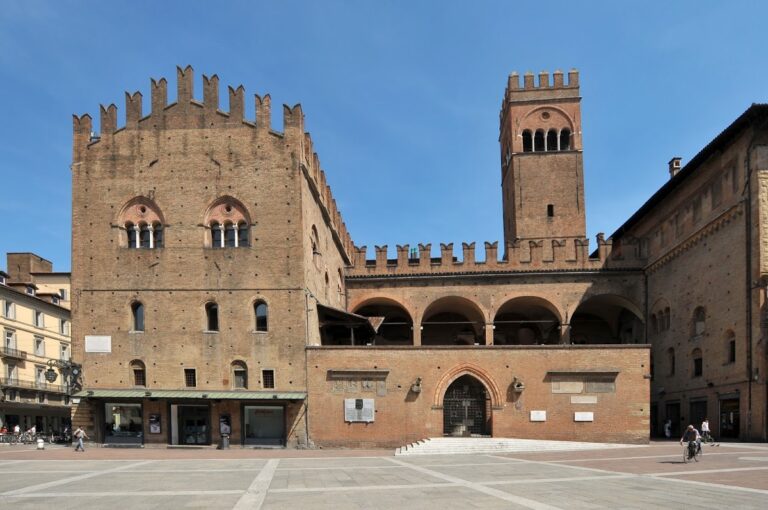
In 1336 the complex became the seat of the Anziani Consoli, Bologna’s senior civic magistrates. They had previously met in Palazzo Re Enzo. At first, the consuls served one-month terms, later extended to two months, and they were required to live in the palace. The building therefore became closely connected with the city’s central administration.
Visconti and Papal rule
The Visconti, the ruling dynasty of Milan, took control of Bologna in 1350. During their signoria, or territorial rule, the palace housed the Visconti captain-lieutenant and the vicar who presided over the college of Anziani Consoli. Alterations were made in connection with new city fortifications, and the Comune acquired the Torre dei Lapi.
When Bologna passed to the Papal States around 1360, the territories governed by the pope through religious and secular institutions, the palace was modified again under Cardinal Anglico de Grimoard. It increasingly assumed the character of a civic fortress, enclosed by a substantial wall and surrounded by a moat. Its political role also expanded as Bologna’s governmental affairs became concentrated within the complex.
The oldest section housed the Senate of Bologna, the city’s governing body during papal rule, together with offices such as the Gonfaloniere of Justice and the Anziani Consoli. The fifteenth-century section contained the apartments and rooms of the papal legates, the pope’s appointed representatives, and became known as the Palazzo del Legato. In the northwestern Torrone, a fortified palace tower, were the prisons and criminal court, known as the Tribunal of the Torrone.
Fifteenth- and sixteenth-century enlargement
A fire on 15 September 1425 damaged buildings north of the palace and allowed the complex to be enlarged. The papal legate Louis Aleman commissioned the architect Fioravante Fioravanti to build a new structure to the right of the principal entrance from Piazza Maggiore.
The Torre di Accursio was raised in 1444. A public clock followed in 1451, and in 1498 it received a procession of mechanical figures that moved at every change of hour until 1796. A bell cast in 1493 was linked to the clock and struck the hour, except at night, repeating the strike one minute after the exact hour.
After Pope Julius II’s conquest of Bologna, the Torrione was built in 1508 at the junction of present-day Via Ugo Bassi and Piazza del Nettuno. A wall enclosed the palace as far as the northwestern Torrone. During the sixteenth century, the complex also acquired important cultural and ceremonial spaces. In 1568 the botanist Ulisse Aldrovandi established a Giardino dei Semplici, or physic garden for medicinal and useful plants, in the courtyard where Sala Borsa now stands. Around the middle of the century, Galeazzo Alessi created the Cappella del Legato and its monumental entrance portal, while Prospero Fontana painted the chapel’s frescoes. In 1565 Tommaso Laureti created a public fountain on the northern side.
From Papal administration to municipal and cultural center
During the Napoleonic occupation, the palace was stripped of the possessions of the cardinal legate. Statues and coats of arms associated with the former papal regime were destroyed. The nineteenth century brought sometimes intrusive restoration work, particularly on the eastern facade. The portico of the oldest section, closed after the fourteenth century, was reopened between 1885 and 1887. In 1886 Sala Borsa was built on the site of Aldrovandi’s former botanical garden.
Further work took place in the early twentieth century and after the Second World War to repair damage caused by aerial bombing. The palace was also the scene of a violent political confrontation on 21 November 1920. During the inaugural council session presided over by the newly elected socialist mayor Enio Gnudi, Fascist squad members entered Piazza Maggiore and fired in the square, including at the palace, while carabinieri returned fire. Red Guards threw hand grenades from the palace windows. Ten people, all Socialists, were killed and 58 were wounded; inside the palace, the liberal councillor Giulio Giordani was shot dead. The event gained national resonance and was later described as the birth of agrarian Fascism.
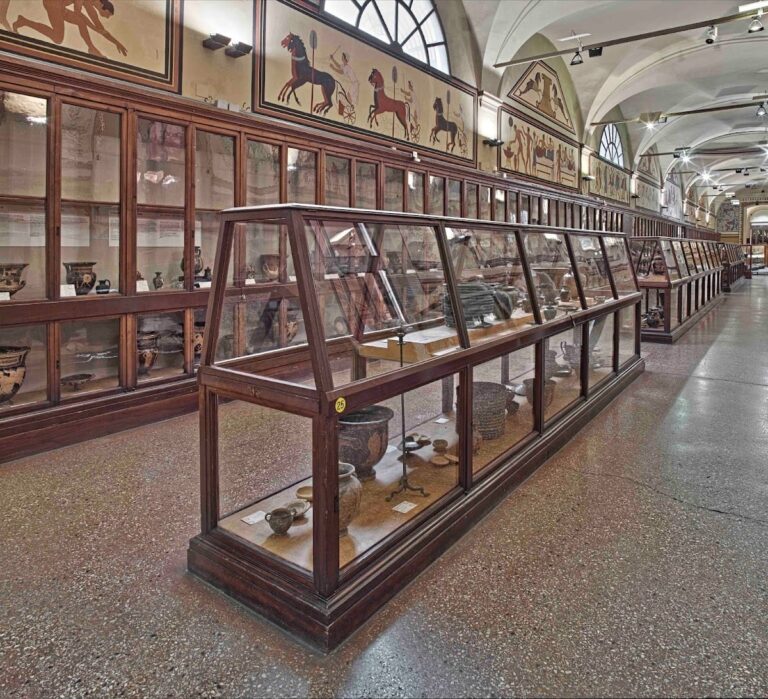
In 2008 many municipal offices moved to Palazzo Bonaccorso, but Palazzo d’Accursio remained the seat of the city council, the municipal executive, and other offices. It housed the Museo Morandi until 2012, when that museum moved to MAMbo. The complex remains a municipal and cultural center, containing the Bologna City Art Collections and the Biblioteca Salaborsa.
Remains
Palazzo d’Accursio occupies approximately 15,000 square metres in Bologna’s historic center. The complex extends between Via IV Novembre, Piazza Roosevelt, Via Giacomo Venezian, Via Ugo Bassi, Piazza Maggiore, and Piazza del Nettuno. It developed through construction and alteration from the thirteenth to the sixteenth centuries, combining medieval and later architectural forms. The three-storey complex incorporates the oldest surviving section and the Torre di Accursio.
Facade, towers, and entrance
Main facade and sculptures
The main facade faces Piazza Maggiore and forms the western boundary of the square. Its monumental sixteenth-century portal was designed by Galeazzo Alessi, completed in its upper part by Domenico Tibaldi, and crowned by a curved pediment. Above it stands a bronze statue of Pope Gregory XIII, made by Alessandro Menganti in 1580. Alessi also designed the large balcony window dated 1553, positioned almost opposite the Fountain of Neptune.
Two red Verona-marble eagles are incorporated into the facade, with one popularly attributed to Michelangelo. The fourteenth-century Balcone degli Anziani formerly carried a wooden-and-copper statue of Pope Boniface VIII by Manno Bandini da Siena. That statue is now preserved in the Museo Civico Medievale. The facade also contains the Madonna di Piazza con Bambino, a terracotta sculpture made by Nicolò dell’Arca around 1478.
Walls and ceremonial access
The walls facing the Fountain of Neptune contain references to historic Bolognese units of measurement and the Sacrario dei Partigiani, a memorial that developed at a place where Nazi occupying forces carried out executions. From Piazza Maggiore, Alessi’s portal leads to a broad, low-stepped staircase in forms associated with the Renaissance architect Donato Bramante. The steps were traditionally suitable for privileged nobles to ride horses up to the second floor.
Government and ceremonial rooms
Galleria dei Senatori
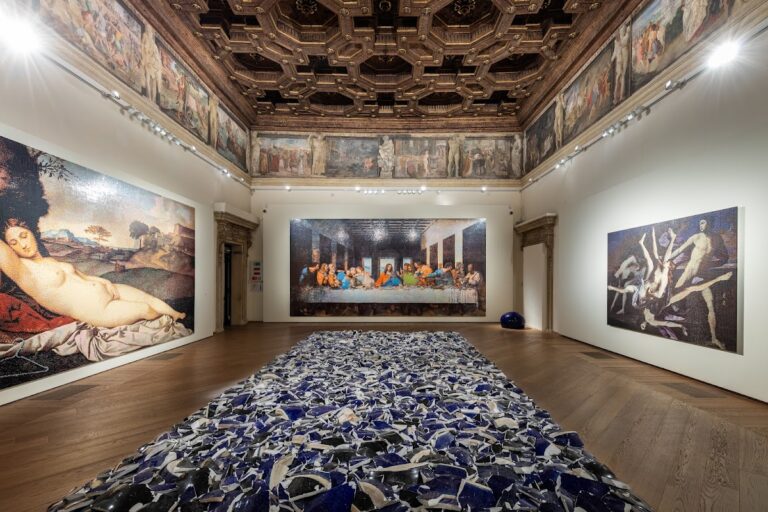
On the first floor, the Sala del Consiglio Comunale contains the Galleria dei Senatori. Angelo Michele Colonna and his young assistant Gioacchino Pizzoli painted its frescoed ceiling between 1675 and 1677. Divided into four sections, the ceiling includes allegorical figures of Minerva, Mars, Cybele pointing toward Olympus, Bacchus, Ceres, and Pomona. Their imagery relates to wisdom, war, papal authority, and the fertility of the region.
Sala Farnese and Cappella del Legato
The Sala Farnese acquired its present form in 1665 at the order of Cardinal Girolamo Farnese. Formerly called the Sala Regia, it contains decorations tracing Bologna’s history from the Middle Ages to the seventeenth century and opens toward the Bologna City Art Collections. The Cappella del Legato opens from the room, with frescoes painted by Prospero Fontana in 1562.
Sala Urbana and Sala dei Cavalleggeri
Cardinal Bernardino Spada built the Sala Urbana around 1630, and Cardinal Gaetano Bedini restored it in 1852. Around two hundred coats of arms were frescoed on its walls in the mid-eighteenth century, forming a series associated with governors and papal legates who ruled Bologna from the fourteenth century onward.
The Sala dei Cavalleggeri served as a resting place for soldiers who escorted the papal legate. Bedini transformed it in 1852 to display wall paintings continuing those of the Sala Urbana, together with additional coats of arms of legates and vice-legates. In honor of Pope Pius IX, it was called the Aula Piana.
Other decorated rooms
Cardinal Pietro Vidoni built the Galleria Vidoniana in 1665. It contains paintings, furniture, furnishings, and household objects given to the Comune of Bologna during the nineteenth and early twentieth centuries. The Sala alla Boschereccia was decorated in tempera in 1797 with representations of green spaces and natural environments.
Collections and Sala Borsa
The Bologna City Art Collections occupy part of the palace. Among the explicitly identified works are Artemisia Gentileschi’s Portrait of a Gonfaloniere, painted in 1622, Donato Creti’s Allegory of Charity and Paris and Mercury, both painted in 1745, and a statue of the dog Tago.
Sala Borsa occupies the former courtyard of the botanical garden in an adjoining nineteenth-century structure. Its entrance is on Piazza del Nettuno, and the public library was inaugurated there in 2000.
Nearby sites