Tatoi Palace: A Greek Royal Country Estate in Greece


Site at a Glance
- Rating
- 4.4
- Popularity
- Medium
- Country
- Greece
- Primary era
- Modern
- External website
- Open
- Eras represented
- Classical, Modern
- Civilizations
- Ancient Greek, Greek
- Site type
- Domestic
- Remains
- Palace
On this page23 sections
History
Tatoi Palace is a Greek royal country estate in Greece, about 15 to 20 kilometres north of Athens on the southeastern slopes of Mount Parnitha. Developed chiefly from the late nineteenth century, it combined an English country-house and Neo-Gothic residence with a managed forest, agricultural lands, production facilities, roads, and a royal cemetery. Its history extends from the ancient fortification of Decelea to the modern Greek state’s efforts to preserve the former royal property.
Decelea and the Ottoman Estate
Tatoi occupies the site traditionally identified with ancient Decelea, an Attic deme, or local civic district associated with Athens. In 413 BC, during the Peloponnesian War, Spartan forces commanded by King Agis II fortified the area to observe the plain between Athens and the sea. Remains of these defenses survive on Palaiokastro Hill.
During the Ottoman period, the area was an estate containing mills, chapels, farms, and settlements inhabited largely by people of Albanian origin. After Greek independence, it passed through the hands of the Phanariot Alexandros Kantakouzinos and the Soutzos family. The name Tatoi may derive from the Albanian-Vlach chieftain Tatoi.
Creation of the Royal Estate
King George I acquired Tatoi from the Soutzos family in 1872 for 300,000 drachmas. The estate initially covered about 20,000 stremmata and expanded through further purchases and the addition of the former Bafi monastic estate. By 1898, it reached 47,427 stremmata. George viewed Tatoi chiefly as a private country estate and place of recreation, with the forest taking precedence over the construction of a monumental palace.
The property was developed as a productive and largely self-sufficient royal estate. Reforestation, vineyards, olive groves, irrigation, water management, roads, firebreaks, bridges, workshops, livestock production, and wine and dairy manufacture were established under the management of Hans Ludwig Münder, a Danish forester and supporter of Greek culture, from 1873 to 1892, and Otto Weismann from 1893 to 1914.
The first royal residence was completed in 1874. As the royal family grew, George I commissioned Savvas Boukis to design a larger country residence after studying the Farm Palace at Peterhof in Russia. Construction began in 1884 and ended in 1886. The gardens and interiors were completed by May 1889, when the palace was inaugurated. Tatoi then became the Greek royal family’s principal spring and summer residence.
The earlier residence was later assigned to Crown Prince Constantine and Princess Sophia and became known as the Palace of Constantine. The newer building served as the main royal residence. Unlike a state royal residence, Tatoi was privately owned by George I.
The Cemetery and the Reign of Constantine I
The southern part of the estate became a dynastic cemetery, a burial ground reserved for members of a ruling family, after the death of Princess Olga in 1880. At Queen Olga’s initiative, the Church of the Resurrection was founded on Palaiokastro Hill on 6 August 1899. Members of the Greek royal family were subsequently buried there.
After George I was assassinated in Thessaloniki on 5 March 1913, Tatoi passed to his son Constantine I. Queen Olga retained the usufruct, meaning the legal right to use and benefit from property owned by another party, of the Royal Palace in Athens. Constantine I and Queen Sophia commissioned practical improvements at Tatoi, including the Staff Wing in 1913 and 1914.
Tatoi also became a setting for national political decisions. The government of Eleftherios Venizelos was sworn in there in August 1915 in the former Palace of Constantine, while political consultations took place during the First World War. The conflict known as the National Schism, which divided Greece over neutrality or entry into the war on the Allied side, intensified opposition to Constantine I and formed part of the background to the crisis at Tatoi.
Fire, Abdication, and Republican Administration
On 30 June 1916, fire destroyed or severely damaged much of Tatoi. Two-thirds of the forest burned, together with the royal stables, the Church of the Prophet Elijah, the Clock Tower, the Palace of Constantine, the Lyders House, and the telegraph office. Nine people died, and most of the estate’s animals were lost. Foreign agents were blamed at the time, but the most probable explanation was the severe heat wave affecting Greece that summer.
Constantine I was forced from the throne in 1917. His son Alexander I died in 1920 after an infection caused by a monkey bite at Tatoi. Constantine returned to the throne but abdicated again in 1922. George II was deposed after the Second Hellenic Republic was proclaimed in 1924.
Under the republic, Tatoi was confiscated and transferred to the State Estate Office, the Greek public body responsible for property transferred to the state. Vasilios Drouvas served as forester and estate director from 1925 to 1961. He oversaw replanting, improvements to the firebreaks, and stricter management. By the early 1930s, the property had again become profitable. Some service buildings housed an orphanage, and the palace served as a summer presidential residence, reportedly used only by Alexandros Zaimis.
Restoration of the Monarchy and War
George II returned to the throne after the republic was overthrown in 1936, and Tatoi again became a royal estate. Reconstruction and modernization followed, including major alterations to the palace between 1937 and 1939. During the same period, Constantine I, Queen Sophia, and Queen Olga were reinterred at the royal cemetery after their remains were transferred from Florence.
During the Second World War, the royal family went into exile and the palace was sealed. German occupation forces used auxiliary buildings, confiscated supplies, and cut trees for fuel. EAM-ELAS, the principal communist-led resistance organization in occupied Greece, later took provisions from the stores and stables. The estate was looted on Christmas Day 1944 and Epiphany 1945, and several opponents were executed. Valuable royal possessions were moved to the Royal Palace in Athens for safekeeping.
Between 1 and 3 August 1945, Tatoi suffered another major, apparently deliberate fire and was again abandoned. After the royal family returned in 1946, Drouvas directed recovery during the Greek Civil War, with assistance from UNRRA, the United Nations Relief and Rehabilitation Administration. The damaged economic base was rebuilt around vineyards, firewood, livestock, wine, and dairy production. Much of the agricultural and production infrastructure was reconstructed between 1948 and 1954.
The Permanent Royal Residence
From late 1948, Tatoi became the permanent residence of King Paul I and Queen Frederica, while the Royal Palace in Athens was used mainly for official receptions. Their children Sophia, Constantine, and Irene grew up at the estate. Paul I died there on 6 March 1964. The government of Dimitrios Rallis was sworn in at the new palace in November 1920, and the government of George Papandreou was sworn in there in February 1964.
Tatoi hosted ceremonies and receptions associated with the September 1964 wedding of Constantine II and Princess Anne-Marie of Denmark. From 1966, celebrations of the Sunday of Orthodoxy, an Eastern Orthodox observance commemorating the restoration of the veneration of religious icons, were held there instead of at Athens Cathedral.
On 21 April 1967, tanks surrounded the estate during the colonels’ coup and communications were cut. Constantine II left Tatoi with his family on 13 September 1967 and never returned. The military junta abolished the monarchy in 1973 and confiscated Tatoi and the family’s other properties. Movable possessions from the royal residences were concentrated at Tatoi and entered in a 400-page inventory.
Ownership, Protection, and Recent Conservation
Ownership remained contested after the restoration of the republic. Confiscations had occurred in 1924, 1973, and 1994, while the former royal family and the Greek state disputed whether Tatoi was private hereditary property or property attached to the institution of the monarchy. The European Court of Human Rights ruled that Tatoi and certain other estates constituted private property and that Greece could retain them only after paying compensation. Following the settlement, the Greek state formally took possession of Tatoi on 3 March 2003, and the former royal family was compensated.
In September 2003, the Central Council of Modern Monuments declared Tatoi a protected monument. Proposals to convert the estate into a museum were announced in 2007, while proposals for sale or private development were considered in 2012 and 2019. Founded in 2012, the Friends of Tatoi Association promoted restoration and the conversion of the estate into a museum and public space.
Archaeological and historical research, including Kostas M. Stamatopoulos’s investigation of the estate between 1998 and 2004, contributed to renewed public interest. In 2020, restoration and preventive conservation began, including the recovery and relocation of historic carriages and automobiles. Forest fires in August 2021 destroyed a large part of the forest and several buildings, including the Staff Wing, caretaker’s house, communications building, forestry office, and Director’s House. Two containers holding palace objects also burned, but the main palace was preserved.
Former King Constantine II was buried as a private citizen in the royal cemetery beside his parents in 2023. The cemetery had been cleared of fire-damaged trees and prepared for the funeral procession. The estate’s long history, its political associations, and its surviving buildings and collections continue to shape plans for its conservation and future museum use.
Remains
Tatoi forms a wooded estate on the southeastern slopes of Mount Parnitha. Its physical layout includes the palace complex, agricultural and service buildings, roads and avenues, managed forest, royal cemetery, Palaiokastro Hill, and the remains of the ancient fortifications associated with Decelea. The buildings and infrastructure were organized around both royal residence and economic production, giving the estate the character of a rural settlement as well as a country residence.
Palace Complex
First Royal Residence
The first royal residence was designed by Ernst Ziller as a simple two-storey Greek-Swiss house with a gabled roof on a high stone base. Completed in 1874 as a royal guesthouse, it instead became the family’s first country residence. A second floor was later added, and Crown Prince Constantine and Princess Sophia occupied the building, which thereafter was known as the Palace of Constantine.
Tatoi Palace
The newer Tatoi Palace was designed by Savvas Boukis in an English country-house and Neo-Gothic manner inspired by the Farm Palace at Peterhof. Construction took place from 1884 to 1886, and the interiors and gardens were completed by 1889. The building covers about 1,100 square metres. Its original complex included a service building, the Church of the Prophet Elijah, and two stables. A vine-covered pergola connected the chapel to the residence, while the kitchen was later placed in an adjoining pavilion linked to the palace by an underground tunnel.
Modernized Palace Interiors
Alterations made between 1937 and 1939 added bathrooms and central heating. Metal lacework decoration and elegant iron balconies from the period of George I were removed, some openings were blocked or newly created, heavy reinforced-concrete arches and battlements were added, and the southwest gable was demolished. These changes substantially reduced the palace’s earlier Neo-Gothic appearance. A cinema was installed in the basement in 1953, and a swimming pool was built in the gardens. Vegetable greenhouses were added in 1955 and 1956.
Estate Buildings and Infrastructure
Rural and Service Buildings
Late nineteenth-century buildings were arranged to evoke rural settlements of western Europe. They included the school or House of the Royal Children, the Director’s House, the Munter House, the Lyders House, Sturm House, the Tatoion Hotel, royal stables, workers’ houses, service residences, Guard accommodation, a telegraph office, workshops, warehouses, a winery, a butter factory, a dairy, and the Lygda Khan. The Tatoion Hotel opened to the public and operated until 1935, when it was incorporated into the royal residential complex. The Lygda Khan served travellers on the public road between Athens and Chalkis, which crossed the estate.
Clock Tower
A former windmill belonging to the Soutzos family was converted into a tower. George I added a floor and crowned it with battlements. The ground floor housed an archaeological museum displaying finds from small excavations in the area, while the upper floors contained a zoological museum with stuffed animals. The building was also known as the Clock Tower. It was destroyed in the fire of 1916.
Economic Infrastructure
The estate developed about 400 kilometres of roads and avenues, together with bridges, a water-supply system, fire-protection infrastructure, and two small artificial lakes named Chyna and Kithara. Wells, canals, irrigation works, mills, and firebreaks supported the managed forest and productive grounds. Vineyards, olive groves, agricultural land, and facilities for livestock and food production formed part of the same system. Deer imported from Hungary were introduced to create a private hunting reserve.
After the 1945 fire, agricultural and production facilities were rebuilt between 1948 and 1954. The work included a pig farm, a new stable, a dairy, and a cowshed. A new cowshed of notable architectural design was built in 1952, and its products were sold to hotels, hospitals, institutions, and military camps. The estate also contained the Director’s Office, designed by Konstantinos Sakellariou, a mausoleum probably designed by Emmanouil Lazaridis, and scattered stone guardhouses. The Staff Wing, built in 1913 and 1914, stood behind the Palace of Constantine and was destroyed in the 2021 fires.
Chapels, Cemetery, and Ancient Fortifications
Church of the Prophet Elijah
The Church of the Prophet Elijah was completed in 1873 and was the first completed building on the estate. Designed in an Italian-Byzantine style with distinctive dentil ornament, it stood within the original palace complex and was connected to the residence by a vine-covered pergola. The chapel was destroyed in the fire of 1916.
Church of the Resurrection
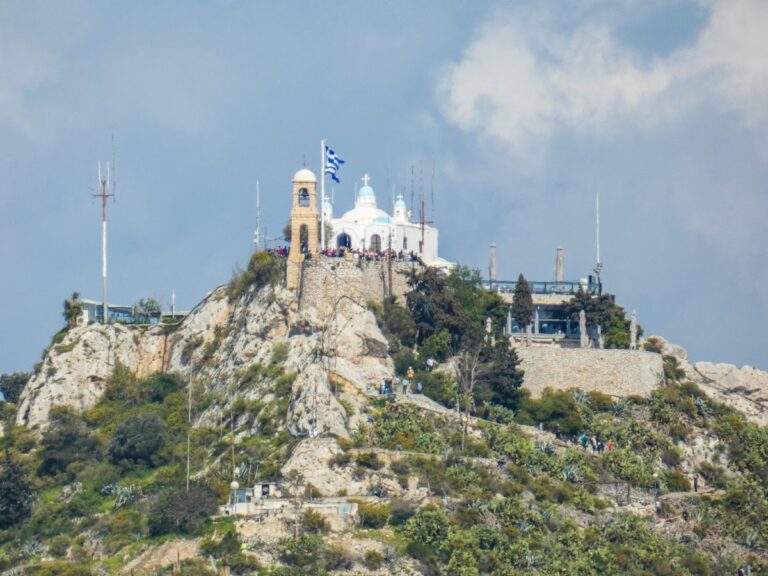
The Church of the Resurrection was designed by Anastasios Metaxas as a reproduction of the Byzantine Church of Panagia Gorgoepikoos in Athens. Built between 1898 and 1900 on Palaiokastro Hill, it forms the principal chapel of the royal cemetery.
Royal Cemetery and Mausoleum
The royal cemetery lies in the southern forest on Palaiokastro Hill, which is identified with the ancient acropolis of Decelea. Most graves are marked by simple marble tombs. The separate funerary chapel known as the Mausoleum of Constantine I and Queen Sophia was designed by Emmanouil Lazaridis and built between 1936 and 1940. It also accommodates the remains of their son Alexander I.
The cemetery contains the graves of George I, Queen Olga, Constantine I, Queen Sophia, George II, Alexander I, Aspasia Manos, Paul I, Queen Frederica, Constantine II, and members of the wider Greek, Russian, Danish, Bonaparte, and Orleans royal families. Princess Alexandra of Greece, the last queen of Yugoslavia, was buried at Tatoi until her remains were transferred to Serbia in 2013. Aspasia Manos was transferred there in 1993, and Princess Alexandra of Greece, who became a grand duchess of Russia, was transferred there in 1940. The tomb monument of Paul I and Queen Frederica was vandalized on 1 September 2020, when the cross above the tombs was broken.
Palaiokastro Fortifications
Palaiokastro Hill contains the remains of the fortifications associated with ancient Decelea. The defenses were constructed in 413 BC by Spartan forces under King Agis II during the Peloponnesian War, when the position was used to observe the plain between Athens and the sea. Their remains form the ancient archaeological element within the later royal estate.
Movable Collections and Fire Damage
Historic movable property associated with Tatoi included royal furniture, paintings, icons, clothing, toys, carpets, carriages, automobiles, and other palace objects. Ten automobiles were designated cultural objects in 2015. In 2020, several historic carriages and automobiles, including four Rolls-Royces, were found, removed from unsuitable storage, and restored. One recovered vehicle was a carriage used at the 1962 wedding of Juan Carlos I and Sophia of Greece.
Post-fire clearing and restoration work uncovered a collection of about 4,000 bottles of local wine that had been hidden during wartime. Surviving objects had suffered from prolonged neglect, theft, vandalism, and structural deterioration, while some palace objects were lost when two storage containers burned in 2021. The 1916 and 1945 fires caused extensive destruction across the estate, and the 2021 fires burned the forest and additional service buildings without destroying the main palace. Restoration and preventive conservation begun in 2020 have focused on stabilizing the complex, recovering movable property, and planning a future mixed use that may include a museum in the central palace and hospitality facilities elsewhere in the estate.