Palais du Pharo: An Imperial Residence and Public Landmark in Marseille


Site at a Glance
- Rating
- 4.7
- Popularity
- Medium
- Country
- France
- Primary era
- Modern
- External website
- Open
- Eras represented
- Modern
- Civilizations
- French
- Site type
- Domestic
- Remains
- Palace
On this page10 sections
History
Palais du Pharo is a nineteenth-century palace in Marseille, France, commissioned by Louis-Napoleon Bonaparte, later known as Napoleon III, as a residence for Empress Eugénie. Conceived during the growth of Marseille’s port and population, the palace was built between the 1850s and the fall of the Second Empire in 1870, although the imperial couple never lived there.
Planning and construction
Louis-Napoleon expressed his wish to establish a residence in Marseille during a visit in 1851. The municipality offered him one million francs, partly in recognition of his Mediterranean policy and its contribution to the city’s development. This money helped purchase the site. Between 1792 and 1852, Marseille’s population grew from 106,000 to 195,000, while the annual value of its maritime trade increased by 852 million francs. From 1852, Louis-Napoleon also promoted major building and infrastructure projects in the city.
After Louis-Napoleon became emperor, he commissioned the Geneva architect Samuel Vaucher in November 1852 to select a location. Vaucher chose La Teste More, a crater-shaped site overlooking the port and coastline, and presented plans in February 1853. Hector-Martin Lefuel later revised them. The municipality spent nearly 1.2 million francs acquiring the land, and preliminary leveling preceded the laying of the first stone on 15 August 1858, Saint Napoleon’s Day.
Construction was influenced by the parallel building of Villa Eugénie at Biarritz, an imperial residence whose work began in 1854. Napoleon III wanted the latest technical improvements considered at Marseille, so Lefuel was asked to study them and the works were interrupted in November. Construction resumed but progressed slowly because of insufficient funds and difficulties obtaining stone while Marseille Cathedral was being built at the same time.
Changes in direction and the end of the Empire
In August 1861, Vaucher was held responsible for the delays and replaced by Henri-Jacques Espérandieu. François Gilbert, Vittoz, and Simon were commissioned to produce the interior and facade ornamentation. The palace was still unfinished when the Second Empire, the imperial regime ruled by Napoleon III from 1852 until 1870, fell. The imperial couple therefore never occupied it.
After the regime’s collapse, a crowd destroyed the building’s Napoleonic emblems and ornaments. Napoleon III died in 1873, after which Marseille brought a legal action against Eugénie, who was then the estate’s sole legal owner. She won the case in 1884 and offered the palace and gardens to the city on the condition that they serve public purposes.
Medical and civic uses
During the cholera epidemic of 1884, the unfinished building became a temporary hospital called the Hôpital du Pharo. It subsequently received patients with cholera and tuberculosis until the end of the nineteenth century. Buildings beside the palace esplanade were occupied by the Faculty of Medicine from 1890.
The Army Health Service established its Institute of Tropical Medicine, known as the École du Pharo, there in 1905. Since 2012, the building has housed the headquarters of Aix-Marseille University. The city of Marseille now owns the palace, which functions as a reception and congress venue. An auditorium is used for Marseille Opera performances, while another building on the site became the seat of one of the territorial councils of the Aix-Marseille-Provence metropolis after it replaced the Communauté urbaine Marseille Provence Métropole.
An order dated 28 January 2025 entered the Palais du Pharo, its garden, entrance pavilions, gates, and boundary walls on the French register of historic monuments.
Remains
Palace and grounds
Palais du Pharo
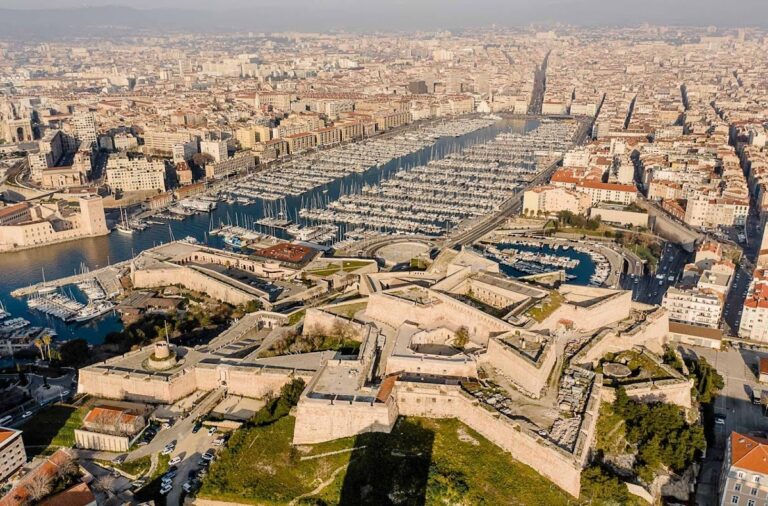
The palace stands between the seaward view toward the entrance to the Vieux-Port and the Pharo garden on the city side. Its site overlooks the port and coastline opposite Fort Saint-Jean, the historic fortress guarding the entrance to Marseille’s Old Port. The building has a U-shaped plan, with two lateral wings forming a barrier against the mistral, the strong, cold wind that reaches Marseille from the Rhône valley toward the Mediterranean.
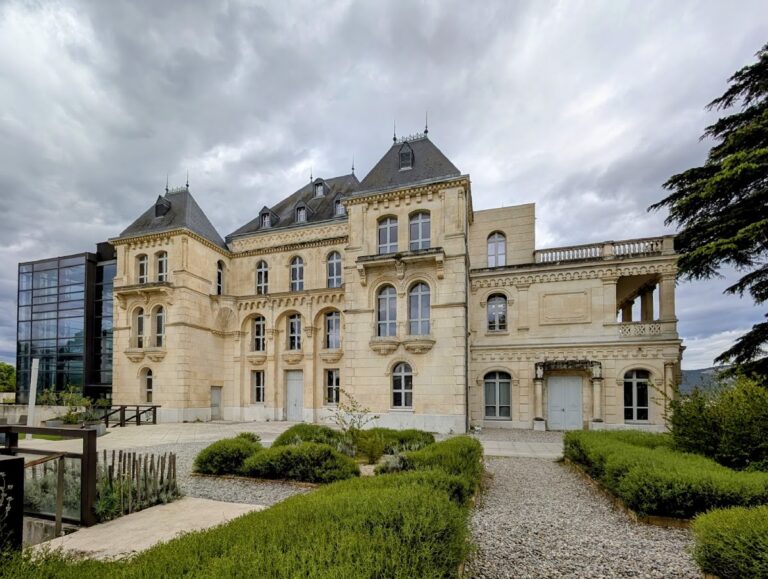
Its design is closer to that of a seaside resort than to a conventional imperial residence. The building is related to Villa Eugénie at Biarritz but is larger and more monumental, partly because it includes an attic level. Whereas the Biarritz residence used brick, the Marseille palace was built entirely in stone. Its classical references include semicircular-arched openings on the ground floor and arched windows on the upper floors, decorated with garlands and shell motifs.
Facades and roofs
The triangular pediment, the classical triangular upper section of a facade, carries the arms of Marseille in its tympanum, the enclosed field within the pediment. Two children hold the arms. Simon, a sculptor from Marseille, carved the ashlar motifs on the ground floor, using finely cut and dressed masonry to create a regular stone surface.
The palace’s later adaptation for the Faculty of Medicine changed its original appearance. The lateral wings were raised, their Mansard roofs were removed, and the harmony of the first design was altered. The central body still retains its Mansard roof, whose lower, steeper slopes create attic space.
Garden and underground rooms
The palace overlooks a 5.7-hectare public garden now named the Émile Duclaux Garden, although it continues to be commonly called the Pharo garden. Glazed underground rooms were added beneath the gardens. They provide views toward the Vieux-Port, and the complex also includes an auditorium.
Monument to the Heroes and Victims of the Sea
Near the palace, facing the coast, stands the large metal Monument to the Heroes and Victims of the Sea. The monument is itself registered as a historic monument and forms a separate landmark within the setting of the Palais du Pharo.
Nearby sites