Palazzo della Ragione: Padua’s Medieval Palace of Justice and Market


Site at a Glance
- Rating
- 4.6
- Popularity
- Medium
- Country
- Italy
- Primary era
- Medieval
- External website
- Open
- Eras represented
- Classical, Medieval, Early Modern
- Civilizations
- Roman, Venetian
- Site type
- Civic
- Remains
- Palace
On this page10 sections
History
Palazzo della Ragione is a medieval civic palace in Padua, Italy, built for the city’s courts, financial offices, and covered market. Its lower section existed by 1166, while the first major realization of the building is dated to 1219, with 1218 also associated with an earlier construction date. The palace became one of the principal settings for public administration and commercial life in medieval Padua.
Communal and Carraresi Padua
The palace may stand on ground that had already been occupied for centuries. Excavations in the 1990s uncovered a Roman house, or domus, dating from the first or second century AD, together with medieval structures that included towers. These discoveries place the medieval civic complex within a long sequence of occupation.
During the period of the medieval commune, the palace accommodated judicial and financial functions. It retained these roles under the Carraresi, the ruling family of Padua before the city entered the Venetian state. Its commercial purpose also continued as trade intensified in the surrounding market squares and the city government regulated and protected commercial activity.
The enlargement of 1306 to 1309
Between 1306 and 1309, the Augustinian friar Giovanni degli Eremitani directed a major enlargement. The work added the portico and loggias, raised the roof, and joined three previously separate rooms to form the great upper hall. This intervention established much of the palace’s monumental internal organization.
Fire, frescoes, and Venetian rule
Padua came under Venetian rule in the early fifteenth century, after the end of Carraresi authority. The name Palazzo della Ragione, meaning “Palace of Reason,” came into use during this period, and the frescoes contain repeated references to the Serenissima, the traditional name for the Republic of Venice.
A major fire in 1420 destroyed the original fresco cycle, traditionally associated with Giotto, a leading Italian painter of the late thirteenth and early fourteenth centuries. The upper floor was then rebuilt as one hall. Between 1425 and 1440, Niccolò Miretto and Stefano da Ferrara painted a new astrological cycle that followed the earlier program associated with Pietro d’Abano, a Paduan physician, astrologer, and scholar. Sacred figures in the east-south corner survive from an earlier phase and are attributed to Giusto de’ Menabuoi, a fourteenth-century Italian painter; they date from before 1390.
The palace was rebuilt by Venetian craftsmen after the fire. On 17 August 1756, a violent tornado destroyed the roof and exposed the great hall. Reconstruction was entrusted to Bartolomeo Ferracina, a Venetian clockmaker and engineer, who restored the roof structure and protected the upper interior.
Changing civic uses
The courts moved elsewhere in 1797. After that change, the Salone, or Great Hall, hosted popular assemblies, celebrations, and festivities. It has also been used for artistic exhibitions, conferences, and other events, while commercial activity continued in the building.
Since 2000, the frescoes have been the focus of a restoration project. Palazzo della Ragione forms part of the Civic Museums of Padua. In 2021, it was included in the UNESCO World Heritage site “Padua’s fourteenth-century fresco cycles.” The designated component covers 73.4 hectares and has a 5,300-hectare buffer zone. It also includes the Loggia Carraresi and the Baptistery of Padua, forming one of the four complexes within the World Heritage site.
Remains
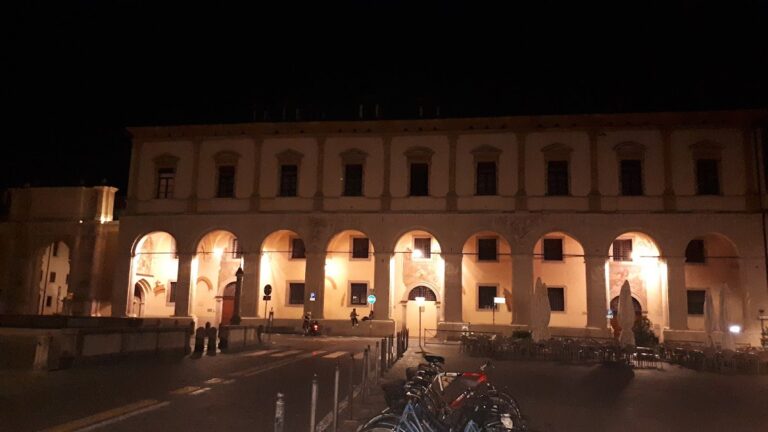
The palace stands between Piazza delle Erbe to the south and Piazza della Frutta to the north, dividing Padua’s market area between the two squares. Its plan is slightly trapezoidal because it follows water channels that were not mutually perpendicular. The building rests on 90 piers arranged in four rows and has the form of an enormous inverted ship. Its principal facades present a broad upper loggia, a covered open-sided gallery, and a lower Venetian loggetta that projects from the building and partly covers an earlier loggia of tall, wide arches.
Roof and upper hall
The roof has the distinctive shape of an inverted ship’s hull. Rebuilt with larch-wood trusses, it has no central columns and is covered with lead plates. Its structure consists of two wooden shells. Beneath it, the upper floor contains the Salone, a trapezoidal hall approximately 80 to 81 metres long, 27 metres wide, and nearly 40 metres high. A wooden ship-keel ceiling is supported by arches and pillars with groin vaults, while rows of two-light windows open toward the loggias.
Four stairways reach the Salone from the corners of the building. Their traditional names preserve associations with the market activities once carried on in those areas: the stairways of the birds and wine face Piazza delle Erbe, while those of fruit and wrought iron face Piazza della Frutta.
Fresco cycle and painted imagery
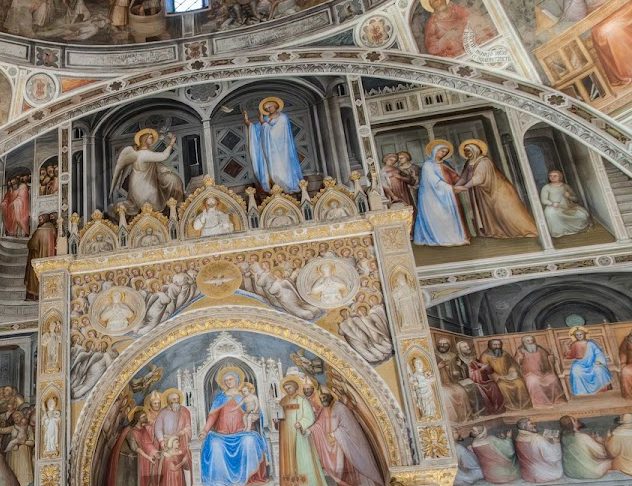
The frescoes occupy the three upper bands of all four walls, extending for more than 200 linear metres. The cycle begins at the south-eastern corner, on the wall facing Piazza delle Erbe, with Aries at the spring equinox. Its astrological program is divided into twelve sections corresponding to the months. Each month is arranged in three superimposed bands of nine shelves or tiers and begins with an apostle occupying the space of two panels.
The paintings combine zodiac signs, constellations, planets, nearby celestial figures known as paranatellonta, major stars, occupations, and people whose characters and activities are linked to their date of birth and ascendant. The arrangement functions as a large solar clock: at dawn, sunlight reaches the zodiac sign corresponding to the Sun’s astronomical position. The conception follows the studies of Pietro d’Abano, whose work drew on Averroes, the Latin name used in medieval Europe for the Andalusian philosopher and physician Ibn Rushd.
The images place nobles and common people, rural and urban communities, farmers, merchants, ladies, and knights within the same astrological scheme. In the lower fresco band, the four cardinal virtues, prudence, justice, fortitude, and temperance, appear alongside the three theological virtues, faith, hope, and charity. Padua’s patron saints, including Saint Justina and Saint Anthony of Padua, and the Doctors of the Church are also represented.
Animal images appear on circular painted panels called deschi. Judges and notaries sat beneath them, and the animal symbols helped people who could not read identify the judges. Other scenes include the Judgment of Solomon, a courtroom, allegories of Justice, Law, and the Commune in Lordship, and the Coronation of the Virgin. Judges prayed before the Coronation of the Virgin before beginning trials. Additional votive frescoes were added later.
Market galleries and civic connections
Below the Salone, two parallel galleries, a perpendicular gallery, and the sides facing the market squares contain numerous food shops. Romanesque carved heads survive on the jambs of the arches leading into this market area.
On the east, an arched passage called the Volto della Corda still connects the palace physically with Palazzo Comunale. Beneath it, bankrupts, swindlers, and insolvent debtors were historically beaten on the back with a cord. The nearby corner, known as the Canton delle Busie, or “Corner of Lies,” was a meeting place for merchants. White-stone carvings of traditional Padua measures survive near the passage.
A former suspended passage once linked the palace on the opposite side with Palazzo delle Debite, a building that housed prisons for insolvent debtors. That historic building was demolished in 1873 and replaced by the present Palazzo delle Debite, designed by Camillo Boito.
Objects and marked spaces in the hall
The Salone contains a gigantic wooden horse, a Renaissance copy of Donatello’s equestrian monument to Gattamelata. Donatello was a major Florentine sculptor, while Gattamelata was the military commander Erasmo da Narni, whose monument stands in Padua. The Capodilista family commissioned the wooden horse for a spectacular parade in 1466. Giorgio and Giordano Emo Capodilista donated it to the municipality on 11 December 1837 after it had lost its head and tail; Antonio Rinaldi carved the missing parts. The sculpture was restored again in 2004. It is 5.75 metres high, has a circumference of 6.20 metres, and contains a hatch in its back that provides access to the interior.
A Foucault pendulum hangs in the hall. Its 20-metre cable is fixed to the vault and supports a 13-kilogram steel-and-aluminium sphere. An electromagnet produces a pulsed magnetic field that maintains the oscillation, while 180 LEDs display the apparent rotation of the oscillation plane relative to Earth.
A black-and-white strip on the floor follows the south-north axis and represents the twelfth meridian passing through Padua. On the east wall, an ancient Roman tombstone is attributed to Titus Livy, the Roman historian, and a medallion depicts the Paduan explorer Giovan Battista Belzoni, who was associated with Egyptian antiquities.
Near the east wall stands the Stone of Shame. Insolvent debtors were required to sit on it three times while publicly renouncing their property before exile. They had to strip to their shirt and underwear before sitting on the stone, a practice associated with the Padovan expression “to remain in cloth trousers.” Two statues of the Egyptian goddess Sekhmet once stood beside the doorway to the municipal offices. Belzoni brought them from Egypt and donated them in the nineteenth century; they were later transferred to the Archaeological Museum of Padua.
Archaeological investigations in the underground areas revealed the Roman domus and medieval towers. The surviving fabric of Palazzo della Ragione therefore incorporates evidence of Roman, medieval, judicial, commercial, and post-medieval phases.
Nearby sites