Častolovice Castle: From Medieval Water Castle to Renaissance Palace


Site at a Glance
- Rating
- 4.7
- Popularity
- Medium
- Country
- Czechia
- Primary era
- Early Modern
- External website
- Open
- Eras represented
- Medieval, Early Modern, Modern
- Civilizations
- Habsburg, Holy Roman Empire, Kingdom of Bohemia
- Site type
- Domestic
- Remains
- Castle
On this page15 sections
History
Častolovice Castle is a historic castle complex in Czechia, probably established as a water castle in the thirteenth century during the settlement of the foothills of the Orlické Mountains. A water castle was a fortified residence protected partly by surrounding water, such as a moat or marsh. The site stood on marshy ground beside the Wild Eagle River and was later transformed into a Renaissance palace, a residence shaped by the revival of classical forms, ordered plans, arcades, and humanist decoration.
Medieval origins and early owners
The first known owner was Puta the Elder of Častolovice, a land judge recorded in 1342. A land judge held a senior judicial and administrative office in the medieval Bohemian lands. His son, Puta the Younger, became provincial governor and later a pledge-holder of Kladsko, Frankenstein, and Münsterberg. A pledge-holder administered territories temporarily held as security for a financial obligation. The male line of the Častolovice family ended in 1434.
Ownership later passed to the Bohemian King George of Poděbrady, his son Henry the Elder of Münsterberg, and William II of Pernstein. By 1559, the castle was described as abandoned, marking the decline of its medieval phase.
Renaissance palace and aristocratic residence
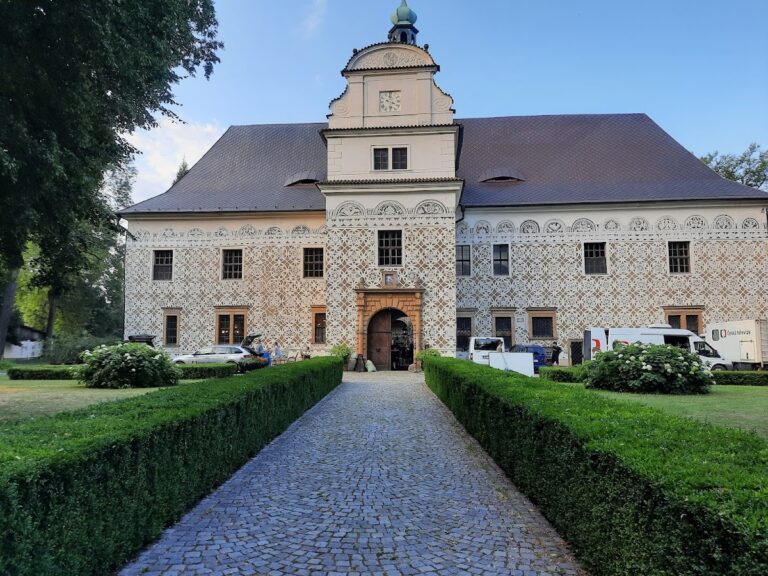
Johann, Wilhelm, and Georg of Oppersdorff acquired the uninhabited castle and its estate in 1577. Under Friedrich of Oppersdorff, the former water castle was converted into a Renaissance palace between 1588 and 1615. This transformation replaced the earlier fortified residence with a more ordered aristocratic dwelling arranged around a courtyard.
The estate passed to Count Thomas Czernin of Chudenitz in 1684. In 1694 it came into the possession of Adolf Wratislaw von Sternberg, the Bohemian supreme burgrave, who commissioned a comprehensive renovation. Further alterations took place under Jaroslaw von Sternberg between 1858 and 1874 and again in 1910. The nineteenth-century work reshaped the palace in an English style.
Enlightenment culture and the Sternberg household
Under Franz Joseph, Count of Sternberg-Manderscheid, the palace became a cultural center of the Enlightenment. This intellectual movement encouraged critical inquiry, scholarship, education, and the study of language, history, and society. Josef Dobrovský, a founder of Czech linguistic and literary studies, stayed at Častolovice several times. The historian František Palacký served as archivist to the Sternberg family.
The historian Bohuslav Balbín spent the years 1625 to 1630 at Častolovice after his father’s death. The palace’s intellectual associations therefore extended across several generations, linking its aristocratic household with scholarship in language, history, and literature.
Nationalization and restitution
After the communist coup of February 1948, Častolovice Castle was nationalized. Leopold Sternberg was expropriated and emigrated to the United States with his wife, Cecilia, née Reventlow, and their daughter Diana. Restitution, the legal return of confiscated property to former owners or their heirs, followed the end of communist rule. In 1993, Častolovice Castle and Zásmuky Castle were restituted to Diana Phipps Sternberg. The library was restituted with the castle in 1992 but remained under the administration of the National Museum in Prague.
Remains
Courtyard, palace, and grounds
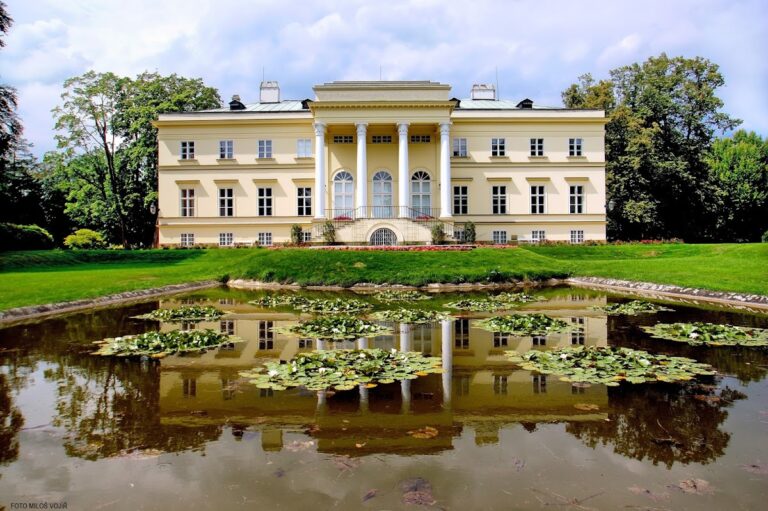
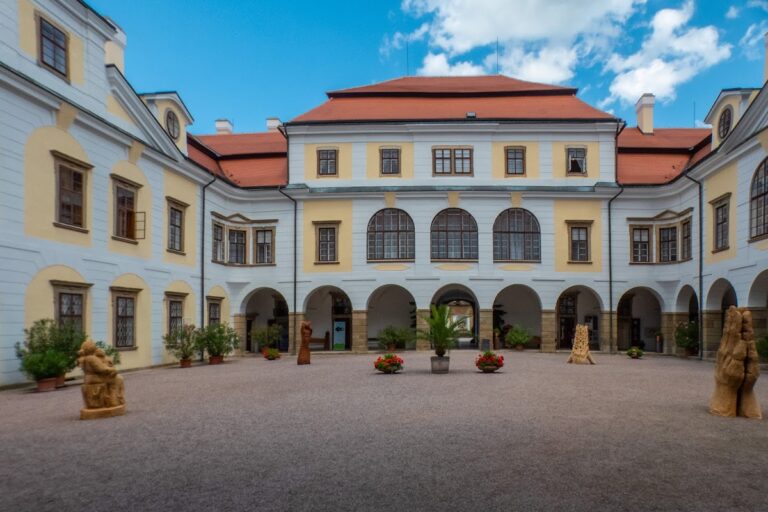
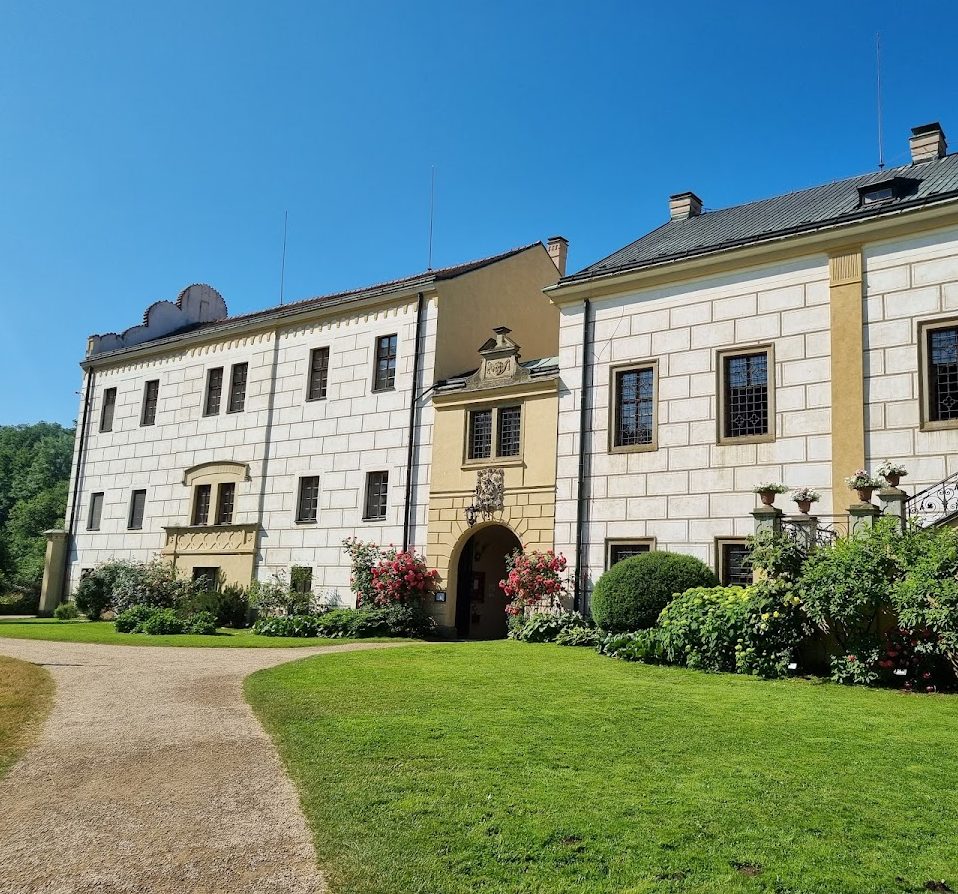
The surviving palace occupies the site of the former water castle and is organized around a square courtyard with arcades. Its present form reflects the Renaissance rebuilding and later English-style alterations. The palace is surrounded by an extensive English landscape park, which forms part of the surviving setting of the residence.
Paintings and ceremonial rooms
Dining room picture gallery
The dining room contains a portrait cycle of Bohemian rulers dating from 1453 to 1705. The series was originally at Jindřichův Hradec Castle, where Adam II of Neuhaus commissioned it. It passed to Konopiště Castle after the marriage of Anna Lucia Slavata and Adolf Wratislaw von Sternberg in 1654, and was later brought to Častolovice.
Knights’ Hall
The walls of the Knights’ Hall, a ceremonial reception room associated with aristocratic display, carry portraits of members of the Sternberg and Slavata families. Its coffered ceiling, formed from recessed or framed panels, contains twenty-four panels showing scenes from the Old Testament.
Palace chapel
The palace chapel contains an altar from the beginning of the seventeenth century that is traditionally said to have come from Tyrol.
Painting collection and library
Painting collection
The wider painting collection was acquired by Franz Joseph, Count of Sternberg-Manderscheid. It includes substantial groups of Flemish, Bohemian, and Austrian paintings, complementing the portraits displayed in the palace’s ceremonial interiors.
Castle library
The castle library contains 5,834 volumes, including five manuscripts, 708 printed works from the seventeenth and eighteenth centuries, and approximately 4,000 works from the nineteenth century. About 20 percent of the other holdings date from the first half of the twentieth century, while approximately 35 percent are German-language works. Around 1900, the library operated as a publicly accessible count’s book-lending office. Cecilia von Sternberg expanded it shortly before her expropriation and emigration in 1948.
Marian column
A Marian column, a devotional or commemorative monument dedicated to the Virgin Mary, stands in front of the palace. Dated 1744, its pedestal bears the coats of arms of Ulrich Adolf von Sternberg and his wife, Anna Lucia Slavata.
Nearby sites