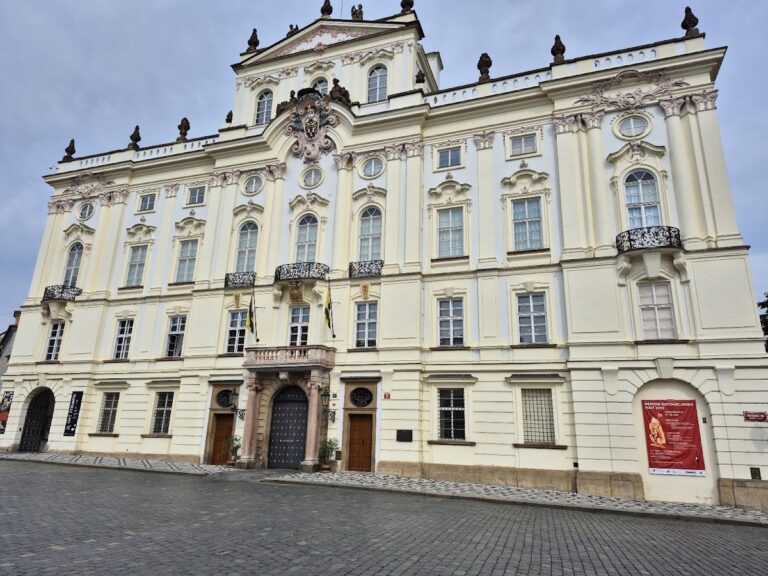
Lobkowitz Palace: Noble Residence and German Embassy in Prague


Site at a Glance
- Rating
- 4.6
- Popularity
- Medium
- Country
- Czechia
- Primary era
- Early Modern
- External website
- Open
- Eras represented
- Early Modern
- Civilizations
- Habsburg, Holy Roman Empire
- Site type
- Domestic
- Remains
- Elite Residence
On this page8 sections
History
Construction and noble ownership
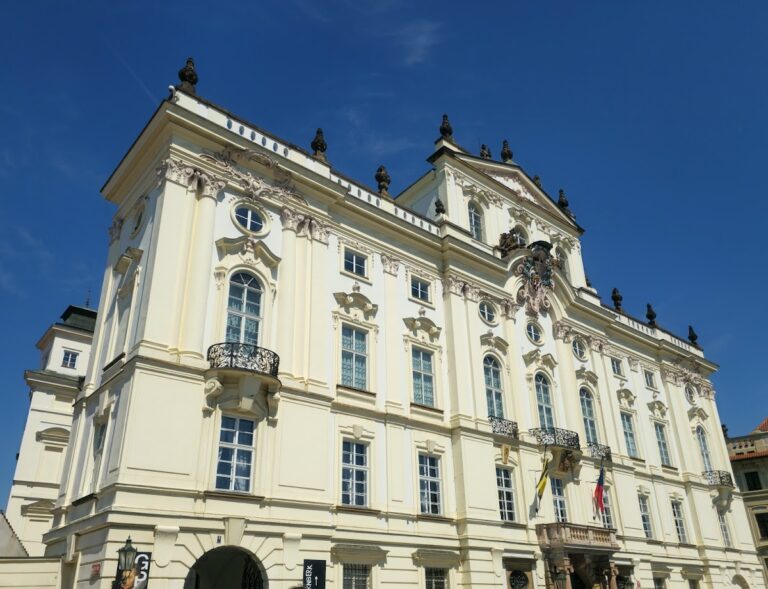
Lobkowitz Palace is a Baroque palace in Prague, Czechia, built in the early eighteenth century as an urban residence and Prague headquarters for the Bohemian Lobkowicz noble family. Its construction took place between 1703 and 1707 for Franz Karl, Count Přehořovský, under the direction of Giovanni Battista Alliprandi, a Baroque architect of Italian origin active in Bohemia, and the court stonemason Giovanni Pietro della Torre.
The palace and its gardens passed to Count Franz Karl Kolowrat-Liebsteinsky in 1717. In 1753, the marriage of Maria Josefa Ludmila Černín of Chudenic to Prince August Anton Josef of Lobkowicz brought the property into the Lobkowicz family. The family retained it until 1927, and under its ownership the palace became the Prague seat of the Hořín–Mělník branch of the Bohemian Lobkowicz family. Its musical history included concerts by Ludwig van Beethoven and Carl Maria von Weber, two prominent German-speaking composers.
State institutions and diplomatic use
In 1927, the Lobkowicz family sold the palace to the Czechoslovak state. It was acquired for the Ministry of National Education and later accommodated the Monuments Office, the Slavonic Institute, the Institute of Archaeology, the Oriental Institute, and the Masaryk Academy of Labour.
Following the Communist seizure of power in February 1948, the palace became the embassy of the People’s Republic of China. After diplomatic relations with West Germany were established in 1973, it became the West German Embassy in 1974. It subsequently continued as the embassy of reunified Germany.
The refugee events of 1989
In the late summer of 1989, thousands of citizens of the German Democratic Republic, the communist East German state, sought refuge at the embassy while trying to leave for the West. They occupied the palace and its grounds for several weeks, and their number eventually reached about 4,500. The crowded conditions created serious difficulties with food, sleeping accommodation, and sanitation.
On 30 September 1989, West German Foreign Minister Hans-Dietrich Genscher announced from the palace that the refugees would be allowed to travel to the Federal Republic of Germany, the West German state that later became the state of reunified Germany. Speaking from the first-floor balcony, he began, “We have come to you to tell you that today your departure …” before the rest of his sentence was drowned out by cheering. The announcement helped create the political conditions that led to the fall of the Berlin Wall on 9 November 1989.
Later preservation
After the occupation ended, the palace grounds were renovated. Plans formed in the mid-1990s to transfer the palace into German federal ownership in exchange for the former United States Embassy in Berlin did not succeed. In 2014, the two sides instead agreed to a 50-year lease. Lobkowitz Palace and the Lobkowicz Garden are protected as cultural monuments of the Czech Republic.
Remains
Palace elevations and gardens
Lobkowitz Palace is a Baroque building whose long street façade is almost straight, while the garden façade uses a more dynamic arrangement of curves. Its center projects outward in a convex form, flanked by two concave wings. An ornamental grille decorated with sculptures separates the palace from its gardens. The gardens were laid out in the Baroque manner before being transformed into an English-style landscape park in 1790. The fronton bears the coat of arms of the Lobkowicz family.
Interior and commemorative features
The palace includes a domed hall associated with the concerts given there by Beethoven and Carl Maria von Weber. Its first-floor balcony is linked to Genscher’s announcement of 30 September 1989 and carries a commemorative plaque recalling the event. The refugee episode is also commemorated by David Černý’s sculpture Quo vadis, whose title means “Where are you going?” The work uses a Trabant, a car associated with East Germany, as a reference to the 1989 events. The original sculpture is preserved in the collection of the Forum of Contemporary History in Leipzig.