Palazzo Leopardi: Historic Family Residence and House Museum in Recanati


Site at a Glance
- Rating
- 4.5
- Popularity
- High
- Country
- Italy
- Primary era
- Early Modern
- External website
- Open
- Eras represented
- Medieval, Early Modern
- Civilizations
- Papal States
- Site type
- Domestic
- Remains
- Elite Residence
On this page12 sections
History
Palazzo Leopardi is a historic palace in Recanati, Italy, and the birthplace of the poet Giacomo Leopardi. Its present form dates mainly from the mid-eighteenth century, when earlier buildings on the site were united into a classically proportioned residence. Giacomo was born there on 29 June 1798 and lived in the palace until his final departure in 1830.
From Medieval Buildings to an Eighteenth-Century Palace
The Leopardi family had occupied buildings on the site continuously from the thirteenth century. During the mid-eighteenth century, Count Vito Leopardi commissioned his brother Carlo Orazio Leopardi to bring these structures together as a single palace. Carlo Orazio was a canon, a cleric belonging to the chapter of a cathedral or collegiate church, as well as the architect responsible for the principal remodeling. This work created the family residence that largely survives today.
The palace remained the home of the Leopardi family. Its history is also closely connected with the intellectual life of Giacomo’s household. His father, Monaldo Leopardi, and his youngest son Pierfrancesco assembled a family library of more than 20,000 volumes. In the early nineteenth century, Monaldo revived Recanati’s Literary Academy of the Peaceful Unequals, an institution that had already existed in the city during the fifteenth century.
Giacomo Leopardi and the Modern Institution
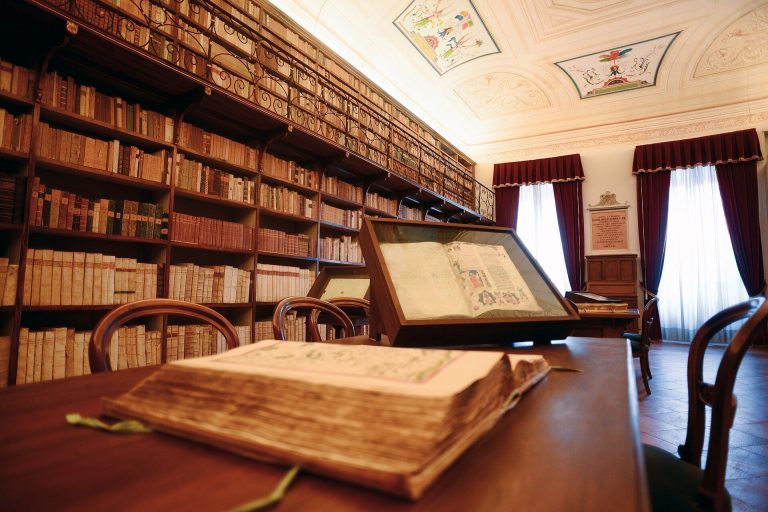
The rooms of Palazzo Leopardi preserve the setting in which Giacomo spent his childhood with his brothers. The building is now both a house museum and a library. Its Leopardi Library contains about 15,000 books, reviews, and journals devoted to critical study of Giacomo’s life and works, including first printed editions of his writings.
The National Centre for Leopardi Studies was established in 1937 to encourage research into the poet, gather writings about him, and organize cultural conferences. A building designed by Guglielmo De Angelis d’Ossat and attached to the palace serves as its headquarters. The former family gardens and adjoining property later became sites for the National Centre and the World Centre for Poetry. Since 1995, the former olive press has also served as an exhibition space for major exhibitions concerning Giacomo Leopardi.
Remains
Palazzo Leopardi stands in Recanati’s Monte Morello district and faces the small square associated with Giacomo Leopardi’s poem Saturday in the Village. The long facade is built of brick and organized with fifteen symmetrically arranged window bays. Carlo Orazio Leopardi gave it its classically proportioned appearance, while the surviving interior combines ceremonial rooms, domestic spaces, library areas, gardens, and the working spaces of a historic household.
Facade and Principal Interior
Monumental Staircase
A monumental staircase rises through a bright, curving stairwell. Its two opposing balustraded flights form elliptical segments around the central space. Monaldo Leopardi had the balustrades remade in Sirolo travertine at the end of the eighteenth century.
Piano Nobile and Historic Rooms
The piano nobile, the principal ceremonial floor of a traditional palace, contains elegant rooms with frescoed ceilings, decorated walls, and furnishings dating from the sixteenth through the nineteenth centuries. These rooms include the domestic spaces where Giacomo spent his childhood with his brothers. One room contains four large canvases called the “Depicted Herds,” attributed to the German painter Rosa da Tivoli, whose pastoral and animal subjects are also recalled by Giacomo in The Recollections.
Academy Room and Giacomo’s Bedroom
The “Academy Room” was used by Monaldo Leopardi for meetings of the Literary Academy of the Peaceful Unequals. In the eastern part of the palace, an apartment associated with Giacomo and Carlo Orazio includes Giacomo’s bedroom. The simple room has been preserved intact in its period arrangement.
Library, Cellars, and Gardens
Leopardi Library
The first floor houses the Leopardi Library and is the only part of the building accessible to the public. The upper floors remain occupied by Pierfrancesco Leopardi’s descendants. Pierfrancesco was the only member of the family to have children.
Former Olive Press and Cellars
The semi-basement contains the former olive press, a facility used to crush olives and extract their oil, together with the palace’s historic cellars. Barrels and old winemaking tools remain in the cellar areas, which also contain an exhibition about the Leopardi family’s wine production. The former press is used for exhibitions concerning Giacomo Leopardi.
Family Gardens
Gardens enclose the palace to the north and east. Successive generations of Leopardi children used these spaces as play areas, linking the formal family residence with the domestic life that continued around it.