Château de Grignon: A Seventeenth-Century Estate and Agricultural Institution in France


Site at a Glance
- Rating
- 4.5
- Popularity
- Very Low
- Country
- France
- Primary era
- Early Modern
- Eras represented
- Early Modern, Modern
- Civilizations
- French
- Site type
- Domestic
- Remains
- Castle
On this page7 sections
History
Château de Grignon is a seventeenth-century château in Thiverval-Grignon, France, built in 1636 in the Louis XIII style during the period identified as the French Renaissance. Its estate later became the home of France’s oldest agricultural and agronomic school still in operation, as well as a centre for agricultural research.
The Bellièvre estate
Pomponne de Bellièvre, president of a chamber of the Parlement of Paris and later Chancellor of France, purchased the Grignon estate from Diane de Poitiers in 1582, together with the estate of Buc. A manor had stood on the fief of Buc since the twelfth century. Pomponne’s son Nicolas de Bellièvre, Lord of Neauphle-le-Château, built the present château in 1636. In 1651, he obtained the elevation of Grignon to a marquisate, a territorial lordship held by a marquis.
The estate grew in 1674 through a land exchange with the church of Thiverval. Part of the village’s houses was demolished, and the settlement was moved westward. On 12 May 1682, Pierre de Bellièvre sold the Marquisate of Grignon and the lordship of Saint-Germain-de-la-Grange to André Potier, Lord of Novion and a counsellor of the Parlement. Grignon then remained in the Potier family until Anne Marie Gabrielle Potier de Novion, who died in 1793. She had married Guillaume Alexandre de Galard Béarn in 1768. Nicolas IV Potier de Novion died at Grignon in 1693.
From aristocratic estate to royal institution
Pierre César Auguié, administrator-general of the Posts and widower of Adélaïde Henriette Genet, acquired the estate in 1796. In August 1802, Auguié’s daughter Aglaé married General Michel Ney in the château chapel. Ney was a senior French military commander who became a Marshal of France under Napoleon in 1804. Auguié sold the estate to General Jean-Baptiste Bessières in 1803. Bessières, another senior commander who became a Marshal of France under Napoleon, died in 1813. His widow put Grignon up for sale in 1821, and the estate was adjudicated in 1826 in favour of King Charles X.
Charles X established the Institution royale agronomique de Grignon there in 1826. The institution was renamed the École impériale d’agriculture in 1852, the École nationale d’agriculture in 1870, the École nationale supérieure d’agronomie de Grignon in 1960, and the Institut national agronomique Paris-Grignon in 1971. Following an inter-institutional merger, it became AgroParisTech in 2007. From 1828 to 1971, students completed all three years of their studies at Grignon and lived in residences near the château. From 1971 until the school relocated in 2022, the estate hosted only the first year of study.
Research, relocation, and public ownership
The estate also housed research laboratories, including laboratories belonging to the INRAE Versailles-Grignon centre, associated laboratories such as Terres Inovia, and INRAE administrative offices. INRAE is France’s national research institute for agriculture, food, and the environment, while Terres Inovia supports research and development for oilseed and protein crops. After the 2022 relocation, only the Terres Inovia laboratories remained active at Grignon.
The proposed relocation of AgroParisTech to the Saclay plateau led to plans to sell the château and convert it into a Paris Saint-Germain training centre. After protests, the football club selected the nearby Poissy site instead in July 2016. The Association Patrimoine AgroParisTech-Grignon 2000, founded in 1999 by former students, AgroParisTech teacher-researchers, and other supporters, proposed an international campus devoted to meetings, debate, research, education, mediation, and innovation in agriculture, food, and the environment.
During the night of 15 to 16 March 2021, first-year AgroParisTech students, supported by older students and much of the AgroParisTech and INRAE community, blocked the site to oppose the proposed sale. Their objections concerned insufficient consultation, uncertainty about the authority of the sale-process jury, and the criteria used in the tender and their weighting. The State suspended the proposed sale to the property developer Altarea in November 2021, with a new procedure planned for the second half of 2022.
In June 2022, furniture from the château was auctioned in controversial circumstances. Proceedings followed before the Court of Auditors, whose prosecutor-general pursued the case. The Court estimated a loss of 159,000 euros for the State and total financial damage of 219,000 euros. In December 2024, four officials were sanctioned, including two school directors fined 4,000 and 5,000 euros and two officials of the National Directorate of State Property Interventions.
The former student campus was used for accommodation after the school’s relocation. At the request of Olivier Klein, Minister Delegate for the City and Housing, the Yvelines prefecture entrusted Emmaüs Solidarité with accommodating 200 migrants there during the winter beginning in November 2022. In February 2024, capacity was renewed for 195 people evacuated from a camp in Mayotte. They stayed in former student residences near the château, not in the château itself. In June 2024, the Prime Minister’s services confirmed that the estate would remain public property and announced the creation of a dedicated company serving the public interest. The entire complex within its surrounding walls had already been listed as a historic monument, a legally protected heritage site under French heritage law, by an order dated 5 July 1941.
Remains
Château and park
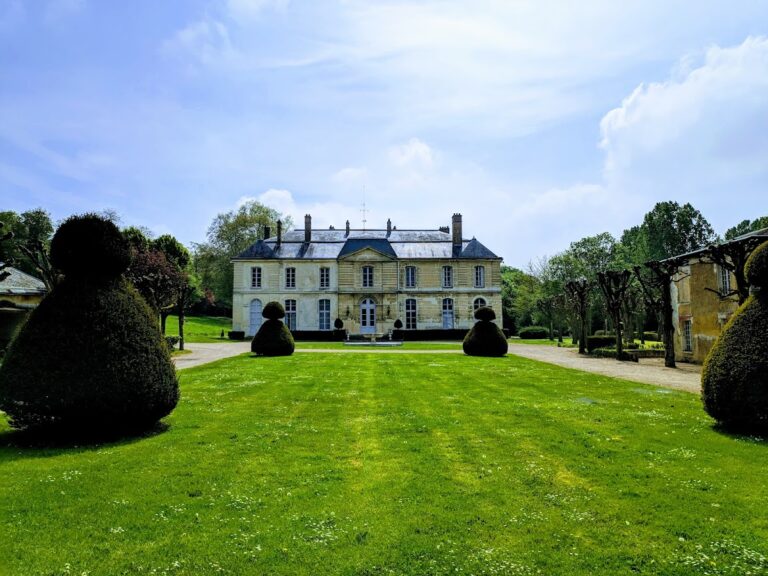
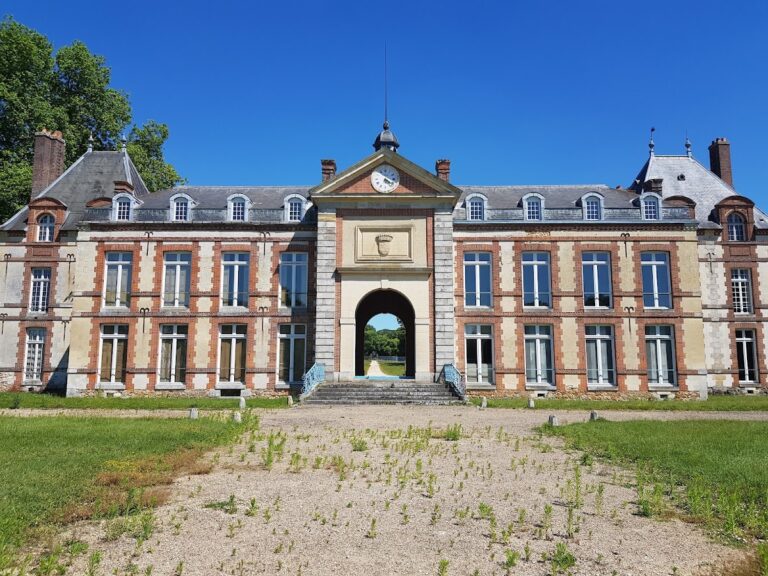
The château stands at the centre of a 300-hectare park enclosed by a long wall. Its main building follows a U-shaped plan and has façades faced in brick and stone, characteristic materials of the Louis XIII style. The park includes 130 hectares of agricultural land and 130 hectares of woodland, placing the château within a large estate combining cultivated and wooded areas.
Buildings within the enclosure
Numerous buildings surround the château within the enclosed complex. They include former service and farm buildings, together with scientific facilities added during the nineteenth century, the twentieth century, and the beginning of the twenty-first century. The entire complex contained within the surrounding wall forms part of the historic-monument protection established in 1941.