Château de Grand’Maisons: An Eighteenth-Century Residence in Villepreux


Site at a Glance
- Rating
- 4.5
- Popularity
- Very Low
- Country
- France
- Primary era
- Early Modern
- External website
- Open
- Eras represented
- Early Modern, Modern
- Civilizations
- French
- Site type
- Domestic
- Remains
- Castle
On this page12 sections
History
Château de Grand’Maisons is an eighteenth-century château in Villepreux, France, a few kilometres from Versailles. Developed from the Grand’Maisons residence by the Francini family, it remained unfinished for much of the eighteenth century before its east wing was completed in the nineteenth century. The estate’s history reflects changing royal landholding, private ownership, artistic collecting, and the literary culture of nineteenth-century France.
The Francini estate and the county of Villepreux
Thomas de Francini, a specialist designer of fountains for Henri IV, settled at Villepreux in 1598. He acquired the Grand’Maisons estate near the Gondi lords of Villepreux, whose earlier château was a separate building. That earlier Château de Villepreux had been built by Albert de Gondi and completed in 1603. The future Louis XIII visited it in 1607. It later became a weaving workshop and, in 1812, a cashmere factory.
Grand’Maisons passed from Thomas de Francini to his son François de Francini, also a fountain designer, and then to François’s son Pierre François de Francini in 1701. François was associated with work carried out alongside André Le Nôtre, the principal landscape designer of the gardens of Versailles.
During the creation of the Plain of Versailles, Louis XIV’s extensive royal hunting domain, an exchange of land enabled Pierre François de Francini to recover the lordship of Villepreux in 1706. The following year, the lordship was raised to a county. After Pierre François died in 1720, his son François Henri de Francini began transforming the Grand’Maisons residence into a château suited to contemporary taste. The work was still incomplete when the eighteenth century ended.
From the Crown to François Heurtier
François Henri’s son Honoré was later forced by financial ruin to sell the lordship to Louis XVI in 1768. In 1776, the château moved from the Crown’s domain to the Versailles domain. Three years later it became the property of François Heurtier, an architect associated with Versailles.
The transfer followed a legal arrangement connected with the proposed demolition of the château. The Crown sold the building materials to the highest bidder, with the purchaser expected to undertake the demolition. Heurtier instead retained the château, while the land remained in Crown possession. He rented the park for a life annuity and subsequently bought out that arrangement.
Heurtier also served as a municipal councillor at Villepreux. In 1789, during the political crisis that preceded the French Revolution, he carried the commune’s grievance notebooks. These registers collected local complaints and requests before the meeting of the Estates-General. He owned the château until 1802, when he transferred it to Pierre Jacques Dubois-Desmeures.
Reunification and nineteenth-century completion
The Grand’Maisons farm remained in the royal domain until Pierre Elie Heny bought it in 1797. Heny sold it the following year to Louis Michel Bocquet. Bocquet’s daughter Augustine married the journalist Louis François Bertin de Veaux in 1798, beginning the period in which the estate’s art collection took shape and was later enlarged by successive owners.
When Pierre Jacques Dubois-Desmeures became ruined, he sold the château at auction in 1811. Thomas Jean Baptiste Merlin, who already owned the farm through his wife, bought it. This reunited the farm and château after their separation in 1779. Following Madame Merlin’s death in 1816, her daughter Augustine Bertin de Veaux became owner of the farm. In 1826, after the death of her godfather Thomas Jean Baptiste Merlin, she inherited the château and completed the east wing begun by François Henri de Francini.
Louis François Bertin de Veaux assembled an extensive library at Grand’Maisons, which his heirs later enlarged. During the nineteenth century, the house’s literary salons, private gatherings where writers and artists met under a host’s patronage, received Chateaubriand, Berlioz, Gounod, Corot, Renan, Taine, and Sainte-Beuve.
Later owners and protection
After Augustine Bertin de Veaux died in 1848, the estate passed to her son, General Auguste Bertin de Veaux. The château was damaged during the Franco-Prussian War of 1870, the conflict in which Prussia and its allies defeated France and helped bring about the creation of the German Empire.
General Bertin de Veaux died in 1879, and his daughter Louise inherited the estate. She was married to Count Alphonse Gérard de Rayneval, a diplomat and relative of Conrad Alexandre Gérard. Louise added objects from her family to the château’s collections, acquired furnishings, renovated the Grand’Maisons farm, and reduced the estate’s landholdings through sales.
Louise de Rayneval died in 1909. Her grandson Thibault Le Gouz de Saint-Seine then inherited the estate and managed it through both world wars with his son-in-law Roland. After Thibault’s death in 1949, his daughter Simone occupied the château. In 1972, she installed her son Luc Le Gouz de Saint-Seine in the farm.
An order dated 9 July 1970 gave the château partial protection as a historic monument, a legal designation for heritage buildings of recognized importance. The protection covered the façades, roofs, small salon, and large blue salon. After Luc Le Gouz de Saint-Seine died in 2012, the heirs sold the collections in November 2016 because maintaining the estate had become financially burdensome. The sale raised nearly four million euros. Pietro Tenerani’s Psyche achieved a world-record price, while two portraits of Louis-François Bertin were acquired through pre-emption by the Maison de Chateaubriand, a literary museum devoted to François-René de Chateaubriand.
Remains
The château and its interiors
Exterior and east wing
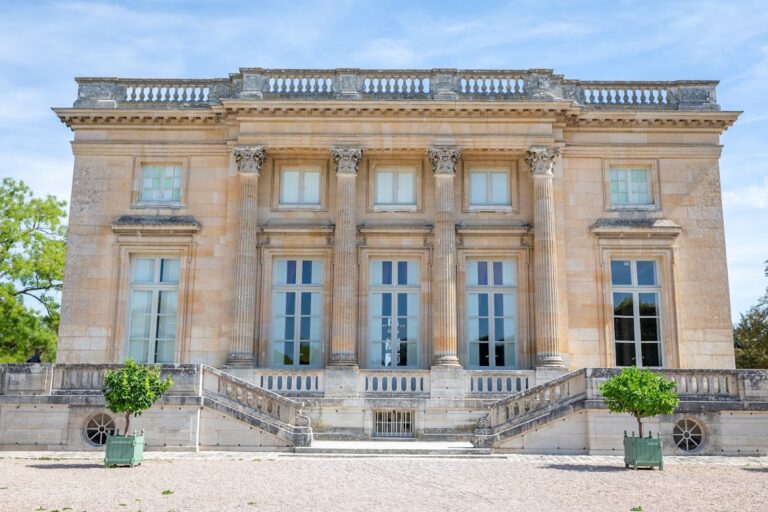
The surviving château is an eighteenth-century residence developed from the Grand’Maisons hôtel. Its construction began under François Henri de Francini and remained incomplete until Augustine Bertin de Veaux finished the east wing in the nineteenth century. The façades and roofs form part of the protected fabric of the building, together with the small salon and large blue salon.
Salons and library
The interiors held a literary and family collection assembled over approximately two centuries by the Bertin de Veaux family and their descendants. The library contained nearly 2,500 volumes gathered by Louis François Bertin de Veaux. Its subjects included classical literature, history, memoirs, and travel, and its bindings bore the signatures of Bozerian, Simier, Bauzonnet, and Thouvenin.
Paintings, sculpture, and furniture
Portraits and paintings
The collection included portraits by Anne-Louis Girodet-Trioson, Michel Martin Drolling, Étienne-Jean Delécluze, Henri Lehmann, Jean-Auguste-Dominique Ingres, and Jean-Louis Laneuville. It also contained paintings by Pierre-Henri de Valenciennes and Gabriel Revel. Among the identified works were Laneuville’s Louis-François Bertin, dated 1796 to 1797; Girodet’s Augustine Bertin de Veaux, née Bocquet, dated 1806; and Girodet’s Marie-Françoise-Claudine Merlin, née Tricard, with a Yellow Shawl, dated 1810.
Other works by Girodet included Louis François Bertin de Veaux, dated 1815, and Augustin Bertin de Vaux at the Age of Eighteen, dated March 1817. The two works depicting Louis-François Bertin were acquired by the Maison de Chateaubriand through its right of pre-emption at the public sale.
Sculpture and furniture
Sculpture was represented by works by Pietro Tenerani, including Psyche, which reached a world-record price when the collection was sold. Furniture included pieces by the cabinetmakers Bernard Molitor and Jacob-Desmalter, makers known for fine furniture. The library, paintings, sculpture, and furnishings together expressed the collecting history formed around the château by the Bertin de Veaux family and later generations.
The collection was dispersed in November 2016 rather than remaining together at Grand’Maisons. The château’s surviving architectural fabric and its former interiors therefore preserve different aspects of the estate’s history: the building records its long construction and alteration, while the dispersed collection records the literary, familial, and artistic life associated with the house.