Château de Montaupin: An Eighteenth-Century Estate in Oizé, France


Site at a Glance
- Rating
- 4.5
- Popularity
- Low
- Country
- France
- Primary era
- Early Modern
- External website
- Open
- Eras represented
- Medieval, Early Modern, Modern
- Civilizations
- French
- Site type
- Domestic
- Remains
- Castle
On this page11 sections
History
Château de Montaupin is an eighteenth-century château in France, south of Oizé in the historical province of Maine, now the Sarthe department, about 30 kilometers south of Le Mans. The present building occupies the site of a feudal castle dating from the eleventh and twelfth centuries, and its surviving fabric combines eighteenth- and nineteenth-century work. Montaupin developed as a seigneurial estate, meaning land held by a lord within the feudal system, and its history is closely connected with the superior jurisdictions of Oizé and Foulletourte.
Medieval lordship
Two seigneurial sites called Montaupin lay south of Oizé: Montaupin-Jacquette and Montaupin-la-Cour, the latter corresponding to the present estate. Jean and Girard de Montaupin appear around 1239 as vassals of the castellany of Oizé. A castellany was a territorial jurisdiction organized around a lord’s castle or administrative center. By about 1342, Montaupin was recognized as a seigneurial possession.
Montaupin-la-Cour belonged to the du Bouchet family from the fourteenth century and was held from the castellany of Foulletourte. The family was also associated with the nearby fortress of Bouchet-aux-Corneilles, which dated from the eleventh or twelfth century. During the Hundred Years’ War, a conflict between the English and French crowns, the fortress fell to English forces under Henry VI in 1425 before being retaken.
Simon du Bouchet, chamberlain to King Charles VII, became the first recorded lord of Montaupin in 1407. He seems to have inherited the castle or its lands before establishing himself there. His son Geoffroy du Bouschet made a donation to the church of Requeil in 1457. The seigneurial center probably shifted from Montaupin-Jacquette to Montaupin-la-Cour during the period when the family’s authority was being consolidated.
Transfers between noble families
In the late fifteenth century, Guyonne du Bouchet recovered properties alienated by her brother through a lawsuit at the Court of Le Mans. On 13 September 1486, she sold the estate to her brother-in-law Jacques de La Chevrière for 2,211 livres. The property then entered the d’Aubigné family through Perrine de La Chevrière, who brought Montaupin as her dowry when she married Jacques d’Aubigné on 4 August 1488.
Jacques d’Aubigné formally acknowledged the lord of Foulletourte from whom he held the estate. After his death in 1531, his sons bore the titles of lords of Aubigné and Montaupin. During the sixteenth century, ownership passed through the d’Aubigné and La Carrière Le Roy families. Françoise d’Aubigné became Lady of Montaupin through her marriage to Jean de La Carrière Le Roy in 1565. He acknowledged André de Beauvau, lord of Foulletourte, in 1574, and Pierre Le Roy later succeeded his father, formally acknowledging the estate on 11 June 1593.
The Le Roy family retained the seigneury through the seventeenth and eighteenth centuries. Louis René I Le Roy inherited the estate during the seventeenth century. René Jean Le Roy, lord of Montaupin and lieutenant in the Lyonnais Regiment in 1689, received the Beaumont estate and the Mocque-Souris mill on behalf of his wife while an inheritance was being settled.
The eighteenth century and the Revolution
Louis-Auguste Le Roy inherited Montaupin with René-Pierre. He married Marie-Madeleine Aubert de Boisguiet in 1731 and Marie-Thérèse de Moloré in 1752. His military career included command of artillery at La Rochelle, service as lieutenant commander of the artillery in the department of Valenciennes, and later the rank of brigade chief in the Strasbourg Regiment.
Louise-Armande Le Roy de Montaupin inherited the estate by succession. On 19 July 1791, she and her first husband, Pierre-Étienne de L’Hermitte, received two-thirds of the inheritance. This share included Montaupin and its domain, several farms and smallholdings, the Mocque-Souris and Boisard mills, and between 80 and 100 journals of fir plantations or coppiced woodland. Her sister Augustine-Louise-Madeleine Le Roy and her husband received the remaining third.
The French Revolution damaged the château: one part was burned and another destroyed. Pierre-Étienne de L’Hermitte, associated with Louise-Armande’s lordship, served as second-in-command in the artillery of the Army of the Coasts of Cherbourg under Wimpffen. He later became one of the principal Chouan leaders in Sarthe. The Chouannerie was a royalist civil war and insurgency in western France during and after the Revolution. L’Hermitte was killed at Saint-Denis-d’Orques in April 1795.
The damaged château was partly destroyed and later reconstructed during the nineteenth century, probably in the aftermath of the revolutionary conflicts. The rebuilding was carried out by the La Porte de la Thébaudière de Sainte-Gemme family. Louise-Agathe d’Orvaulx brought Montaupin as her dowry to Louis-François d’Arlanges on 28 February 1799. Their daughter Marie-Louise-Zoé d’Arlanges and her husband Charles-André-Auguste de la Voyrie inherited the property and sold it in 1827 to Ambroise de La Porte de la Thébaudière de Sainte-Gemme, mayor of Oizé.
Agricultural estate and changing ownership
Ambroise de La Porte de la Thébaudière de Sainte-Gemme lived at the château from 1830 until his death in 1866. He operated the property as a farm and cultivated crops that received awards. The estate then passed to his eldest son, Ambroise de La Thébaudière, who later sold it by public auction.
Ownership changed repeatedly during the nineteenth and twentieth centuries. M. Vrament acquired the estate in 1880 and sold it in 1888. The château and its outbuildings, covering 58 hectares, went to Pierre Cureau, while portions of the land went to Piedor, Dupuy, Sacré, and Le Bled. The subsequent sequence of ownership became unclear, although the property appeared again in records in 1900.
From 1915, Montaupin belonged to Athanase-Modeste Mary and Joséphine-Augusta Mary, née Maissin. In 1917, during the First World War, the château housed soldiers, including American reinforcements for the Allied forces. They remained there for more than eleven months before being sent to the front. Soldier booklets preserve details of the units, dates, and conditions of their stay.
The property later passed to the Mary daughters Geneviève Mary, wife of Bataille, and Louise Madeleine Mary, wife of Chesnais. It was sold to M. Ferré in 1957 and to the David family in 1959. Pierre and Germaine David owned it from 1959 to 1967, followed by Alain David and Nicole Dubois from 1984 to 2000, and Marie-Paule David from 2000 to 2021. The Fadel family acquired the château in 2021 and began a complete renovation. The estate is protected as built heritage under Article L.151-19 of the French Urban Planning Code.
Remains
Medieval fabric
Fifteenth-century turret and cellars
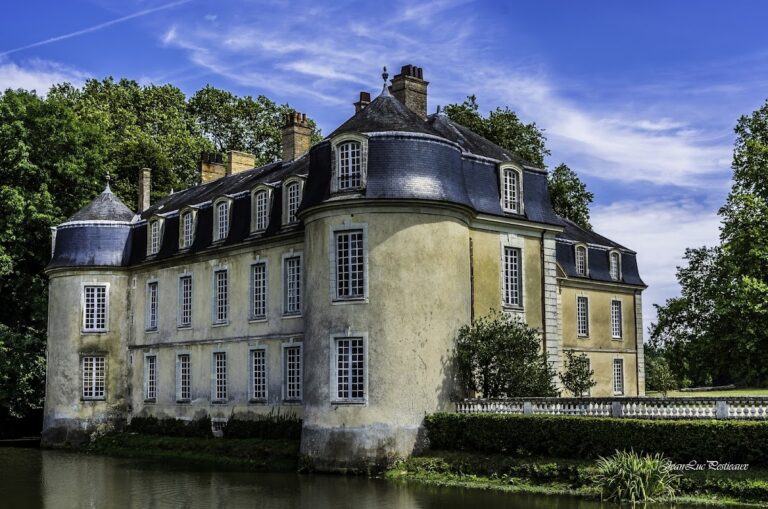
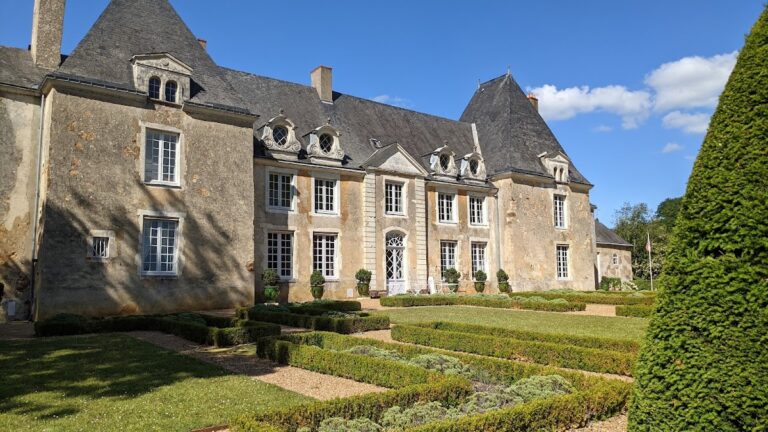
The present château stands on the site of the former feudal castle, while the surviving structure incorporates work from the eighteenth and nineteenth centuries. Its oldest surviving element is a fifteenth-century turret. A second matching turret was demolished at the beginning of the twentieth century, and the building has undergone further alterations. Two cellars also survive from the fifteenth-century phase and form part of the small group of earlier elements incorporated into the later château.
Sainte-Marie-Madeleine chapel crypt
The former Sainte-Marie-Madeleine chapel was built in 1407 and dedicated to Saint Mary Magdalene. Its crypt is a modest chamber cut directly into the rock. The chapel had fallen into ruin well before 1945 and was probably abandoned toward the end of the First World War, leaving the intact crypt as its surviving tangible remnant. During the Second World War, the chamber sheltered Chinda Laja Nadanowski, a Polish Jewish woman, and her daughters Berthe Ginette and Jacqueline for several months while they evaded Nazi persecution. Their survival depended on the solidarity of several inhabitants of Oizé.
Park and plantings
The château park covers more than one hectare and includes a pond, trees and fruit trees, flower gardens, vegetable areas, and berry bushes. Its recorded plantings include firs, cedars, chestnuts, Italian poplars, walnuts, apples, palms, cherries, pears, plums, roses, vines, tulips, hyacinths, daffodils, lilies of the valley, reeds, irises, mint, mulberries, raspberries, blackcurrants, and redcurrants.
A thuja in the park is traditionally said to be more than five centuries old, with a trunk nearly 10 meters in circumference. Its seeds are attributed by local tradition to the naturalist Pierre Belon, a sixteenth-century French scholar known for studying and introducing plants and writing about their medicinal properties. According to that tradition, he brought the seeds from the Orient.
Salon paintings
Paintings acquired by Pierre Cureau in 1881 represent nineteenth-century Japan, the Netherlands, Russia, Tuscany, and the Ottoman Empire. They hang in the wood-paneled salon and were restored in 2025, preserving a later decorative layer within the château’s changing interior history.