Corbières Castle: A Savoyard Stronghold and Fribourg Residence


Site at a Glance
- Rating
- 5
- Popularity
- Very Low
- Country
- Switzerland
- Primary era
- Early Modern
- Eras represented
- Medieval, Early Modern
- Civilizations
- Duchy of Savoy
- Site type
- Domestic
- Remains
- Castle
On this page9 sections
History
Corbières Castle is a historic castle in Switzerland, above the Sarine and the eastern shore of Lake Gruyère. Its origins lie in the medieval lordship of Corbières, whose first recorded nobleman was Williermus de Corbere and whose castle controlled an important crossing of the river. The settlement is first mentioned in 1115, although a lordship probably existed by about 1080.
The lordship of Corbières
The lordship originally extended mainly east of the Sarine, between La Roche, the Jaun Pass, and the County of Gruyère. It also held rights west of the river and possessions in the Vaud region. Lietold and Wilhelm II of Corbières founded Humilimont Abbey, while members of the ruling family gave property to several monasteries in the surrounding area.
Corbières was reduced in territory when the lordship of Vuippens was created in 1224. Related branches of the family later established seats at Charmey and Jaun, although these territories formally remained part of Corbières for military and sovereign purposes. Around 1250, Corbières submitted to the House of Savoy, a major ruling dynasty whose lands included areas around western Switzerland, northern Italy, and southeastern France, and became a Savoyard fief.
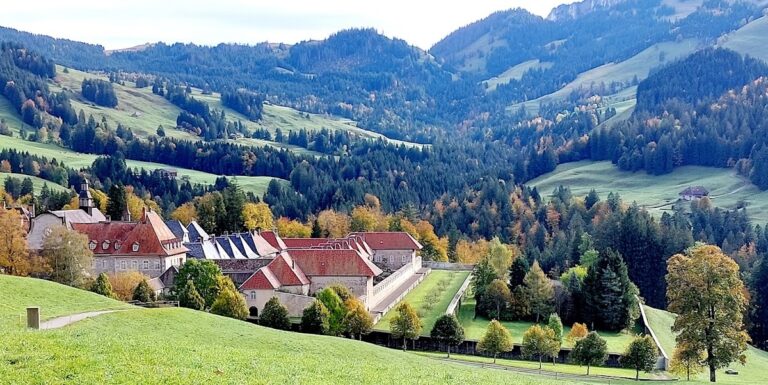
Girard I and Girard II of Corbières-Charmey founded La Valsainte Charterhouse in 1295. A charterhouse was a monastery of the Carthusian order, whose religious life combined communal worship with periods of solitude. The main and Charmey branches of the family died out during the 1360s, leaving the Jaun branch as the principal line. It continued into the sixteenth century.
Savoyard and Fribourg administration
Corbières’ traditional rights were recorded in 1301 and formalized in a charter of liberties issued by Amadeus VII of Savoy in 1390. The territory became a Savoyard castellany in 1375. This was an administrative district governed for the House of Savoy, and the status lasted until 1543, when Corbières became a Fribourg bailiwick.
Control of the lordship shifted in several stages. Louis II of Savoy, lord of Vaud, acquired the portion associated with the old castle in 1326, while the lords of Grandmont obtained another part, associated with the newer castle, in 1330. The Savoyards gained the whole lordship in 1375, after transferring their share to Boniface of Châtillon in 1341. Corbières was pledged to Johannes vom Thurm from 1379 to 1390, held as an apanage by Humbert, half-brother of Amadeus VIII of Savoy, from 1406 to 1443, and acquired by Francis I of Gruyère in 1454. Fribourg, which had held it as a pledge since 1543, acquired it permanently in 1554.
Separate settlements grew around the old and newer castles. The newer castle and its town contained about thirty houses in 1408. The decline of both associated towns has been tentatively linked to plague and a major town fire. In 1554, the castle became the residence of Fribourg’s bailiffs. A bailiff administered a lordship for a higher authority and could exercise administrative, judicial, and fiscal duties. Bartholome Renault, the first Fribourg bailiff of Corbières, received permission to restore the building in 1560.
Bailiffs, followed by government lieutenants and prefects, occupied the castle until 1848. Corbières remained a Fribourg bailiwick until 1798, then served successively as a subprefecture, an administrative district, and, from 1815, a prefecture. In 1848 it was incorporated into the Gruyère District.
From private residence to artists’ centre
The older castle was gradually removed by quarrying, although parts of its keep were still visible in 1886. The newer castle was sold by the State of Fribourg to Elisabeth Bourknecht in 1850 and passed through several private owners. Athénaïs Clément later established a House for Moral Rehabilitation there. Franciscan sisters first ran the institution, followed by the Sisters of the Congregation of Our Lady of Charity of the Good Shepherd.
In 1927, a Fribourg notable gave the castle to Benedictine monks, members of the Order of Saint Benedict. They converted it into a convent and occupied it from 1928 until the mid- to late 1950s, when they moved to Le Bouveret. After the building stood empty for about two years, the sculptor brothers Emile and Louis Angéloz acquired it in the late 1950s. They repaired the deteriorated castle themselves and used it as a home and meeting place for artists, including the painters Émile Aebischer, known as Yoki, and Bernard Schorderet, the photographer Jean-Claude Fontana, and the architect Jean Pythoud.
In 1963, the Angéloz group established the AEL exhibition gallery, named from the brothers’ names and artistic work. The enterprise made Corbières a regional artistic centre for roughly a decade. The earlier AEL community also included the photographer René Bersier. The brothers later sold the castle to a wealthy English or Irish owner. Corbières Castle is listed as an A-object in the Swiss Inventory of Cultural Property of National and Regional Significance, a classification indicating national importance.
Remains
Corbières Castle stands west of the village on heights above the Sarine, at the eastern shore of Lake Gruyère. The lake was formed between 1945 and 1948 when the Sarine was dammed. Before then, the river’s deeply cut meanders contributed a natural defensive feature to the castle’s position. A Roman road descended along the eastern bank to a ford, which was later replaced or supplemented by a bridge first mentioned in 1343. Three wooden bridges stood there in 1837.
The two castle sites
The old castle
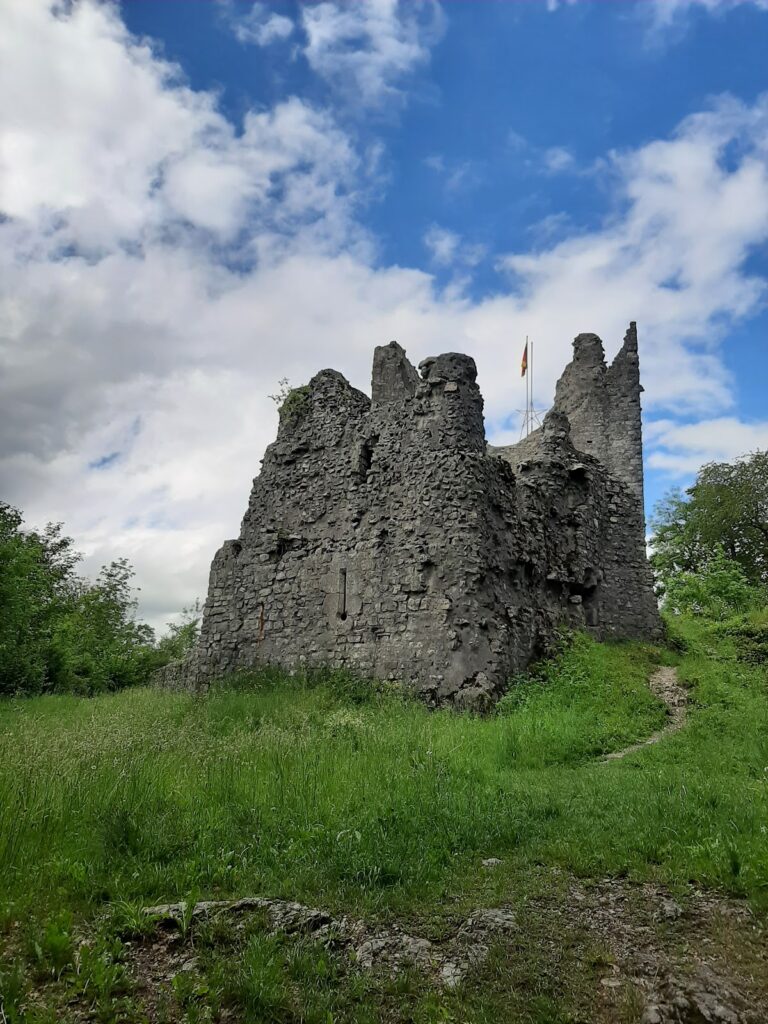
The first castle occupied the hill of La Montagnettaz, about 200 metres northeast of the village church. Its square keep, the principal fortified tower of a castle, was probably the only building on the hill. Quarrying later destroyed the castle remains and parts of its associated town, while other town remains were flooded in 1947. Fragments of the keep could still be seen in 1886, and quarrying ultimately removed the remaining visible structure in 1965.
The newer castle
A second castle was built west of the church, probably after 1225 and during the second half of the thirteenth century. In 1408 it was called Château de Grandmont, reflecting the power of its then rulers. This is the castle that survives today. The building was entirely reconstructed in 1560 after being described as severely dilapidated in 1556. A chronicle entry from 1547 to 1548 calls a castle at Corbières broken, although that reference may concern either the newer building or the older castle.
The Renaissance castle
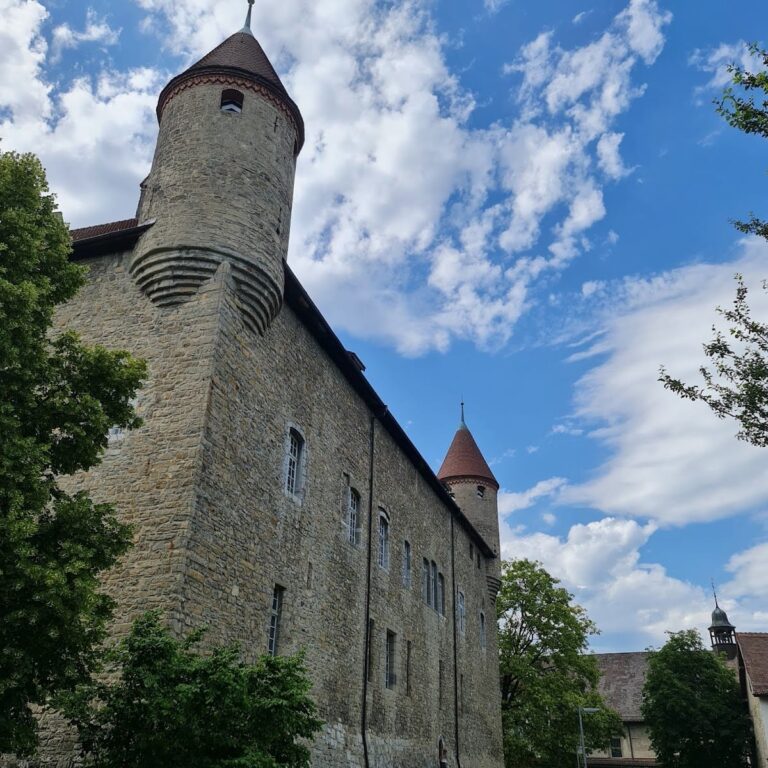
The surviving building is a rectangular Renaissance structure. Renaissance architecture revived classical forms through regular proportions and formal façades. The castle has a broad hipped Bernese roof, cross-frame windows divided by intersecting vertical and horizontal members, round-arched entrances, dormer windows, and chimneys. Its walls enclose several courtyards and gardens, some retaining medieval origins.
Several coats of arms connected with Fribourg and its bailiffs appear on the façade. A tower-like annex projects from the southeast corner, and wooden galleries run along the west side. The building was restored again in 1750 and contains 45 rooms. Its later physical history also includes the repairs and occupation carried out by the Angéloz brothers and the artists associated with their exhibition gallery.
Nearby sites