Ziegenhain Fortress: A Water Fortress and Hessian Stronghold in Germany
Site at a Glance
- Rating
- 5
- Popularity
- Very Low
- Country
- Germany
- Primary era
- Early Modern
- Eras represented
- Medieval, Early Modern, Modern
- Civilizations
- Holy Roman Empire
- Site type
- Military
- Remains
- Fort
On this page16 sections
History
Ziegenhain Fortress is a historic fortress in Schwalmstadt, Germany, whose medieval castle was rebuilt as a strategic water fortress between 1537 and 1546. Its development reflects the changing political, religious, and military history of Hesse, from the residence of the counts of Ziegenhain to a landgravial stronghold and, later, a prison complex.
Medieval castle and the counts of Ziegenhain
A bergfried, the principal defensive tower of a medieval German castle, stood on the site around 950. In 1144, Count Gottfried of Reichenbach-Wegebach built a new castle between the older tower and an existing circular castle. He made the castle his residence and adopted the title Count of Ziegenhain, a naming tradition continued by his descendants.
In 1363, Werner II of Falkenberg constructed the Stone House as his castle residence. After the Ziegenhain line ended with the death of Johann II, the county passed to Landgrave Ludwig I of Hesse in 1450. A landgrave was a territorial prince. Under Hessian rule, the castle was converted into a landgravial hunting lodge in 1470.
The sixteenth-century fortress
Landgrave Philipp the Magnanimous, the sixteenth-century ruler of Hesse and a leading Protestant prince during the Reformation, ordered the medieval castle and town to be rebuilt as a strategic water fortress. The work took place from 1537 to 1546 according to plans by the fortification engineer Hans Jakob von Ettlingen and the master builder Balthasar von Germersheim. Heinz von Lüder became the first commandant in 1537. A fortress commandant was responsible for the military administration and defense of the stronghold.
The new defenses were also associated with important religious reforms. In 1539, the Ziegenhain Church Discipline Ordinance was adopted at the castle after Philipp invited Hessian theologians and the Reformers Adam Krafft and Martin Bucer. Influenced by Philipp Melanchthon, the ordinance gave church elders shared responsibility, required instruction and confirmation for young people entering the Christian community, and rejected persecution of religious dissenters. It also extended hospitality and civic services to Jewish and non-confessional residents. The provisions became a foundation for the Evangelical Lutheran Church in Hesse and soon spread to places including Waldeck, Wittgenstein, Frankfurt, and Göttingen.
Philipp issued a castle peace ordinance for the fortress in 1542. In a revised testament dated 6 October 1545, he ordered Heinz von Lüder to remain at Ziegenhain as commandant. A heavy cannon called Der Mutz, identified as a Scharfmetze, a type of heavy early-modern gun, was recorded at the fortress that year.
War and survival
During the Schmalkaldic War of 1546–1547, a conflict between Emperor Charles V and an alliance of Protestant princes and cities, Heinz von Lüder commanded Ziegenhain. Charles V, the Holy Roman Emperor and a leading opponent of the Protestant princes, ordered the demolition of three other landgravial fortresses at Kassel, Gießen, and Rüsselsheim. Ziegenhain was the only one of the four that he directed to be spared.
A later tradition says that Lüder refused to surrender the fortress to Count Reinhard of Solms, declaring that he would return it only to a free landgrave. The story continues that Charles V demanded his execution, while Philipp, after his release from imprisonment, rewarded Lüder by having him symbolically hanged from a gold chain at the Lüder Gate and presenting him with the chain. August Kopisch later treated the episode in his poem Landgrave Philipp the Magnanimous, which Carl Loewe set to music in 1856.
Four ravelins, detached outer defenses placed before a fortress wall or gate, were added between 1622 and 1623. The suburb of Weichaus was also enclosed by a wall. During the Thirty Years’ War, the major European conflict of 1618–1648, Ziegenhain resisted every siege and was never captured. This record produced the saying “As strong as Ziegenhain.”
In the first week of October 1631, Bavarian and Tilly’s troops entered Weichaus, plundered the suburb, and partly burned it. Swedish Chancellor Axel Oxenstierna visited the fortress in 1633. On 15 November 1640, Imperial General Johann Rudolf von Breda was shot by Velten, or Valentin, Muhly, captain of Ziegenhain’s citizens’ marksmen, during the engagement at Riebelsdorf Hill near Riebelsdorf. The general’s name also appears as Johann Ludolf von Bredaw and von Bredau, and his rank is variously given as lieutenant field marshal or major general.
Later military and penal uses
The Schafhof was built in 1669 as a military supply base and depot. During the Seven Years’ War, fought from 1756 to 1763, the obsolete fortress was surrendered without combat to French troops in 1758, avoiding major destruction. Hessian artillery shelled it in 1761, however, heavily damaging 47 houses in the town and the cloth manufactory.
The parade ground and New Guard were built in 1769. From 1776 to 1783, the parade ground served as an assembly point and the fortress as a recruiting depot for Hessian subsidy troops, soldiers supplied by Hesse to a foreign power in return for payment. On the orders of Landgrave Frederick II, 12,000 Hessians were transferred to Britain for service in the American War of Independence. Johann Gottfried Seume later described this system in his 1802 work A Walk to Syracuse. He had been forced into military service by Hessian recruiters, recruited at Ziegenhain, and shipped to America; his recollections appeared posthumously in his 1813 biography My Life.
A new fortress entrance with a bridge was built between 1776 and 1783. In November 1806, Elector William I of Hesse ordered the fortress to be surrendered without combat to Napoleon’s army. Napoleon ordered its demolition in 1807 because modern artillery had made it militarily obsolete. The casemates were blown up and the gates demolished.
A new south gate was built in 1819 at the urging of local residents. Elector William II dissolved the garrison of the Hesse-Kassel army in 1832, and the last fortress commandant, Colonel von Harras, died at Ziegenhain in 1836. A forced-labor prison for 400 inmates was established in the palace in 1842. The Hessian State Archives moved from Ziegenhain to Marburg in 1857, and a women’s prison was established at the site in 1882.
In 1905, the German Reichstag withdrew the military command stationed at Ziegenhain to guard the royal county of Ziegenhain. The fortress then became a major component of Schwalmstadt-Ziegenhain Prison, now the Schwalmstadt correctional facility. Mohammed Ali Hamadi, a member of Hezbollah, was imprisoned there in 1989. After open custody was separated in 2003, the facility retained only closed custody, meaning secure confinement. Ziegenhain Fortress is a protected monument, and during the Thirty Years’ War it was the fourth-largest fortification in Hesse after the installations at Kassel, Gießen, and Rüsselsheim.
Remains
Ziegenhain developed as a connected defensive complex in which the older tower, circular castle, medieval castle, later palace, and town were enclosed within a water-fortress system. The sixteenth-century defenses used a high earthwork rampart, rounded artillery platforms, outer defenses, protected chambers, and controlled entrances. Parts of the former fortress now form a substantial section of the Schwalmstadt correctional facility.
Ramparts and defensive works
Earthworks and water defenses
The fortress was surrounded by an earthwork rampart approximately six metres high. Raised rondels, rounded artillery platforms incorporated into the fortifications, occupied its four corners. Outside the rampart, a gently sloping glacis extended for about 65 metres. This open ground exposed attackers to defensive fire while shielding the lower fortifications, and water from the Schwalm could be used to flood the surrounding terrain.
Entrances and outer defenses
The original fortress had one entrance reached by a wooden drawbridge. A newer entrance and bridge were constructed between 1776 and 1783, followed by the south gate in 1819. Four ravelins were added to the defensive system in 1622 and 1623. The suburb of Weichaus was enclosed by its own wall, extending the fortified area beyond the central castle and town.
Protected chambers and military installations
The ramparts contained casemates, vaulted or protected chambers used for artillery, storage, or shelter, together with an arsenal, two granaries, a brewery, an archive, barracks, and a horse-powered mill. The casemates were later blown up during the 1807 dismantling, and the gates were demolished. The Schafhof, built in 1669, survives as part of the site’s military logistical history as a depot and supply installation.
Castle and palace buildings
Stone House
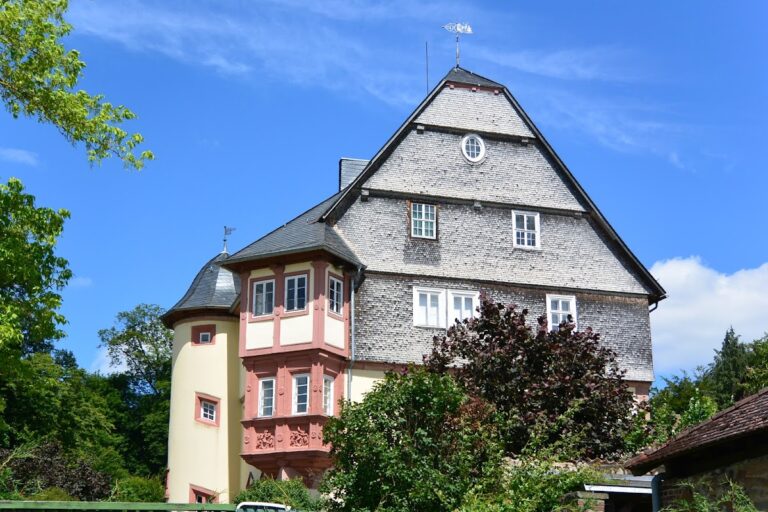
The Stone House was built in 1363 by Werner II of Falkenberg as his castle residence. It represents the medieval residential phase that preceded the later fortress reconstruction. Since 1938, the building has housed the Museum of the Schwalm.
Palace sculpture
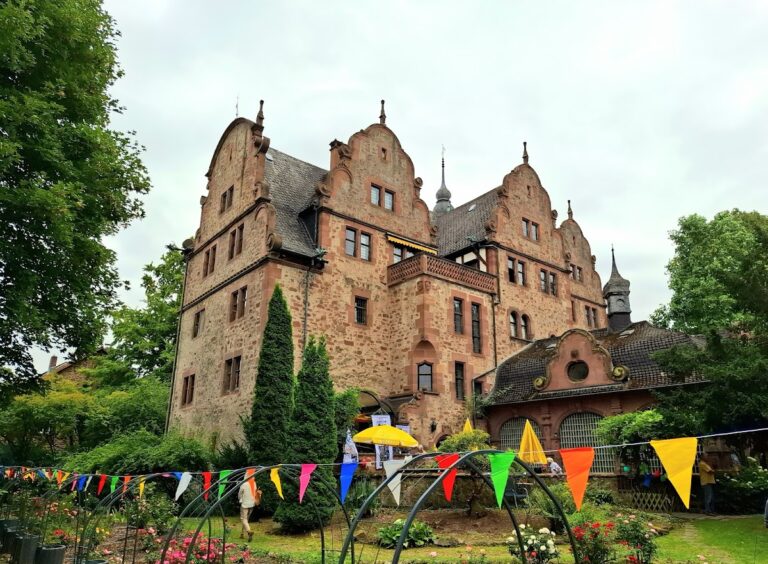
Philipp Soldan created a Renaissance stone relief for the south side of the palace in the sixteenth century. Further sculptural decoration inside the palace is attributed to him. The palace later became the setting for the forced-labor prison established in 1842 and the women’s prison founded there in 1882.
Parade ground and Lüder Gate
Parade ground and New Guard
The parade ground and New Guard date from 1769. Between 1776 and 1783, the parade ground functioned as the assembly area for Hessian subsidy troops before their transfer to British service in the American War of Independence.
Lüder Gate
The Lüder Gate is connected with the later tradition of Heinz von Lüder’s symbolic hanging from a gold chain after his alleged refusal to surrender the fortress. The gate therefore preserves a physical setting associated with one of Ziegenhain’s best-known historical legends.
Nearby sites