Alt Aspermont Castle: A Medieval Hill Castle in Switzerland


Site at a Glance
- Rating
- 5
- Popularity
- Very Low
- Country
- Switzerland
- Primary era
- Medieval
- Eras represented
- Medieval
- Civilizations
- Holy Roman Empire
- Site type
- Military
- Remains
- Castle
On this page7 sections
History
Alt Aspermont Castle is a medieval hill castle in Switzerland, above Trimmis in the Chur Rhine Valley. It was probably established as the home castle of the Aspermont family, although its construction date remains uncertain. The site later became a possession of the Bishop of Chur and was drawn into several regional conflicts.
The Aspermont Family and the Bishopric
The Aspermont family first appears in records from the mid-twelfth century. In 1170, Swiker, Ulrich, Heinrich, and Heinrich’s son Ulrich witnessed a legal document. Later members of the family served as ministeriales, legally unfree nobles who acted as administrators, military retainers, or castle holders, and as vice-domini, representatives of the Bishop of Chur.
The Aspermonts maintained ties with the Lords of Tarasp and the Hohenstaufen, a medieval dynasty whose members held the German kingship and the Holy Roman imperial title. By the middle of the thirteenth century, marriage alliances and rivalry between the bishop and local nobles had helped the family acquire rights in Jenins, Maienfeld, and the Prättigau. The family then moved to Neu-Aspermont Castle in Jenins and Fracstein Castle in the Prättigau, selling Alt Aspermont to the Bishop of Chur.
Bishop Heinrich von Montfort, who held office from 1251 to 1272, purchased the castle for the bishopric. In 1275 he granted it as a fief, a property or right held in return for service or allegiance, to the Lords of Vaz. They retained it until Walter IV von Vaz died in 1284, while Johann von Vaz later abandoned his claims during an arbitration in 1299. Around 1288, Wilhelm of Montfort, Abbot of St. Gall, took refuge at Alt Aspermont while fleeing an anti-abbot supported by Rudolf I of Germany, the German king of the late thirteenth century.
Pledges, Sieges, and Episcopal Administration
In 1328, Bishop Johann pledged the castle to Ulrich von Aspermont. After Ulrich’s death in 1338, the pledge passed to the brothers Ludwig and Walter von Stadion. In 1354, the bishop pledged it to Heinrich and Martin Buwix, and further changes of ownership followed.
The bishop’s forces besieged Alt Aspermont during an uprising in 1395 and 1396. In 1452, the League of God’s House, a political alliance centered on Chur and neighboring ecclesiastical territories, besieged it for about a year during the Schamser Feud, a fifteenth-century conflict in Graubünden. An arbitration by the Confederates guaranteed the bishop’s garrison free withdrawal.
In 1496, the Bishop of Chur sold Alt Aspermont to the Zurich knight Hartmann Rordorff. Episcopal bailiffs continued to administer the castle until the early sixteenth century, and it temporarily served as a prison. The last recorded bailiff was Jorg Rink von Baldenstein, who administered Trimmis and Zizers.
Abandonment and Later Destruction
The Ilanz Articles, accepted in 1526 amid political developments that had begun in 1524, curtailed the bishop’s secular authority. The change ended the need for a bailiff at Alt Aspermont. The castle was abandoned and began to decay, although it remained in good condition at least until 1548.
During the Prättigau uprising and the second Austrian invasion of 1622, part of the Bündner Wirren, or Grisons Troubles, a period of conflict in Graubünden involving local factions and foreign intervention, Austrian forces occupied the castle. A battle took place between Zizers and Trimmis, and the area northwest of the ruin was then called Molinära or Molinera. Alt Aspermont was abandoned again shortly afterward. Its main tower collapsed into the valley on 11 April 1878.
Remains
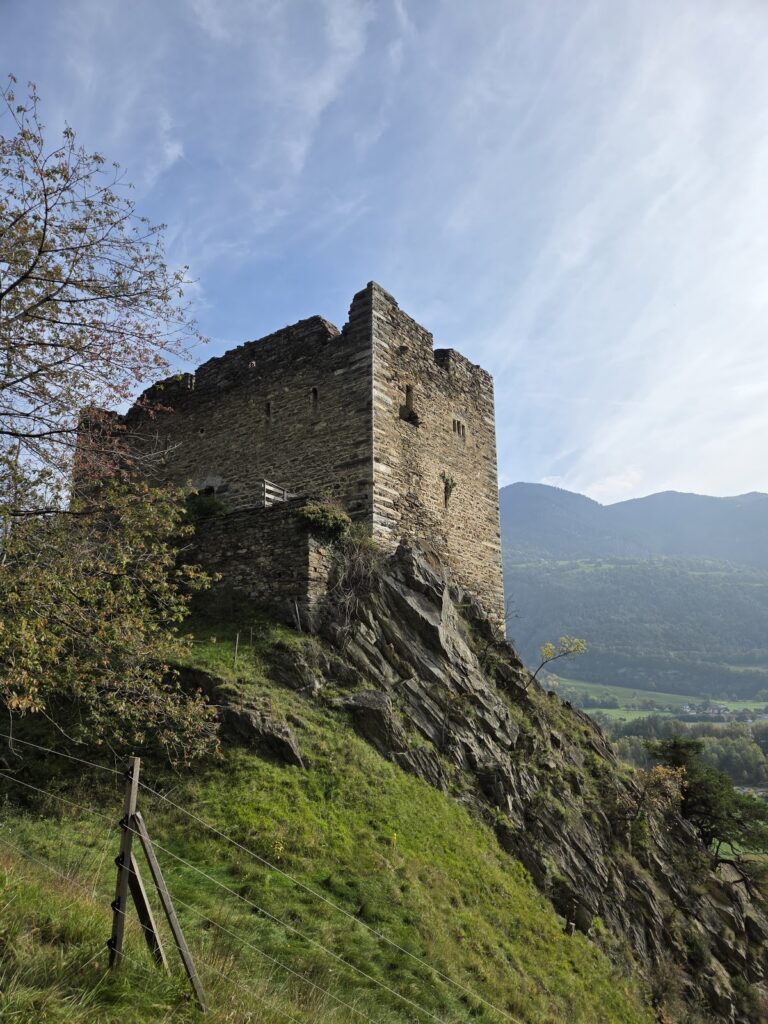
Alt Aspermont stands on a rocky spur at 768 metres above sea level, high above Trimmis. The hill castle lies south of Molinära, the former episcopal farm estate, while a natural saddle-shaped ridge protects its landward side. Once described as one of the largest castles in Graubünden, it is now represented by only a few small remains.
Tower and Upper Rock
The principal surviving feature is the foundation of a rectangular tower on the highest point of the rock. A joint in the masonry shows that the remnant of the northwestern wall is older than the southwestern one. A photograph from 1875 depicts the tower with three standing walls rising approximately five storeys. The tower collapsed on 11 April 1878, and the southern part of the castle slid down the slope.
Lower Terrace
A cistern occupied a lower terrace southwest of the tower. Erwin Poeschel still observed it in 1930, but it can no longer be identified.
Nearby sites