Castle of Ferrellón: A Medieval Frontier Fortress in Spain


Site at a Glance
- Rating
- 5
- Popularity
- Very Low
- Country
- Spain
- Primary era
- Medieval
- Eras represented
- Medieval
- Civilizations
- Crown of Aragon
- Site type
- Military
- Remains
- Castle
On this page7 sections
History
The Castle of Ferrellón is a medieval fortress in Spain, near Añón de Moncayo in Zaragoza Province. Built during the twelfth century, it served as a first-line defensive post on the frontier between the kingdoms of Aragon and Castile. Pottery fragments from the tenth or eleventh centuries suggest a possible earlier Andalusi presence, although that possibility has not been investigated.
Frontier possession and royal authority
Ferrellón appears frequently in records between 1200 and 1367, generally in connection with institutions or fortifications of greater political importance. Peter II of Aragon donated it to Veruela Monastery, a major Cistercian foundation and medieval landholder in Aragon. James I later pledged Ferrellón, together with the fortresses of Ferrera, La Fasina, Peñarredonda, and Çalatamor, to Sancho VII. When the debt could not be repaid, the pledge became a grant for life. The castle returned from Castilian control in 1281 under the Treaty of Campillo.
In the early fourteenth century, Gonzalo Gil de Vera became Ferrellón’s tenente, a medieval official responsible for a fortress’s custody and administration in return for a financial allocation. James II granted him the office, which was renewed in February 1326 with a life annuity charged to the saltworks of El Castellar. Alfonso IV confirmed the arrangement until 1331, when the castle passed to Gil de Rada, who received 600 jaquesan sous, a monetary unit used in the medieval Crown of Aragon. The payment reflects the castle’s role at a frontier passage in the Moncayo region.
Criminal activity in the thirteenth century
During the 1260s, Ferrellón was associated with criminal activity. In 1267, an informer helped expose a counterfeit-coin network involving Pedro Pérez, lord of Trasmoz; Blasco Pérez, sacristan of Tarazona; Elfa Jordán and her sons; Pedro Jordán, formerly lord of the castle of Olalla; and Pedro Ramírez, who took charge after Pedro Jordán’s death. The wider operation minted coins at Tórtoles and Trasmoz. Santa Olalla was its principal mint under Pedro Ramírez, while the person responsible at Tarazona remained unknown.
The main leaders were executed. Pedro Ramírez and the sons of Pedro Jordán escaped into exile, while Elfa Jordán was thrown into the Ebro in a sack. Because Blasco Pérez was a member of the clergy, he came under the authority of Fortuño, bishop of Tarazona, who imprisoned him until his death. Another illicit practice connected with the castle was the slaughter of stolen animals, chiefly sheep and calves, whose meat was sold in the market at Tarazona. After Ferrellón was destroyed, a similar operation took place at Ferrera. In 1474, a band of robbers was expelled from Ferrera after attacking travelers on the Borja-Tarazona road.
The War of the Two Peters and destruction
The War of the Two Peters was the fourteenth-century conflict between the crowns of Aragon and Castile. During the war, northern Zaragoza Province was relatively exposed while Aragon concentrated its defenses on the Jalón Valley. Castilian forces captured Tarazona in 1357, but an Aragonese victory at Araviana in 1359 and the diplomatic recovery of Tarazona in 1360 restored the territory.
On 26 June 1361, Peter IV of Aragon appointed the squire Pedro Jiménez de Astorga as Ferrellón’s tenente and granted him 1,000 jaquesan sous from the saltworks of Remolinos and El Castellar. Sancho Bardají, a resident of Añón, was ordered to surrender the fortress without delay. The first payment followed a few weeks later, and on 8 December the king ordered a thorough inspection of the castle’s condition.
By 5 February 1363, Ferrellón was held by Pedro de Sos. Peter IV instructed Pedro Jiménez de Samper, responsible for the defenses of Borja and Los Fayos, to ensure that the castle received adequate supplies after its tenente made such a claim. In 1362, the fortress had been assigned an income of 2,300 jaquesan sous. Castilian forces captured and destroyed it during the middle months of 1363. Ferrera then became the principal fortification and received Ferrellón’s original financial allocation. The castle is protected as an Asset of Cultural Interest under Spain’s general castle designation of 22 April 1949 and Historical Heritage Protection Law 16/1985.
Remains
The mountain setting
The remains occupy Del Camino, the second-easternmost and highest of the Peñas de Herrera, at 1,463 metres above sea level. The surrounding rocky escarpments rise to approximately 1,500 metres, with relatively flat and regular summits. Del Camino has completely vertical sides, giving the fortress an elevated position and an exceptionally wide field of view. It has been considered possibly one of the fortifications with the broadest vistas in the area and perhaps in the Kingdom of Aragon.
Access and summit features
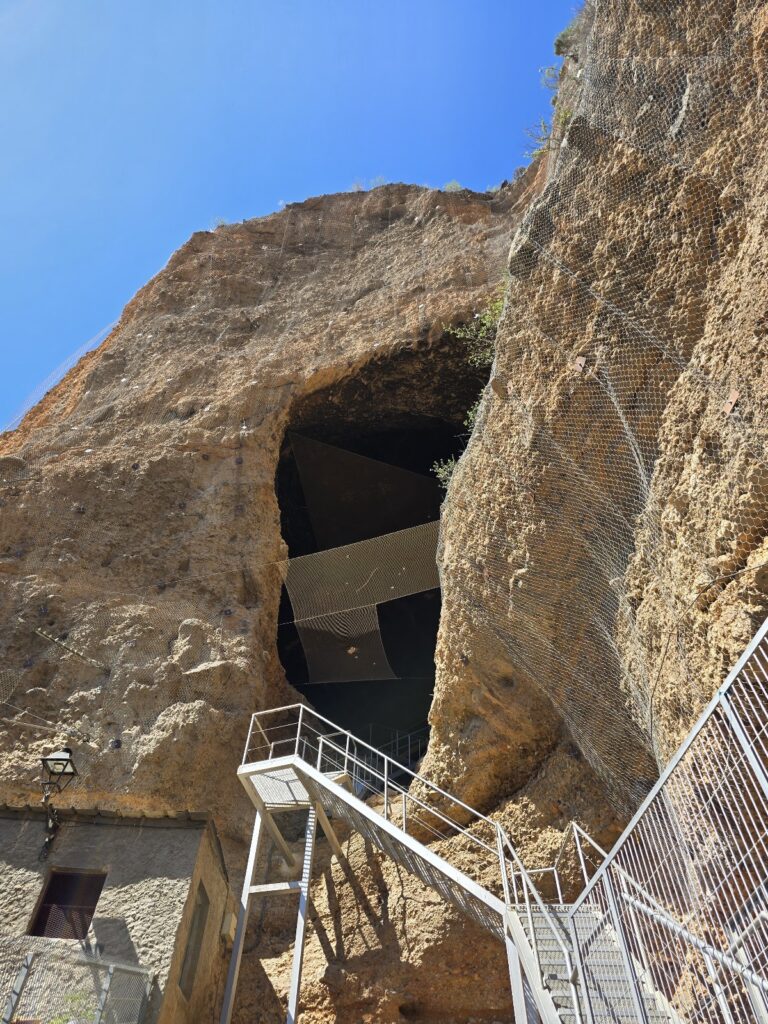
The summit can be reached only through a narrow chimney, and the approach is difficult without climbing experience. At the chimney’s base, an artificial cave has an entrance with a right-angled rock cut, probably made to hold doorjambs. Holes beside it almost certainly supported a small bridge or staircase leading to the summit. That original access has been lost, so reaching the top now requires climbing.
The summit contains another possible cistern and holes cut into the rock that probably represent adaptations for chambers or rooms. Archaeological work also identified remains on another Peñas de Herrera, but those belong to the associated Castle of Ferrera rather than to Ferrellón.
Nearby sites