Castello di Scerpena: A Medieval Castle in Tuscany


Site at a Glance
- Rating
- 5
- Popularity
- Very Low
- Country
- Italy
- Primary era
- Medieval
- Eras represented
- Medieval
- Civilizations
- Holy Roman Empire
- Site type
- Domestic
- Remains
- Castle
On this page6 sections
History
Castello di Scerpena is a medieval castle in Italy, near Manciano, whose construction began after AD 1000 during the eleventh century. It formed part of the fortified landscape of southern Tuscany and held a strategic military position that later made it a contested possession.
Medieval Foundations and Aldobrandeschi Rule
During the twelfth century, the Aldobrandeschi, a powerful medieval family that controlled extensive territories in southern Tuscany and nearby regions, established their rule in the area. They consolidated a network of substantial defensive structures, among them Castello di Scerpena.
By at least the thirteenth century, the castle belonged to the Abbey of the Three Fountains in Rome, a historic monastic complex associated with the Cistercian order. It later became an Aldobrandeschi possession, linking the fortress to the family’s wider territorial power.
Sienese Control and Later Transformation
Shortly before the mid-fourteenth century, Castello di Scerpena came under the control of the Republic of Siena, the independent medieval and early-modern state centered on Siena. Siena subsequently entrusted the castle to the Baschi family, one of the prominent noble families that held castles and territories in central Italy.
Its strategic position kept the castle under prolonged dispute between the Baschi and the Orsini family of Pitigliano. Castello di Scerpena remained under Sienese control until the mid-sixteenth century, when it entered the Grand Duchy of Tuscany, the ruling state that absorbed Sienese territories during that century.
The complex has undergone several renovations. Restored original rooms and furnishings are now combined with modern objects and furnishings, reflecting the building’s continued transformation after its medieval military history.
Remains
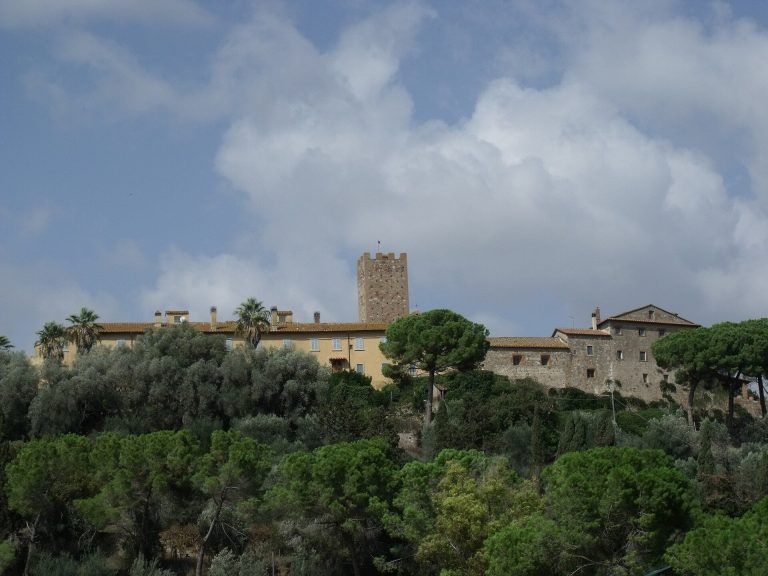
Castello di Scerpena stands in a hilly setting between the Albegna and Fiora hills, at the foot of Monte Amiata, just west of the Campigliola farm. Dense vegetation surrounds the complex, including chestnut woods and cork-oak groves. The surviving buildings use stone masonry, preserving the material character of the medieval fortified complex.
Castle and Garden Front
The main facade faces a garden. From the garden, a short staircase leads to the entrance portal, creating the principal approach to the castle. Inside, renovated rooms retain original furnishings alongside modern objects and furnishings.
Park and Estate Buildings
The property includes a park with a swimming pool, land containing more than 7,000 olive trees, two villas, and a small cottage. These elements form part of the present complex surrounding the castle.