Jajce Citadel: Medieval Fortress of Bosnia and Herzegovina


Site at a Glance
- Rating
- 4.5
- Popularity
- Medium
- Country
- Bosnia and Herzegovina
- Primary era
- Medieval
- External website
- Open
- Eras represented
- Medieval, Early Modern
- Civilizations
- Kingdom of Bosnia, Ottoman
- Site type
- Military
- Remains
- Citadel
On this page12 sections
History
Jajce Citadel is a medieval fortress in Bosnia and Herzegovina, rising above the old walled city of Jajce. It began developing on Hum hill at the end of the thirteenth or beginning of the fourteenth century, probably over an older fortification, and is broadly dated to the fourteenth century. Built for the Bosnian grand duke Hrvoje Vukčić, it became the focal point of a fortified town and served both residential and defensive purposes.
Foundation and medieval development
Hrvoje Vukčić, a powerful medieval Bosnian grand duke and regional nobleman, controlled the citadel from May 1404 until at least 1 November 1423. The settlement grew along the eastern slopes of Hum hill, while the citadel and its ramparts were repeatedly repaired, rebuilt, and enlarged. Over time, the fortified system expanded to include the settlement below.
Jajce developed as a walled medieval town and later came under the authority of Stjepan Tomašević, the last king of medieval Bosnia, as well as the Banate of Bosnia and the Kingdom of Bosnia. The fortress was subsequently involved in an Ottoman siege and passed into the Ottoman Empire, which incorporated Bosnia into its imperial domain. The town acquired its final walled form during the Ottoman period.
Heritage and historical setting
Jajce Citadel forms part of the Walled City of Jajce, also known as the Jajce historic site. The architectural ensemble was designated a National Monument of Bosnia and Herzegovina on 27 January 2003. The wider natural and architectural ensemble of Jajce, including the old city core, the waterfall, and associated sites, is on Bosnia and Herzegovina’s Tentative List for possible future consideration for the UNESCO World Heritage List.
Remains
Citadel and defensive layout
The citadel occupies the summit of Hum hill at approximately 470 metres above sea level and overlooks the old walled city at the confluence of the Pliva and Vrbas rivers. Built mainly of limestone, with sections of regularly shaped ashlar blocks, the fortress is in a repaired condition. Its expanded fortification system has ramparts with a combined perimeter of about 1,300 metres and encloses roughly 11,200 square metres.
A path follows the full length of the walls, linking the Great Southern Bastion and the Great Northern Bastion at diagonally opposite corners of the fortress. The citadel also contains two large bastions and an interior gunpowder tower. Bastions are projecting fortifications designed to strengthen defensive fire and cover adjoining walls.
Portal and town gates
Main portal
The main portal stands near the western corner of the citadel. Its decoration includes the coat of arms of the Kotromanić dynasty, the ruling house of medieval Bosnia, linking the entrance with the Bosnian royal family.
Northern and southern gatehouses
The wider walled perimeter encloses the town from two sides and includes the northern Banja Luka gatehouse and the southern Travnik gatehouse. A gatehouse is a fortified structure that controls entry through a wall.
Ramparts and towers
Northern perimeter
Along the northern side, the ramparts run from the fortress’s northeast corner near the Clock Tower to the Mračna kapija gate, then continue to the Velika tabija gatehouse and bastion, the Džikovac tower, and the Papaz tower before reaching the Banja Luka gatehouse. From there, the wall extends toward the Vrbas River and ends at the Šamić tabije.
Western perimeter
The western line begins at the citadel’s western corner near the main portal and descends southeastward to the Medvjed tower. It then continues south toward the Pliva River, turns east, and ends at the Travnik gatehouse.
Wider architectural ensemble
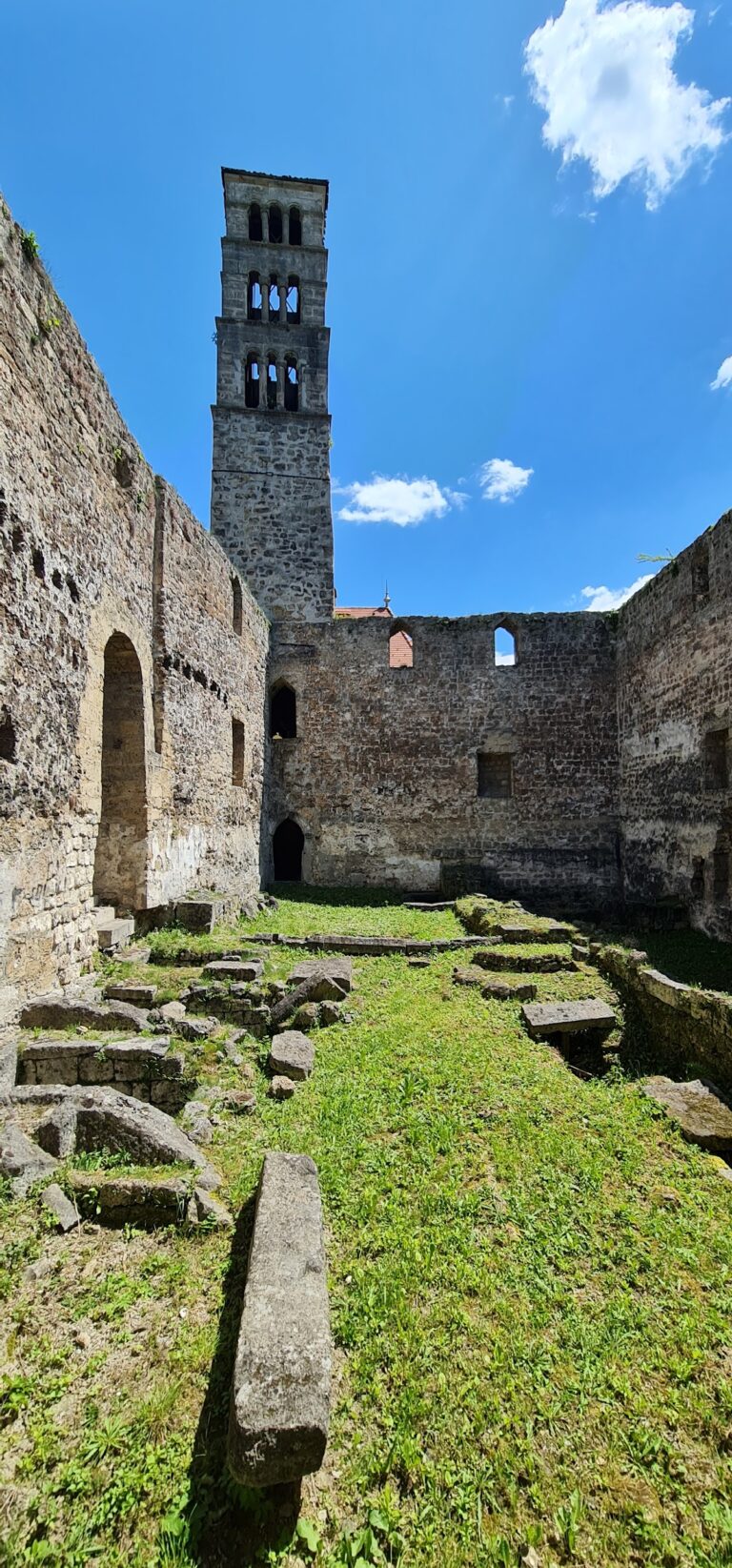
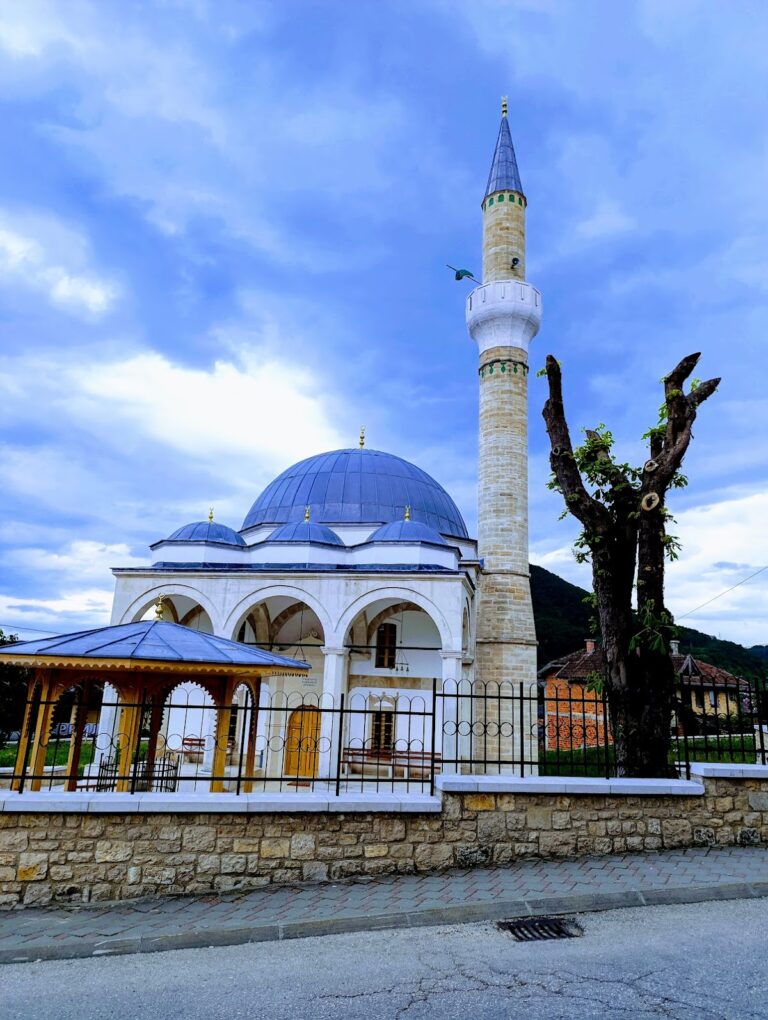
Churches and mosques built during different periods and under different rulers remain within Jajce’s broader natural and architectural ensemble. Together with the old city core, the citadel, and the surrounding defensive works, these elements reflect the town’s development through successive Bosnian and Ottoman phases.
Nearby sites