Franciscan Monastery of Saint Luke, Jajce: A Roman Catholic Monastery
Site at a Glance
- Popularity
- Low
- Country
- Bosnia and Herzegovina
- Primary era
- Modern
- Eras represented
- Modern
- Civilizations
- Austria-Hungary, Habsburg, Ottoman
- Site type
- Religious
- Remains
- Monastery
On this page13 sections
History
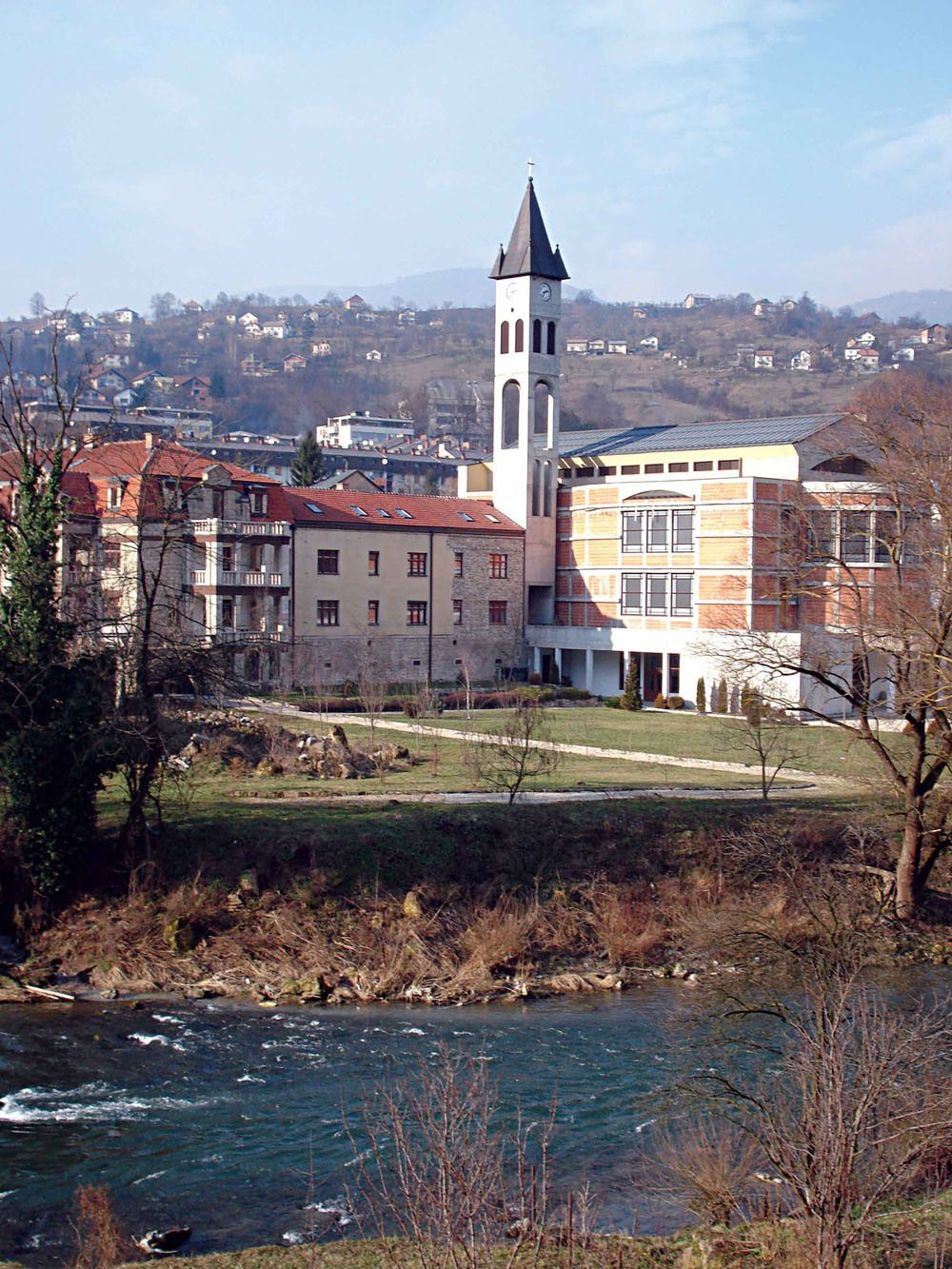
The Franciscan Monastery of Saint Luke is a Roman Catholic monastery in Jajce, Bosnia and Herzegovina. Its construction began in 1877, near the end of Ottoman rule, and it was formally established in 1885. The monastery belongs to the Franciscan order, a Catholic religious community founded by Francis of Assisi, and to the Diocese of Banja Luka, a Roman Catholic territorial jurisdiction. It is associated with the local parish Church of the Assumption of the Blessed Virgin Mary.
Medieval Franciscan presence
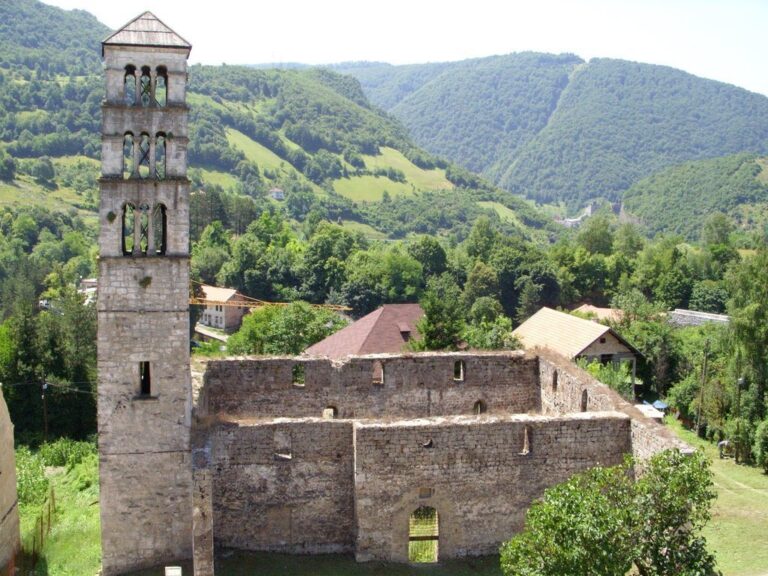
Franciscans were present in Jajce by the Middle Ages. In the 15th century, they had St. Mary’s Church and the bell tower of St. Luke there. After Ottoman forces arrived, St. Mary’s was converted into a mosque. The Ottoman Empire was centered in Anatolia and extended across parts of southeastern Europe, western Asia, and North Africa.
Foundation and later history
Work on the monastery continued after the Austro-Hungarian occupation. Austria-Hungary was a dual monarchy that existed from 1867 to 1918. Construction of the neighboring Church of the Assumption of the Blessed Virgin Mary also began in the late Ottoman period. The Assumption is the Catholic belief that Mary was taken into heaven at the end of her earthly life.
In 1888, archaeologist and historian Ćiro Truhelka excavated a male skeleton beneath a stećak, a medieval tombstone characteristic of parts of the western Balkans, on Kraljev grob (King’s Tomb) hill at Zastinje, near Jajce. Its skull was separated from the body. The remains are believed to be those of Stephen Tomašević, the last king of the medieval Kingdom of Bosnia, who was executed in 1463, although there is no direct evidence for the identification. The skeleton is kept at the monastery.
After the Second World War, Yugoslavia’s communist-led authorities took over some monastery rooms; those rooms were later returned. In the 1970s, the Franciscans sought to bring the bones of Saint Luke back to Jajce, and the monastery has borne his name since then. Saint Luke is traditionally identified as the author of the Gospel of Luke.
Bosnian War and restoration
The Bosnian War, a conflict in Bosnia and Herzegovina from 1992 to 1995, damaged the monastery and destroyed the adjoining Church of the Assumption down to its foundations. Many museum objects, artworks, books, and archival materials disappeared. After three years of Serbian occupation, forces of the Croatian Army and the Croatian Defence Council, military forces involved in the war, liberated Jajce.
Residents returned, and the Franciscans were among the first to do so. For the next five years, they celebrated Mass and administered the sacraments on the ground floor of an elementary school. Restoration of the monastery began in 1995 and continued for several years, including renewal of its older section. Work on the neighboring church was delayed for several years.
Remains
The surviving features include the monastery building, the medieval remains of St. Mary’s Church and St. Luke’s bell tower, and the ruined site of the neighboring Church of the Assumption. The monastery’s appearance was substantially altered by a renovation in 1934–1935, designed by architect Karel Pařík, which added decorative stone details. Its exterior was renovated again in 1973.
Church remains
St. Mary’s Church and St. Luke’s bell tower
St. Mary’s Church is now a ruin after burning repeatedly. Its associated bell tower, named for St. Luke, survives intact.
Church of the Assumption
The neighboring Church of the Assumption was reduced to its foundations during the Bosnian War and was left in ruins.
Museum and other collections
Archaeological and ethnographic holdings
The monastery has a small museum collection of monuments from antiquity, the Early Christian period, meaning the first centuries of Christianity, and the Middle Ages, as well as a small ethnographic collection. The Roman monuments in the collection were found at Šipovo.
Paintings
The artworks include a 17th-century painting of the Holy Family with Saint John the Baptist by an unidentified Italo-Greek artist. Paintings by Sarajevo academic painter Mirko Čurić are arranged in a horizontal band, or frieze.
Treasury
The treasury holds objects used in church services that also have cultural and artistic value. Among them is a 16th-century silver chalice in the Gothic style, a medieval European artistic tradition.
Library
The library contains books, periodicals, and manuscripts on history, philosophy, theology, and literature. Its holdings include books from the 18th and 19th centuries, periodicals and newspapers from the Austro-Hungarian period and later, manuscripts, and parish registers.