Hermann Castle: A Medieval Fortress on Estonia’s Narva River


Site at a Glance
- Rating
- 4.8
- Popularity
- Very Low
- Country
- Estonia
- Primary era
- Medieval
- Eras represented
- Medieval, Early Modern, Modern
- Civilizations
- Danish, Livonian Order, Russian, Swedish
- Site type
- Military
- Remains
- Castle
On this page12 sections
History
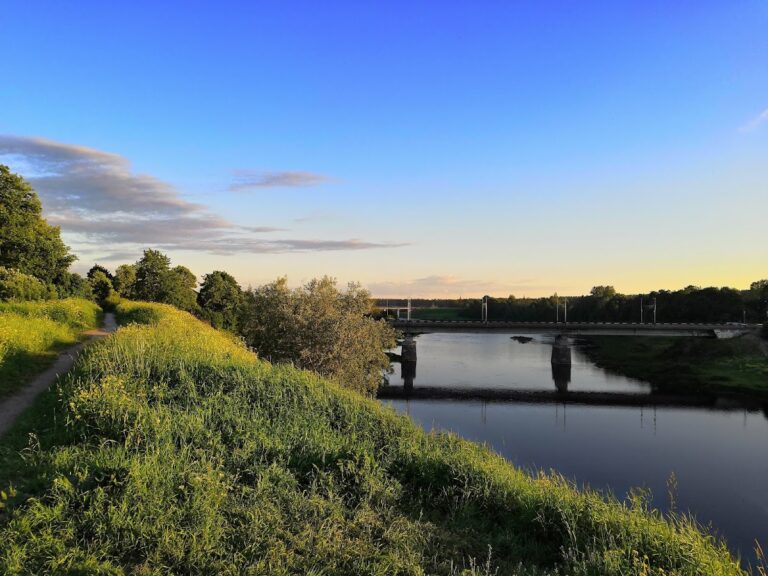
Hermann Castle, also called Narva Castle, is a medieval fortress in Narva, Estonia, built by successive Danish, Livonian, Swedish, and Russian authorities from the thirteenth century onward. Its exact age is disputed, but the fortress existed no later than 1277. Standing beside the Narva River, it protected a crossing where the river met an old road and helped shape the development of Narva.
Danish foundation and early development
After conquering northern Estonia, the Danes established a wooden fort at the river crossing. The settlement protected by this stronghold grew into Narva, which received Lübeck city rights in the first half of the fourteenth century and Hanseatic privileges early in that century. Following conflicts with Russian forces, the Danes began replacing the earlier defense with a stone border fortress. Its first written mention dates from 1329.
A small northern forecourt was created during the early fourteenth century. In 1341 and 1342, a much larger western forecourt was added. Narva did not yet have a surrounding city wall under Danish rule, so civilians could shelter within the forecourt during wartime.
Livonian Order and medieval fortification
In 1347, King Valdemar IV of Denmark sold northern Estonia, including Narva, to the Livonian Order. This Catholic military and religious order controlled territories in the eastern Baltic and used fortified convent-building complexes as administrative and defensive centers. It converted Hermann Castle into such a complex, arranging institutional and residential spaces around a courtyard while continuing to strengthen the fortress.
The first part of Hermann Tower was built in the fourteenth century. After the Livonian Order constructed Ivangorod Fortress on the opposite bank of the river in 1492, the castle was reinforced further. Hermann Tower was enlarged during the early and middle sixteenth century and raised to approximately 50 metres, enabling observation of activity at the Russian fortress across the river.
During the late fifteenth and early sixteenth centuries, a city wall was built around Narva. The Livonian Order also strengthened the city gates and adapted several medieval wall towers into specialized cannon towers. Denmark, the Livonian Order, Sweden, and the Russian Empire later controlled Hermann Castle at different times.
Swedish rule and Russian capture
Sweden controlled the castle from 1581 until Russian forces captured it on 9 August 1704 during the Great Northern War, the conflict in which Russia and its allies challenged Sweden’s dominance in northern Europe. Russian forces had besieged the castle in 1700, and the Battle of Narva took place beneath its walls. In 1704, troops commanded by Peter I, the Russian ruler commonly known as Peter the Great, took the fortress.
Swedish authorities carried out major modernization between 1676 and 1704. Their work added new fortifications, including Wrangel Bastion and a tower protecting the cattle gate, while existing defenses were rebuilt and strengthened. A plan prepared in 1683 by Erik Dahlbergh, a Swedish military engineer and architect, was adopted and approved by the Swedish king. Construction of additional bastions began in 1684. By 1704, six bastions and the Spes, or Hope, fortification had been completed, while Wrangel and Pax, or Peace, remained unfinished.
Later alterations, war damage, and restoration
The Western Gate, positioned between the Triumph and Fortuna bastions, was completed in 1822. Restoration under the engineer Modest Rezvy took place in 1846 and 1847 and continued in 1850. Narva ceased to be a fortress city in 1863. A park was begun near the Dark Gate of the city fortifications, which was demolished in 1875. The city wall itself was ordered to be demolished in 1777.
German forces occupied Hermann Castle from 3 March to 11 November 1918. During the transition before their withdrawal, a German garrison kept the castle under German control under the agreement of 19 November. The fortress suffered severe damage during the Second World War, particularly in the fighting of 1944, when artillery struck even the walls of Hermann Tower.
Postwar restoration began in the 1950s, followed by another phase from 1968. Principal restoration work was completed in 1986, and the first restoration stage together with a museum exhibition was completed in 1989. Further restoration has continued. Narva Museum moved into the restored castle, which also houses a library and other institutions, while the bastions form part of a park. Hermann Castle is listed in Estonia’s Register of Cultural Monuments as an architectural monument and has held that designation since 1998.
Remains
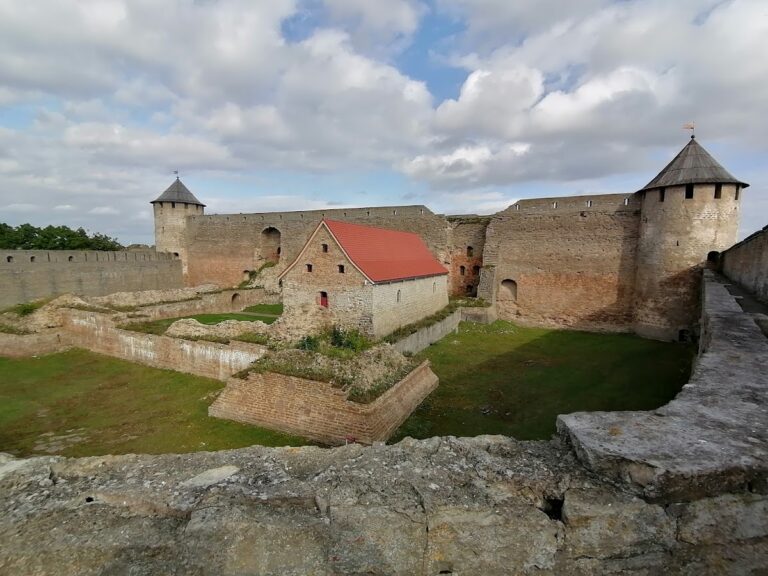
Hermann Castle occupies the high western bank of the Narva River. Its medieval core retains the plan of a fortress with massive wings arranged around a central courtyard. The complex expanded from a small stone stronghold into a convent-building fortress, while later defenses extended mainly toward the west and north. The surviving structure combines restored medieval walls, the principal tower, forecourts, and later artillery defenses.
Medieval castle complex
Central courtyard and forecourts
The earliest stone fortress was a compact building with sides approximately 40 metres long and a tower at its northwestern corner. That tower became the predecessor of Hermann Tower. The Livonian Order developed the site into a fortified convent complex, with substantial wings enclosing a central courtyard. A small forecourt stood to the north, while the larger western forecourt, added in 1341 and 1342, incorporated areas where civilians could seek shelter during war.
Hermann Tower
Hermann Tower, also known as Long Hermann, is the principal tower of the castle. Its construction progressed from the fourteenth century through the early and middle sixteenth century. After Ivangorod Fortress was built across the river in 1492, the tower was enlarged and raised to approximately 50 metres for observation. Artillery in 1944 heavily damaged the tower, but it was restored as part of the postwar reconstruction. The restored tower and the oldest part of the castle now contain facilities of Narva Museum.
City walls and defensive works
Narva’s city wall and gates
The late-medieval wall around Narva was approximately one kilometre long. At least seven towers and a moat protected it. Four gates regulated movement through the fortified town: Viru Gate on the western side, the Cattle Gate to the north, the Old Gate toward the river port, and the Water Gate, also called the Small Gate, to the south. Iron plates covered the gates, and drawbridges stood before them. By the end of the Livonian Order’s period, additional courtyards strengthened the gates, while some wall towers had been adapted into rounded or semi-rounded artillery towers called rondels. Two reconstructed rondels survive at the corners of the castle’s western courtyard.
Bastions and later fortifications
Swedish modernization left the river-facing castle wall largely unchanged but substantially enlarged and strengthened the western and northern defenses. The resulting works included six completed bastions and the Spes fortification. Wrangel and Pax remained unfinished. Wrangel Bastion, the tower protecting the cattle gate, and the Triumph and Fortuna bastions flanking the Western Gate are among the named defensive works associated with the fortress. The surviving bastions now form part of the park surrounding the restored castle.