Storgosia: A Roman Road Station and Late Antique Fortress in Bulgaria


Site at a Glance
- Rating
- 4.1
- Popularity
- Very Low
- Country
- Bulgaria
- Primary era
- Classical
- Eras represented
- Classical, Medieval
- Civilizations
- Byzantine, Roman
- Site type
- Military
- Remains
- Fortified Town
On this page9 sections
History
Storgosia is a Roman road station and later Late Antique fortress in Bulgaria, near present-day Pleven, whose Roman development began on the site of an earlier Thracian settlement. The station probably occupied a location used during the first millennium BC, in an area where settlements had already existed during the Stone and Bronze Ages. The Romans adopted the name Storgosia and established a station that served movement and communication through north-central Bulgaria.
Roman station and economic growth
Storgosia accommodated detachments of Legio I Italica, a Roman legion based chiefly at Novae near modern Svishtov on the lower Danube frontier. Its favourable conditions for trade and local economic activity attracted people from surrounding villages, allowing the road station to grow beyond its original military and transport function.
Transformation into a fortress
After Gothic and other incursions into Roman Balkan territories began after AD 238, Storgosia gradually developed into a fortified settlement of Late Antiquity, the period of the later Roman and early Byzantine empires from roughly the third to the seventh centuries. The raids also apparently encouraged inhabitants from the surrounding area to move toward naturally protected ground south of Storgosia, in the area now occupied by Kaylaka Park.
The Huns destroyed the fortified settlement, which was rebuilt in the sixth century under Justinian I, the Byzantine emperor who ruled from 527 to 565 and sponsored extensive military and building programmes. The fortress continued in use until the end of the sixth century. Slavic settlement in the region then coincided with its abandonment or decline. The Slavs rebuilt the settlement as Kajlika, also rendered Kajluka, and renamed it Kamenez, a name meaning “limestone cliff.”
Later settlements and decline
A separate settlement called Pleven developed to the north, and the two settlements later united. Pleven was first recorded under that name in 1266, when the Magyars, the medieval Hungarian people, captured it. The name was in use by 1270. Pleven later became an important Ottoman fortress, but that military installation was distinct from Storgosia.
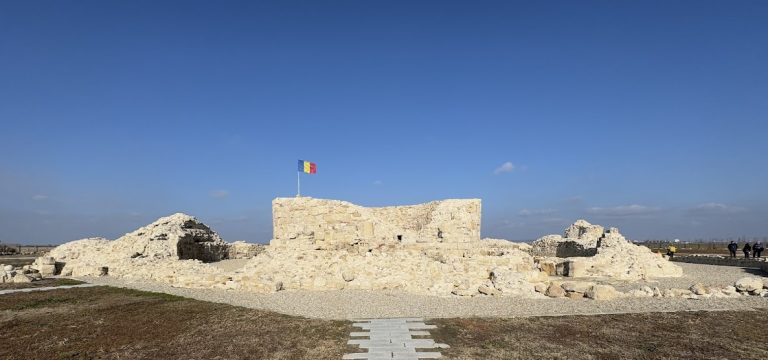
During Ottoman rule, Storgosia was practically destroyed, probably in the sixteenth century. Its stone was apparently reused in a wall built around Ottoman barracks in Pleven. Vegetation was cleared from the archaeological area in 1985, but substantial further work did not follow and the site soon deteriorated. Reconstruction took place in 2005 with European Union support through the PHARE programme connected with Bulgaria’s preparation for accession to the European Union.
Remains
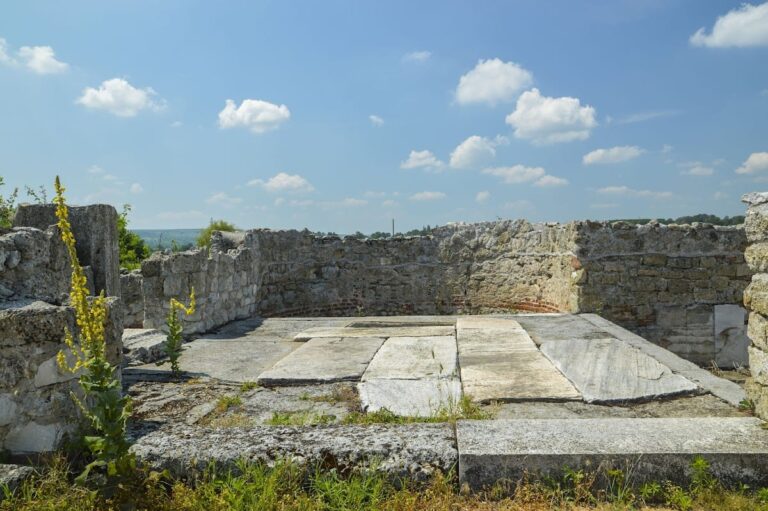
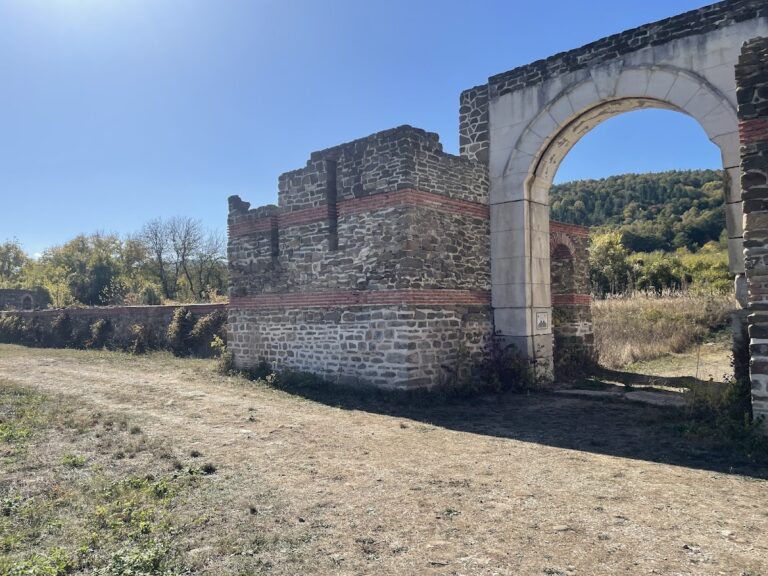
The ruins occupy part of present-day Kaylaka Park and the Kaylaka gorge near Pleven. At the beginning of the fourth century, the fortified area covered 31,000 square metres. Its principal defensive boundary was a wall 2.20 metres thick, constructed from rubble stone set in mortar. Excavations brought to light two gates, three defensive towers, residential buildings, and a public granary, while later stone removal and possible reuse affected the survival of the fortress.
Fortifications and settlement buildings
Defensive wall, gates, and towers
The defensive wall formed the main enclosure of Storgosia, with two gates providing access through the fortified area. Three defensive towers strengthened the perimeter. Built of rubble stone and mortar, the wall survives as part of the remains reconstructed in 2005 after the archaeological area had deteriorated.
Residential buildings and granary
Within the enclosure were residential buildings and a public granary, reflecting the settlement’s role as a permanent fortified community as well as a military station. Pottery, weapons, and coins recovered from the settlement, together with finds from its necropolis, indicate that life continued there until the end of the sixth century.
Christian basilica
A fourth-century basilica, a large hall-type building adapted for Christian worship, measured 45.20 by 22.20 metres. It had three naves, three apses, and a colonnade along its southern side. The apses were semicircular or polygonal recesses placed at the ends of the church spaces, while the colonnade formed a distinct architectural element along the building’s southern side.