Schwarzwasserstelz: A Medieval Water Castle on the Rhine


Site at a Glance
- Rating
- 3.6
- Popularity
- Very Low
- Country
- Switzerland
- Primary era
- Modern
- Eras represented
- Modern
- Civilizations
- Swiss
- Site type
- Military
- Remains
- Fort
On this page10 sections
History
Schwarzwasserstelz is a vanished medieval water castle in Switzerland, built around 1170 on a small rock in the Rhine near Kaiserstuhl, in present-day Fisibach. A water castle is a fortified residence surrounded by, or built within, water that uses the surrounding water as part of its defenses. The island later took its name from the castle, while “Wasserstelz” refers to its position in the water.
Medieval ownership
The Freiherren von Wasserstelz owned Schwarzwasserstelz from 1173 to 1330. In 1294, the castle and Kaiserstuhl passed from the Freiherren von Regensberg to the Prince-Bishop of Constance. In 1303, Heinrich von Klingenberg, a medieval Prince-Bishop of Constance, acquired the castle together with the lower jurisdiction of Fisibach. This jurisdiction was a local judicial authority over lesser civil and criminal matters, separate from higher territorial jurisdiction.
Later owners and decline
The Heggenzer family held Schwarzwasserstelz in 1587, after which it belonged to the Tschudi family until 1831. The castle had formed part of the municipality of Fisibach since 1821. It was uninhabited from the middle of the nineteenth century and gradually decayed before being sold to the Swiss Northeastern Railway and dismantled in 1875.
Memory and twentieth-century transformation
Before the Rhine was impounded after the Reckingen power station was constructed and commissioned between 1938 and 1941, the former castle island was considerably larger. In 1938, the Swiss Army incorporated the island into Switzerland’s frontier defenses by building Infantry Bunker A4203. The installation was designed for two machine guns and remains privately owned by a foundation.
Schwarzwasserstelz also entered literary and artistic memory. The Swiss writer Gottfried Keller described it in his narrative Hadlaub, while a winter painting of the castle is attributed to the German landscape painter Pieter Francis Peters. The coat of arms of the Freiherren von Wasserstelz, showing three seated water wagtails, is reflected in the present coat of arms of Fisibach. The Hegenzer arms show a six-rayed star above a three-hill mount.
Remains
Island site and surviving structures
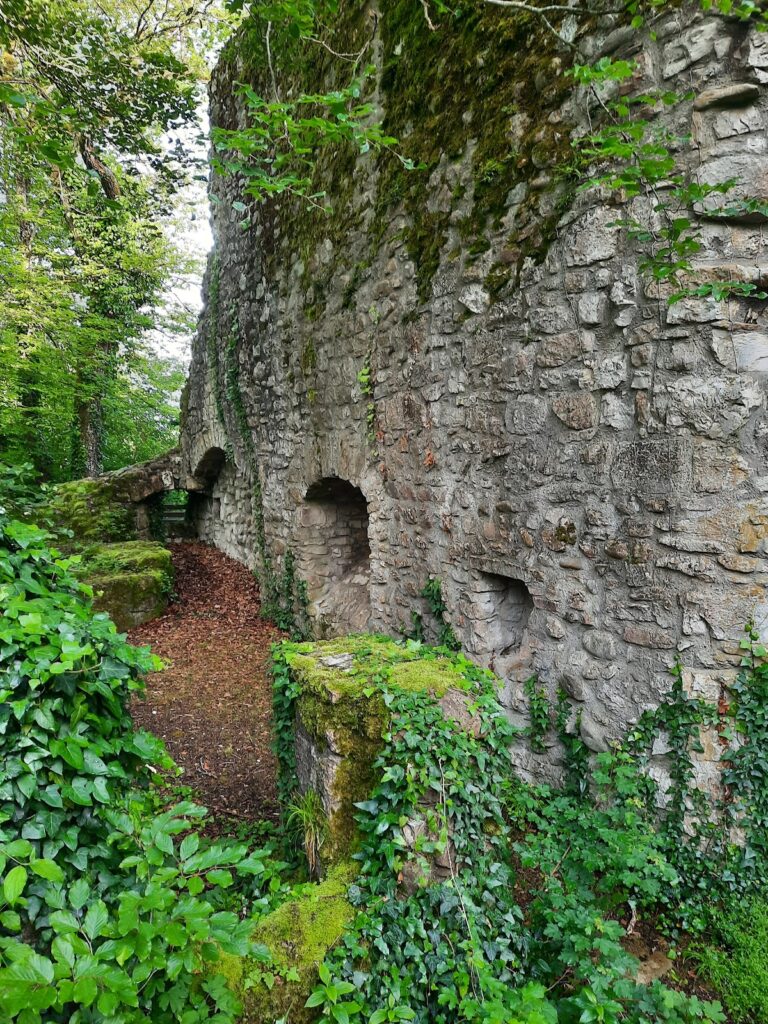
Schwarzwasserstelz occupied a tiny rock in the Rhine, using its island setting as the basis of its water-castle design. The castle site is now substantially overbuilt by the 1938 infantry bunker, while the island itself is smaller than it was before the Rhine was impounded.
Infantry Bunker A4203
Infantry Bunker A4203 is a frontier-defense infantry bunker, a fortified installation intended to protect a border against ground forces. Built by the Swiss Army in 1938, it was equipped for two machine guns. The bunker still stands on the former castle island and is privately owned by a foundation.
Entrance portal and windows
The castle’s entrance portal was made from sand-lime stone in 1776 by Franz Ludwig Wind, a sculptor from Kaiserstuhl. The portal was removed when the castle was dismantled in 1875, and it was incorporated with two windows into the facade of veterinarian Samuel Moor’s house in Zurzach. The building, at Promenadestrasse 17, is known as Haus Arche and serves as the Evangelical Reformed parish house.
Castle bell
The former castle bell survives in the roof turret of the chapel at Rümikon. A roof turret is a small turret rising from a roof, commonly used for a bell or another lightweight installation.
Related Rhine castles
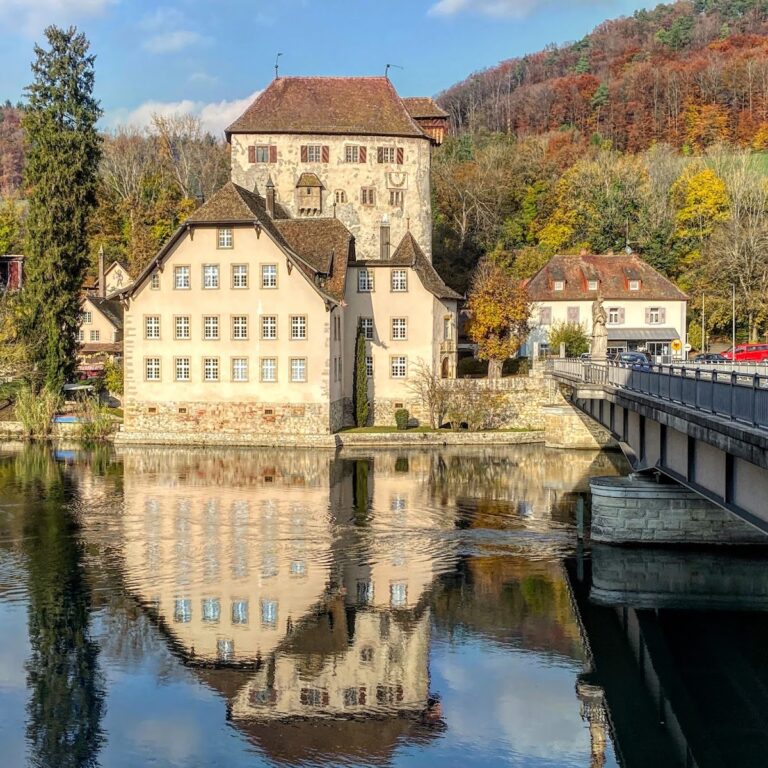
Schwarzwasserstelz stood opposite the later Weisswasserstelz on the German bank of the Rhine. Weisswasserstelz was probably created through an inheritance division, was younger than Schwarzwasserstelz, and occupied the elevated riverbank rather than a river island. The castle now called Rotwasserstelz, opposite Kaiserstuhl near the border crossing, was originally known as Rotenleim or Rötteln.