Burg Neukrenkingen: A Medieval Hilltop Castle in Germany

Site at a Glance
- Rating
- 3.6
- Popularity
- Very Low
- Country
- Germany
- Primary era
- Medieval
- Eras represented
- Medieval
- Civilizations
- Holy Roman Empire
- Site type
- Military
- Remains
- Castle
On this page8 sections
History
Burg Neukrenkingen is a medieval hilltop castle in Germany, near Riedern am Sand in the municipality of Klettgau. The Lords of Krenkingen built it between 1209 and 1241, creating one of the region’s largest castles after Küssaburg. Its later history was shaped by Habsburg rule, aristocratic pledges, conflict with Rheinau Abbey, and repeated changes of ownership.
The Lords of Krenkingen
The Krenkingen family’s ancestral castles, Altkrenkingen and Krenkingen, stood in the Steinatal. The family’s regional authority expanded when Diethelm von Krenkingen served as abbot of Rheinau Abbey from 1157 to 1161. Rheinau was a medieval Benedictine monastery on the Rhine in present-day Switzerland. Through Diethelm’s tenure, the Krenkingens also assumed the abbey’s protective bailiwick, an office involving guardianship and administration on behalf of a religious institution.
In May 1241, Diethelm von Krenkingen and his sons Werner and Diethelm renounced their bailiff rights over Rheinau in return for 1,200 marks of silver in favor of Emperor Frederick II. On 17 August 1241, Frederick confirmed the repurchase. The agreement included 34 surrounding settlements, among them Weißenburg and Neukrenkingen, and required the Krenkingens to redeem everything they had pawned during their administration of the bailiwick.
By this time, the family had already divided into two lines. Their wider aristocratic connections are reflected in a reference from 1254, when the minnesinger Walther von Klingen was described as a nephew of the Krenkingens. A minnesinger was a medieval German-speaking court poet and singer who performed aristocratic love poetry.
Habsburg control and changing lords
In 1270, the castle was sold to the Habsburgs, a major European ruling dynasty whose Austrian branch controlled extensive territories in the region during the later Middle Ages. In 1288, Rudolf of Habsburg ended the Krenkingens’ raiding activities and their long dispute with Rheinau Abbey. He destroyed Weißenburg, which the family occupied, and confiscated their possessions.
Duke Leopold of Austria briefly pledged Burg Neukrenkingen in 1315 to Lütold von Krenkingen of the older family line. In 1359, the Austrian dynasty pledged the castle and its lordship to the Counts of Habsburg-Laufenburg, who held the position of landgraves of the Klettgau. A landgrave was a territorial count whose authority ranked above that of an ordinary count in parts of the medieval German political system.
The transfer of the castle’s fief and bailiwick to Hans von Endingen in 1397 has been attributed to Rudolf of Habsburg-Laufenburg, but this appears to confuse him with Count Rudolf of Sulz. Count Rudolf of Sulz married Ursula of Habsburg-Laufenburg, daughter and heir of Count Johann of Habsburg-Laufenburg, in 1410. In 1412, Duke Frederick of Austria transferred the fief to Friedrich von Endingen. A fief was property or jurisdiction granted by a superior lord in return for service.
Conflict, destruction, and final ruin
The castle became involved in a violent dispute in 1421, when Hermann von Sulz abducted and imprisoned Hugo von Almishofen, the abbot of Rheinau, at Neukrenkingen. In 1429, Friedrich von Endingen sold the fief to Ruegger im Thurn, a Schaffhausen family that had already acquired the nearby lordship of Gutenburg in 1407 from Diethelm von Krenkingen and his wife, Anna von Aarburg.
The priest Mauritius Hohenbaum van der Meer stated that the castle had already been destroyed by 1437. At least parts of it appear to have been rebuilt afterward. In 1439, Ursula of Habsburg-Laufenburg transferred the castle to her sons, who granted its castle residence, or Burgsäß, to Herman von Mandach. In 1481, the residence passed to Heinrich von Mandach and his sons Sebastian and Hans. The Mandachs’ family seat was nearby Mandach Castle.
Burg Neukrenkingen was described as finally ruined in the testament of Johann Ludwig II of Sulz, the last Count of Sulz. The castle was also noted for its unusually elaborate division into three parts, a feature that distinguished its organization within the regional landscape.
Remains
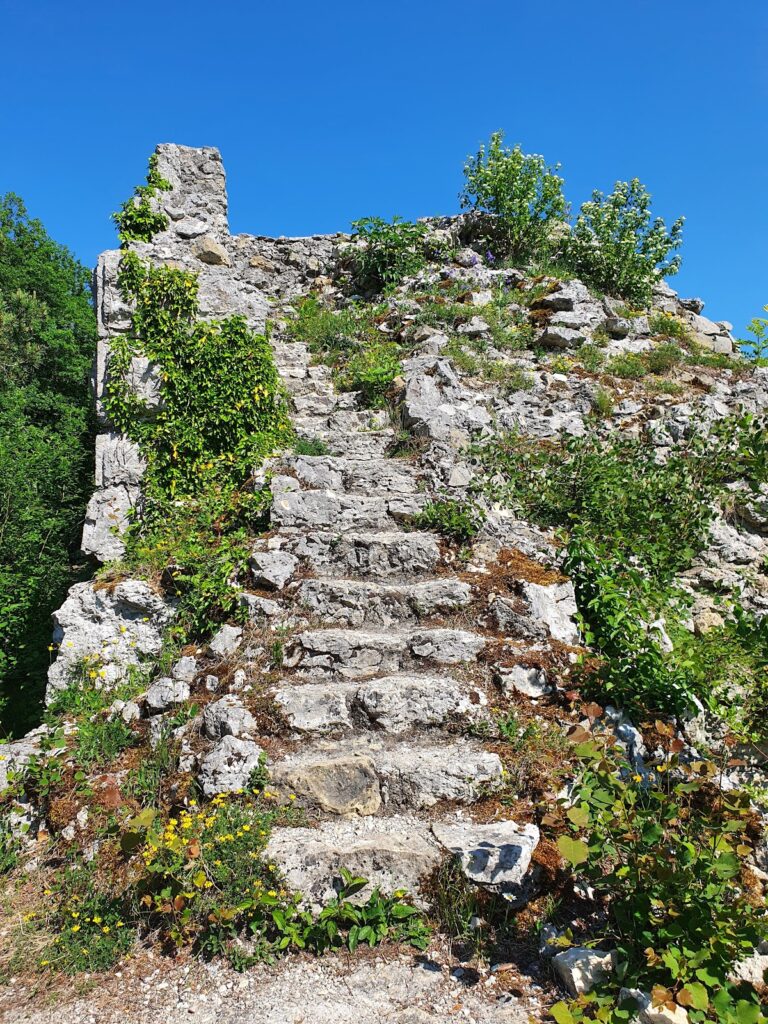
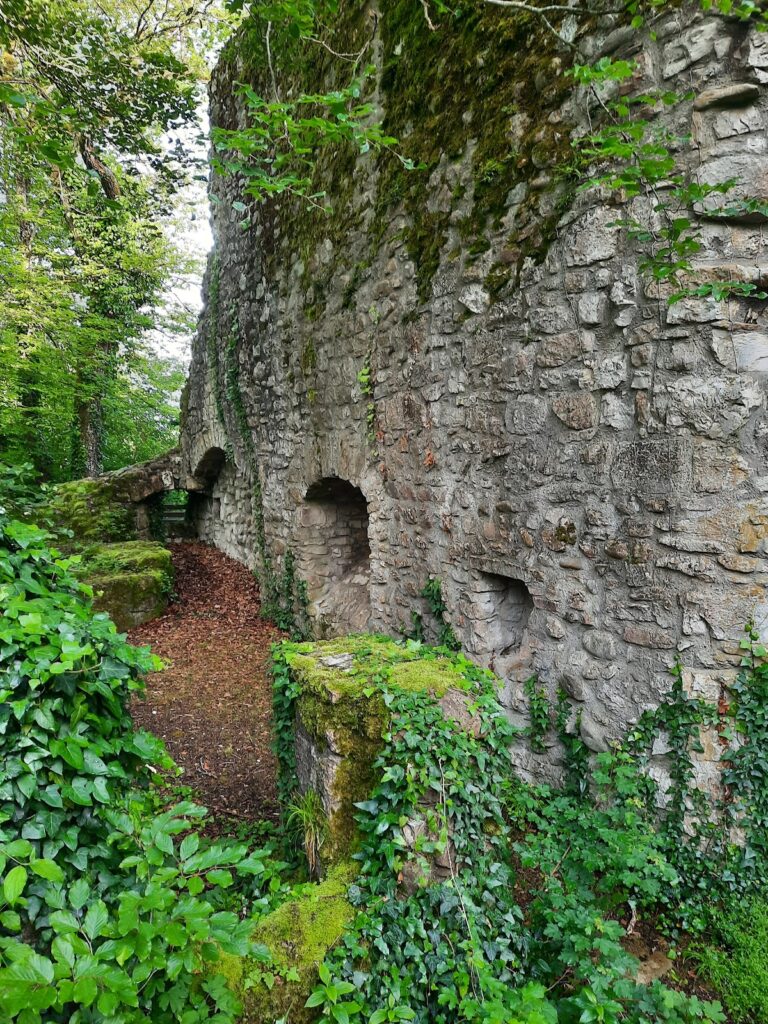
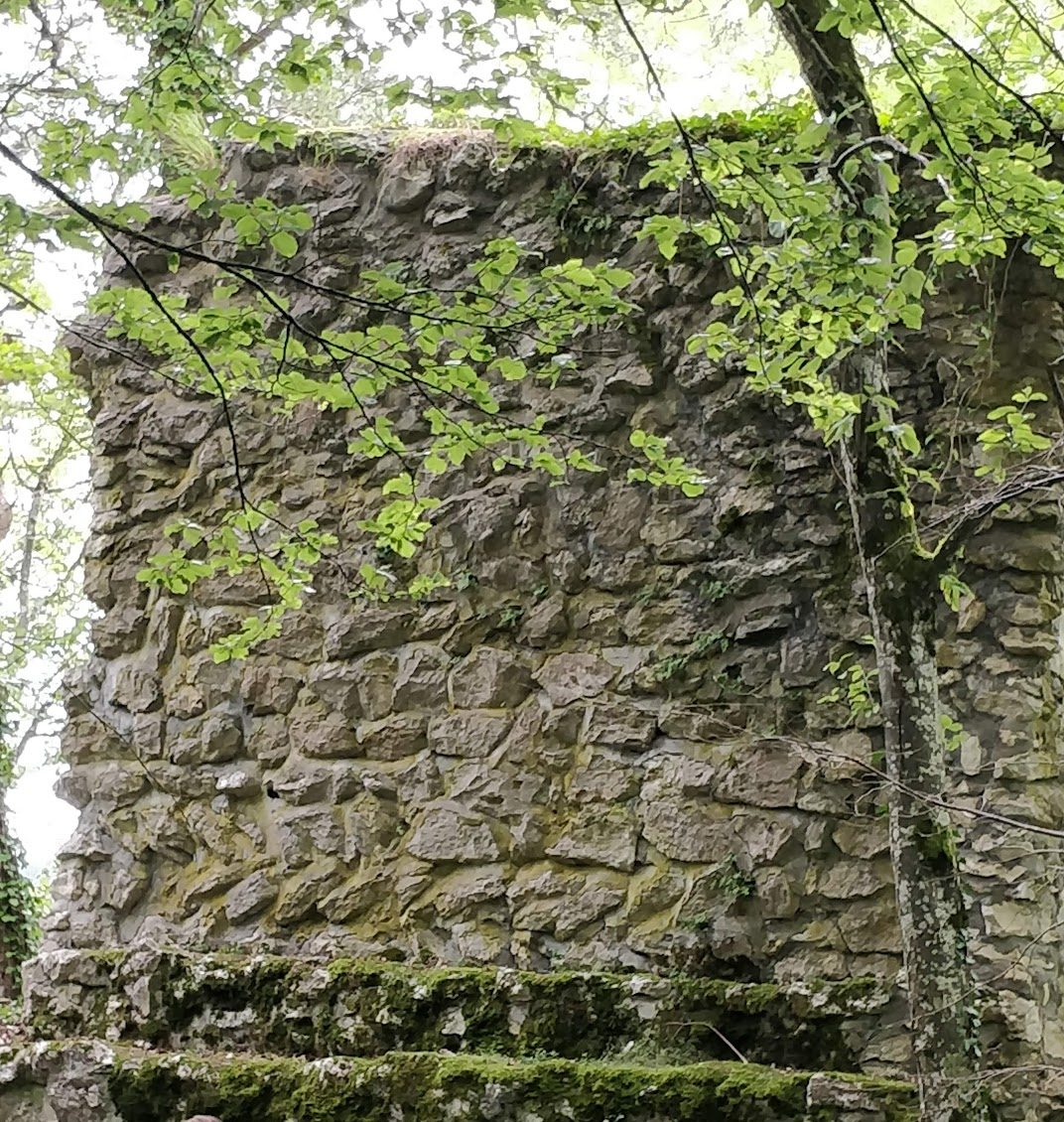
The surviving remains occupy a ridge of the Klettgau approximately 130 meters above Oberriedern. The castle covered the prominent summit of a hill with steep slopes on every side. At the rear, a deep ditch separated the stronghold from the continuation of the ridge. Today, the surviving fabric is represented by wall remains.
Summit fortifications
Main castle
The main castle was roughly quadrangular, with rounded corners, and had a circumference of more than 400 feet. A description from 1770 recorded several wall sections more than 20 feet high, with foundations or buried masonry extending to a comparable depth below ground. The walls measured between 6 and 10 feet in thickness, particularly along the right-hand side, where a tower or prison was thought to have stood.
The interior included a hollow, vaulted space and an opening intended for concealed use, although its exact function is not known. The approach was a steep but solid stone road. Behind the castle, the route was cut into the rock, whose projecting sections overhung the outer side of the path.
Outer fortification
Beyond the ditch, toward the continuation of the ridge, strong wall remains extended for approximately 80 paces downhill. They appeared to belong to a separate fortification on another hill, which was also enclosed by a ditch. The later installation had been reduced to its foundations. Fields reached these wall remains and belonged to the Eichberg farms, approximately a quarter of an hour away.