Donjon de Fauguerolles: A Medieval Fortified Tower in France


Site at a Glance
- Rating
- 4.2
- Popularity
- Very Low
- Country
- France
- Primary era
- Medieval
- Eras represented
- Medieval
- Civilizations
- Duchy of Aquitaine, English
- Site type
- Military
- Remains
- Castle
On this page8 sections
History
Donjon de Fauguerolles is a medieval fortified tower near La Croix-Blanche in France, built around 1300 as part of a defensive castle on the former Roman road linking Agen, Eysses, and Périgueux. Its architecture places its construction probably in the late thirteenth or early fourteenth century. The site belonged to a family that held the fief in co-lordship, a feudal arrangement in which several lords jointly held rights over the same lordship.
The Fauguerolles Lordship
In 1259, the brothers Arnaud and Gaufred rendered homage for the castrum of Falgairolas. A castrum was a fortified settlement or stronghold, often including a defended village rather than only a tower. Several years later, the king of England confiscated the castrum and granted it to Guillaume Montravel. It was probably originally a fortified village, while the tower now known as Donjon de Fauguerolles stood a few metres from Fauguerolles village and probably did not form part of the castrum.
The lordship was divided among numerous co-lords over time. Among them were the families of Fauguerolles, Durfort, Montpezat-Laugnac, Sarrau-d’Arasse, Chazeron, Rovignan, Monfabès, Leguet, Du Bernet, d’Esparbès de Carbonneau, de Nort, de Galibert, Hugon de Latour, and de Raigniac. The tower may later have been altered for habitation, possibly when Jean de Monfabès and Bertrand de Fauguerolles lived at Fauguerolles Castle in 1376.
Decline and Preservation
Most of the enceinte, or enclosing defensive wall, and the buildings that completed the small residential complex probably disappeared after 1592, when the garrison was warned to remain on guard. By the early eighteenth century, only the tower apparently remained. When the possessions of the Count of Laugnac were seized in 1715, the Judges of Requests of the Palace of Paris ordered repairs at Fauguerolles and other properties. This royal judicial body handled petitions and certain civil cases.
The nineteenth-century owner of the old tower was the de Galibert family. Donjon de Fauguerolles was listed as a historic monument in 1950, giving the surviving structure formal protection as part of France’s heritage.
Remains
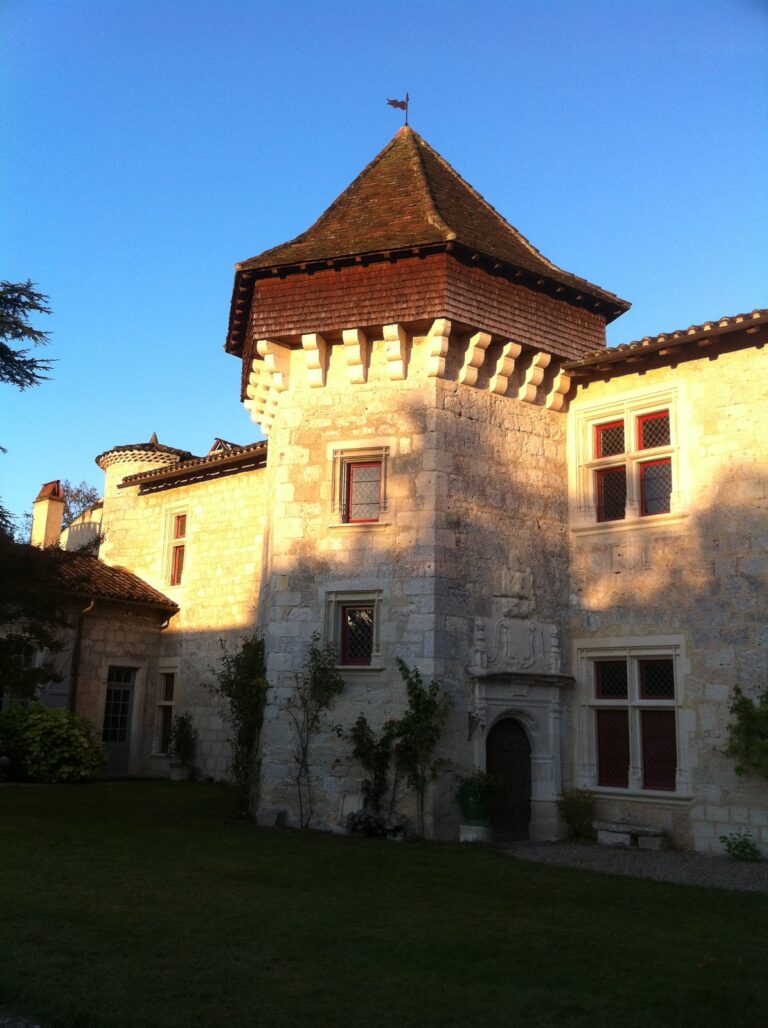
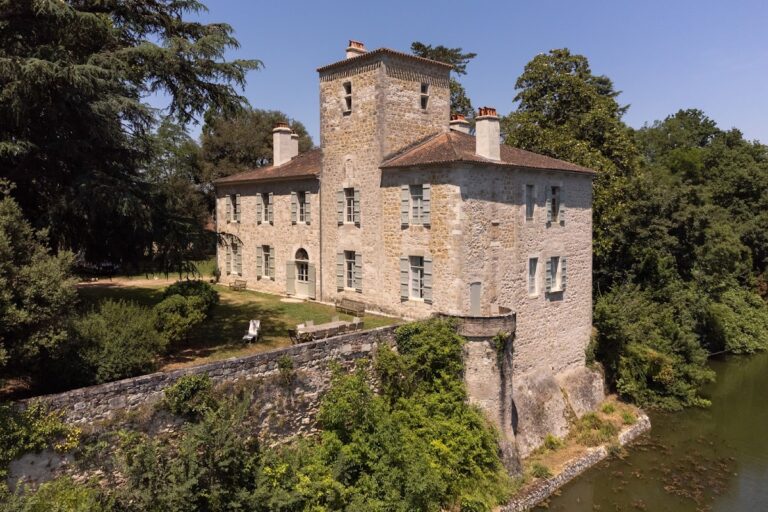
The surviving site is centered on a quadrangular tower with three unvaulted storeys. Two corners are strengthened by buttresses, while the opposite side was connected to another building. The tower’s compact defensive form, narrow openings, and thick walls reflect its medieval role and its later adaptation as a residential element.
The Fortified Tower
Entrance and Ground Floor
The entrance is on the north side at ground level, where a pointed-arched opening leads into the lower room. The interior measures 6.40 by 7.50 metres, and the walls are 1.20 metres thick. Light enters only through the doorway and two arrow slits, narrow openings designed for missile weapons while limiting exposure to attackers.
Upper Storeys and Window
No visible access survives to the first floor. It may have been reached by a wooden staircase or through the castle buildings that have since disappeared. The first floor was probably the only habitable storey, while the second and third floors have no notable features. A paired window, divided into two openings by a central vertical support, was probably remade in the fifteenth century.
Later Roof and Associated Buildings
The 1715 repair estimate states that the tower had lost its floors and was then covered by a pavilion roof, formed by several sloping sides rising toward a central point or short ridge. A chapel stood beside the tower and was dedicated, or probably dedicated, to Notre-Dame, the French religious title for the Virgin Mary. The tower was also joined to another building on the side opposite its buttresses, linking it to the wider residential complex before most of those buildings disappeared.