Neues Schloss Oberrengersdorf: A Neobaroque Manor House in Germany


Site at a Glance
- Rating
- 4.2
- Popularity
- Very Low
- Country
- Germany
- Primary era
- Modern
- Eras represented
- Modern
- Civilizations
- German
- Site type
- Domestic
- Remains
- Castle
On this page8 sections
History
Neues Schloss Oberrengersdorf is a Neobaroque manor house in Germany, located south of Ober-Rengersdorf on the road to Torga in the municipality of Kodersdorf. Built between 1900 and 1902, it served as the principal residence of the Oberrengersdorf estate, which was at times one of the largest manorial estates in Upper Lusatia.
From Outlying Farm to Manorial Estate
The Oberrengersdorf estate began in 1517 as a Vorwerk, an outlying agricultural or administrative unit belonging to a larger estate. It was later raised to the status of a Rittergut, a manorial estate historically associated with noble landholding and special social or administrative privileges. An earlier manor house, Altes Schloss Ober Rengersdorf, was built northwest of the present castle during the eighteenth century.
The Roncador Residence
Julius von Roncador acquired the estate in 1900 and commissioned a new manor house during the next two years. He selected the Neobaroque style, a revival of Baroque forms popular in the nineteenth and early twentieth centuries, and based the design on the family’s ancestral seat in Hungary. The older manor house did not satisfy his expectations for a suitably prestigious residence.
Changing Ownership and Estate Use
Following Julius von Roncador’s death in 1922, his son Heinz inherited the castle and estate. Heinz sold them in 1924 to Joseph Kutz, a commercial councillor from Weißwasser. Kutz presented the castle as a wedding gift to his daughter and her husband, Manfred Graf von Ingenheim.
In 1931, Manfred Graf von Ingenheim was forced to divide the estate and retained only 50 hectares of land. A convalescent home for mothers occupied the castle from 1936. After the Second World War and the land reform carried out in the Soviet-occupied zone, the estate’s owners were expropriated in 1945.
Public Uses and Recent History
After the war, the castle served as a school for children in grades 1 to 3, an after-school centre, and a kindergarten. It has been empty since 1992, while age-related deterioration and vandalism have created a serious need for renovation. Security work was undertaken in 1999, but later sale and restoration proposals did not succeed.
In January 2006, actor Nicolas Cage showed interest in purchasing the castle but abandoned the plan in favour of Neidstein Castle in Bavaria. Shortly afterward, the chairman of the Görlitz Jewish community bought the property and sold it again in 2009. Neues Schloss Oberrengersdorf is protected as a monument in Saxony and forms part of the protected Oberrengersdorf estate ensemble.
Remains
The Manor House
Neues Schloss Oberrengersdorf is an imposing nine-axis building beneath a mansard roof, which has two slopes on each side, with the lower slope steeper than the upper one. Four round corner towers flank the main structure, each topped by a bulbous or domed roof form.
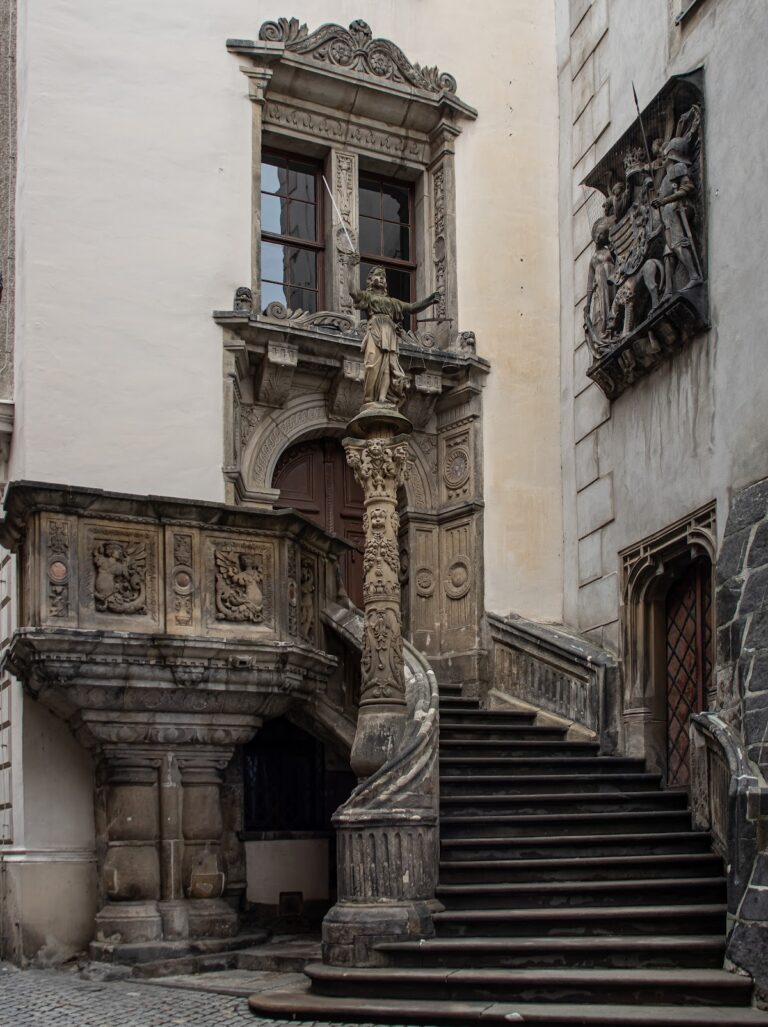
The main façade presents its entrance as a triumphal arch. On the park side, a two-flight exterior staircase rises to a loggia, a roofed, open-sided gallery. The park façade is organized around a semicircular projecting section, or avant-corps, crowned by a decorated curving gable.
Estate Ensemble
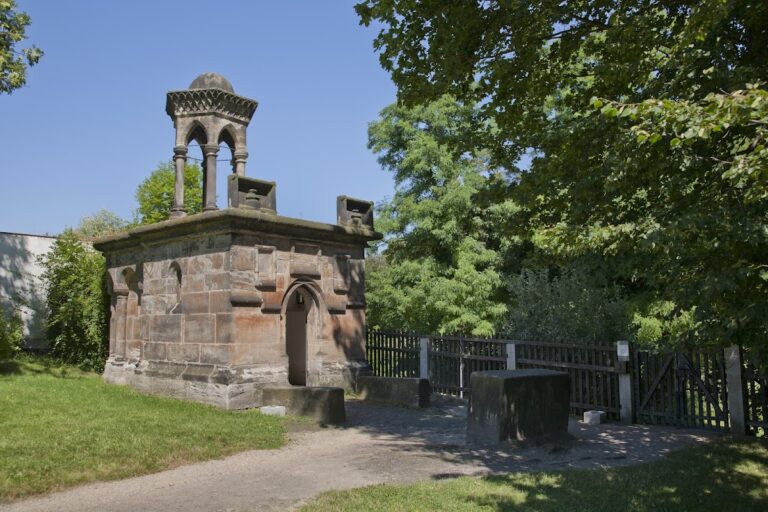
The protected estate group extends beyond the manor house. Its associated features include an ice cellar, an underground or insulated structure once used to store ice, together with a mausoleum, gate pillars, a bridge, and a masonry inlet leading to a pond in the park.
Nearby sites