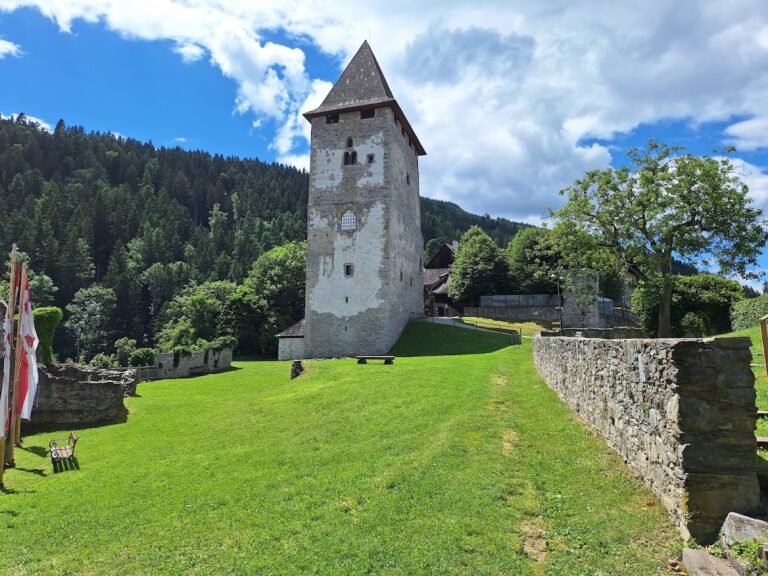
Ruine Althaus: A Romanesque Hilltop Castle Ruin in Austria


Site at a Glance
- Rating
- 4.2
- Popularity
- Very Low
- Country
- Austria
- Primary era
- Medieval
- Eras represented
- Medieval
- Civilizations
- Holy Roman Empire
- Site type
- Military
- Remains
- Castle
On this page8 sections
History
Ruine Althaus is a Romanesque hilltop castle ruin in Austria, in the Görtschitztal of Carinthia. A fortified residence at the site was first documented in 1247, while the surviving tower was built during the first half of the thirteenth century. Mineral extraction had taken place in the surrounding area since the early Middle Ages, so an earlier defensive installation at the site remains possible.
Salzburg administration
During the thirteenth and fourteenth centuries, the area belonged to the Archbishopric of Salzburg, an ecclesiastical principality whose archbishop also governed secular territories. Enfeoffed lords administered these possessions as fiefs. Wulfingus de Huse, named as the owner of Althaus in 1247, died without male heirs in 1279. Archbishop Friedrich Ortlof von Saurau then appointed an administrator. He had previously married Matza von Haus.
By this period the castle was known as vetus domus, meaning “old house,” a name reflected in Althaus. The wording suggests that a newer fortress already existed. That fortress may have been Silberberg, situated farther down the valley on the opposite side.
Later use and abandonment
In 1396, Archbishop Gregor appointed Konrad, Bishop of Lavant, as administrator of Althaus. Lavant was the ecclesiastical see associated with his title. In 1449 the castle was described as dilapidated, although it was later made habitable again.
During the sixteenth century, the owners preferred Silberberg as their residence. Althaus nevertheless regained practical importance when numerous mines began operating in the surrounding area in the early sixteenth century, and the castle was assigned responsibility for protecting them. After the mines were exhausted, Althaus was abandoned and fell into ruin. The last recorded reference dates from 1628, when Regina Grimmigin, born Teuffenbach, asserted inheritance rights.
The land containing the remains still belongs to a neighboring farm. Ruine Althaus is protected as a historic monument.
Remains
Layout and defenses
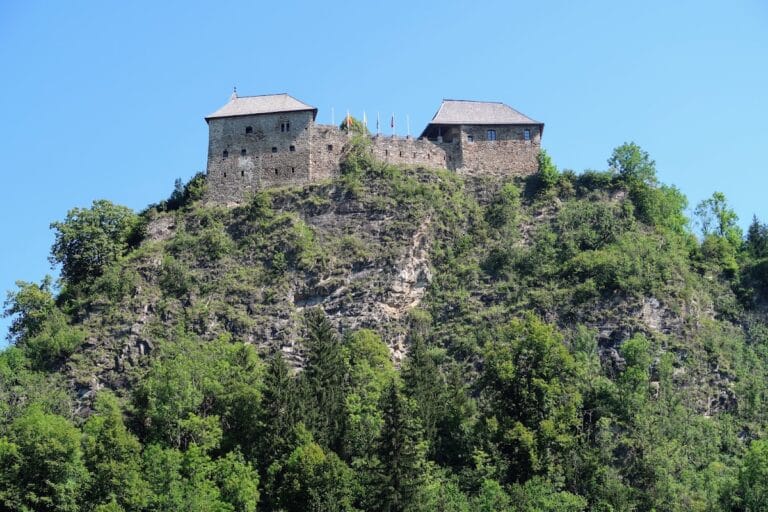
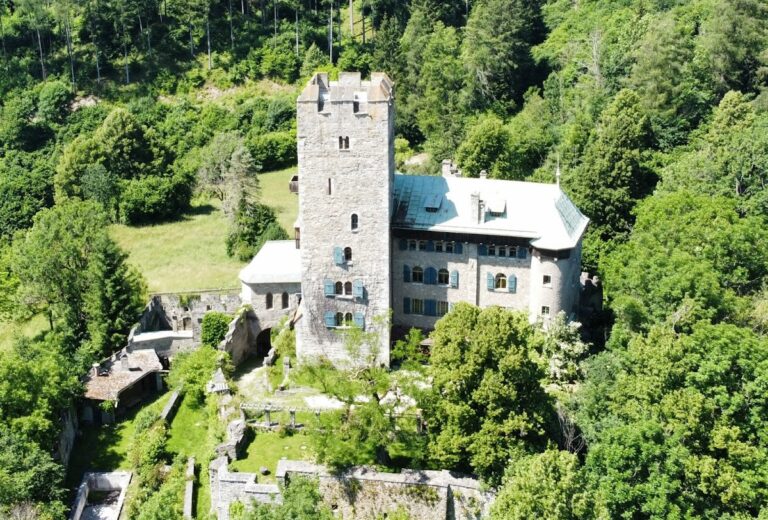
The ruin occupies a rocky hill approximately 30 metres above the road through the Görtschitztal, between Hüttenberg and Neumarkt and about twelve kilometres north of Hüttenberg. The Romanesque castle was centered on a powerful, thick-walled residential tower. A former crescent-shaped rampart remains recognizable in the terrain on the northern side of the castle hill.
Residential tower
The rectangular double tower originally rose through four storeys. Its main construction belongs to the first half of the thirteenth century, while its oldest components probably date from the end of the twelfth century. Massive masonry and vaulted construction reflect the Romanesque architectural tradition, which preceded the Gothic style.
Vaulted lower rooms
The lower storey contains two vaulted rooms. A passage separates them, and the passage itself is covered by a barrel vault, a continuous curved ceiling formed like a half-cylinder.
Castle chapel
Traces of the castle chapel survive on the first upper storey. This small place of Christian worship formed part of the fortified residence.
Nearby sites