Villacher Burg: A Renaissance Castle Complex in Austria


Site at a Glance
- Rating
- 4.8
- Popularity
- Very Low
- Country
- Austria
- Primary era
- Early Modern
- External website
- Open
- Eras represented
- Medieval, Early Modern
- Civilizations
- Holy Roman Empire
- Site type
- Military
- Remains
- Castle
On this page7 sections
History
Bamberg origins and medieval expansion
Villacher Burg is a castle complex in Villach, Austria, whose present Renaissance form was built in the sixteenth century on the foundations of an earlier structure. Its origins reach back to the period shortly after 1007, when Henry II, a medieval German king and Holy Roman Emperor, donated Villach to the Prince-Bishopric of Bamberg, an ecclesiastical principality governed by the bishop of Bamberg. Archaeological investigations in 2000 indicated that construction began soon afterward.
The castle was first documented in 1270 as a Bamberg castle. It was enlarged during the fortification of Villach around 1233 and occupied the northeastern corner of the city’s defenses. As the local administrative seat of the Prince-Bishopric of Bamberg, it housed the residence and offices from which the bishopric’s representative administered the area.
Renaissance rebuilding and decline
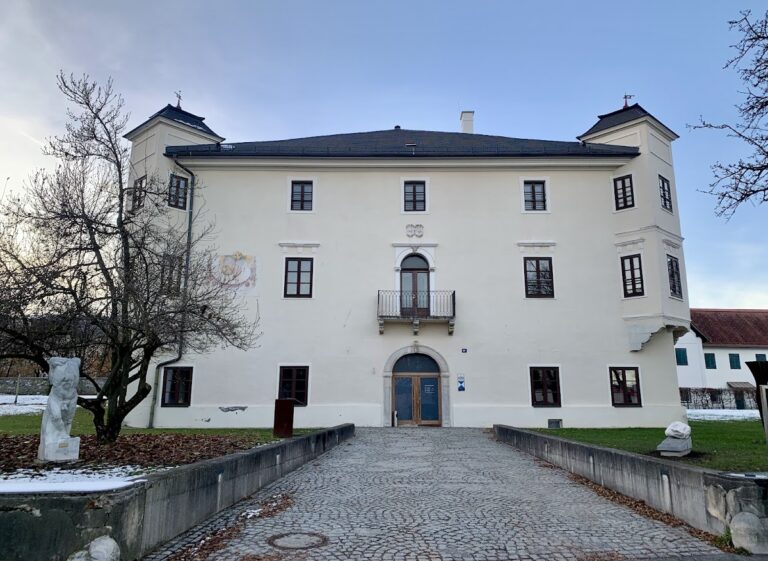
The sixteenth-century rebuilding created the existing four-wing complex, which was remodeled several times during the seventeenth century. The castle combined defensive, administrative, and residential purposes, serving officials stationed there as well as the practical needs of the establishment.
From the 1750s onward, its defensive role became less important and the complex was increasingly neglected. The city fire of 1812 caused further severe damage. Villach or the province owned the buildings but lacked the money needed for renovation, so the complex was sold in 1832 to the wealthy Nagele family. The family repaired and restored it, then bequeathed the property to the city in 1914. It was subsequently converted into rental housing and continued to serve as social housing into the twenty-first century.
The castle chapel
The Castle Chapel of St. Heinrich and Kunigunde was attached to two castle wings in the fourteenth century. It belonged to the parish of St. Martin until 1640 and thereafter to the parish of St. Jakob. The chapel was probably secularized as early as 1738, but it was restored as a sacred space in 1980 and episcopally blessed in October of that year. Since then, it has served the Old Catholic Church, a Christian tradition that emerged from opposition to certain nineteenth-century Roman Catholic developments. The chapel belongs to the pastoral district of St. Mark’s Old Catholic parish church in Klagenfurt. A 2003 renovation renewed the altar and the fresco of Heinrich and Kunigunde, while adapting the chapel for ecumenical use by the Serbian Orthodox community alongside its principal Old Catholic users.
The castle and chapel are protected as historic monuments. A room managed by an outpost of the Villach City Museum presents archaeological finds recovered from the complex.
Remains
Castle complex
The preserved castle is built of stone with plastered surfaces. Its Renaissance building is a simple three-storey structure of four wings arranged around an arcaded courtyard. The courtyard is three-sided and lined with two-storey arcades, which are connected by a covered flight of stairs. On the third storey, an open passage runs along two sides above the arcades. The masonry of a fortification tower at the northeastern corner retains remains of the original structure.
The buildings accommodated representative and living rooms for officials, together with an armory, granary, drinking-water well, latrine, and prison cells. Excavations have also revealed details of life within the complex. Food remains include meat from domestic and wild animals, with turtles, bears, and ibex among the recorded wild species. Oysters imported from the Adriatic, fine tableware, drinking glasses, and children’s toys were also found. A clay figure of a tournament rider dating from the twelfth century is among the oldest discoveries of its type in Europe.
Castle Chapel of St. Heinrich and Kunigunde
The chapel stands on the southwest side of the castle, adjoining two of its wings. It is a single-nave hall with tall rectangular arched windows and a polygonal apse, the many-sided end of the building containing the sanctuary. Renovation at the beginning of the twenty-first century enlarged the altar and extended the fresco depicting the chapel’s patron saints. The restored interior continues to support worship by the Old Catholic and Serbian Orthodox communities.