Turnberry Castle: A Medieval Coastal Fortress in Scotland


Site at a Glance
- Rating
- 4.7
- Popularity
- Very Low
- Country
- United Kingdom
- Primary era
- Medieval
- Eras represented
- Medieval
- Civilizations
- Kingdom of Scotland
- Site type
- Military
- Remains
- Castle
On this page9 sections
History
Turnberry Castle is a medieval Scottish coastal fortress in the United Kingdom, built for the Lords of Galloway and later used as the seat of the Earls of Carrick. Its construction date and builder are uncertain, although tradition credits Duncan, first Earl of Carrick, with ordering the work and his son Neil with continuing it. The castle occupied a strategically placed promontory and became closely connected with the family of Robert the Bruce.
From Galloway Lords to the Earls of Carrick
William I of Scotland granted the site to the Lords of Galloway, who later became the Earls of Carrick. Around the beginning of the thirteenth century, the castle passed into the hands of the Carrick family. After Neil died in 1256, ownership went to his daughter Marjorie, the widowed Countess of Carrick.
A medieval tradition tells that Marjorie captured the visiting knight Robert de Brus and held him until he agreed to marry her. Their marriage in 1271 transferred Turnberry Castle and the earldom of Carrick to Robert de Brus. Their son, Robert Bruce, later Robert I of Scotland, spent his childhood at the castle and may have been born there in 1274, although his birthplace remains uncertain.
A Centre of Bruce Resistance
On 20 September 1286, Scottish barons who supported Robert Bruce’s claim to the Scottish crown met secretly at Turnberry Castle. The gathering brought together the Bruce clan and its allies, including Scottish and Anglo-Irish nobles. The meeting took place during the political struggle surrounding the Scottish succession and helped establish the castle’s association with Bruce resistance.
William Douglas, known as “the Hardy,” set the castle on fire in 1297. During the Scottish Wars of Independence, the late-thirteenth- and early-fourteenth-century conflicts in which Scotland resisted English rule and intervention, the castle came under English control.
Siege, Destruction, and Ruin
In spring 1307, Robert Bruce attempted to recover Turnberry. An English garrison commanded by Henry Percy held the fortress. Bruce attacked the English troops quartered in the nearby village, and the surviving soldiers withdrew into the castle. Scottish forces then besieged the garrison until an English relief army arrived. The garrison subsequently withdrew, leaving the castle in Bruce’s hands, and the fortress was probably destroyed during these events.
In 1310, Robert Bruce ordered the castle’s deliberate destruction, or slighting. This was the near-total or partial demolition of a fortification to prevent its effective reuse as a military stronghold. Turnberry was nearly destroyed, then abandoned and gradually reduced to ruins. By the mid-1570s, the barony of Turnberry belonged to Gilbert, fourth Earl of Cassilis.
Later Historical Associations
The ruins acquired a modern diplomatic association when the North Atlantic Council, NATO’s principal political decision-making body, met among them from 7 to 8 June 1990. During the meeting, the “Turnberry Message” conveyed a peace message to the nations of the Warsaw Pact, the Cold War military alliance led by the Soviet Union and including several Eastern European states.
The ruins were added to the scheduled-monument register in 1995. A scheduled monument is a legally protected archaeological or historic site considered nationally important. The designation excludes the area occupied by Turnberry Lighthouse.
Remains
Coastal Fortress
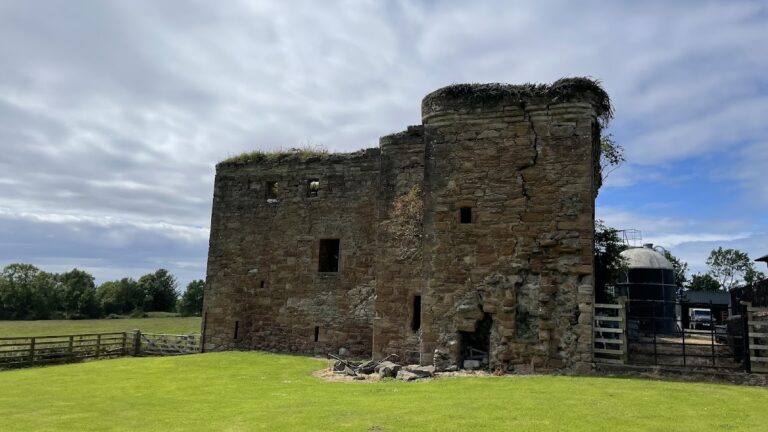
Turnberry Castle occupies a coastal promontory at the end of the lower peninsula in Kirkoswald parish, near Maybole in South Ayrshire. The sea surrounds the spur on three sides, while the landward side is occupied by the Turnberry golf course or resort. The fortress was built of rubble stone and incorporated a broad extent of the underlying rock, indicating that the original structure was a large and strongly built complex. Severe weather and marine erosion have left the castle heavily ruined, with parts of the lower vaults and cellars among the principal surviving elements.
Entrance Defences
Vestiges of a drawbridge survive at the approach to the castle. A drawbridge is a movable bridge used to control access across a defensive approach. An old portcullis, a heavy gridded gate lowered vertically to protect an entrance, also remains and may have formed part of the gateway. Together, these features show how access to the fortress was controlled.
Sea Caves and Lighthouse
Caves leading from the castle site to the sea may have served as a harbour. Their position links the fortress to the surrounding maritime landscape and forms part of the surviving archaeological setting. Turnberry Lighthouse was built on part of the castle site in 1873 and still stands near the ruins. Its grounds are excluded from the scheduled-monument designation.