Horneck Castle: Teutonic Order Commandery and Baroque Palace


Site at a Glance
- Rating
- 4.9
- Popularity
- Very Low
- Country
- Germany
- Primary era
- Early Modern
- Eras represented
- Medieval, Early Modern
- Civilizations
- Crusader, Holy Roman Empire, Teutonic Order
- Site type
- Civic
- Remains
- Palace
On this page10 sections
History
Horneck Castle is a medieval fortress and later Baroque palace in Gundelsheim, Germany, whose origins are probably connected with the Lords of Horneck around 1200. Expanded by the Teutonic Order, a medieval religious-military organization that administered territories through local commanderies, it controlled routes along the Neckar between Heilbronn and Heidelberg together with Guttenberg Castle.
Origins and Teutonic Order expansion
The castle’s beginnings remain uncertain. A Ludovicus de Horneck appears in a document from 1238, and the Lords of Horneck are regarded as possible founders and builders. Around 1250, Konrad von Horneck transferred the castle and his share of Gundelsheim to the Teutonic Order. He entered the order with his two sons and became commander of the newly established Horneck commandery, an administrative and economic district of the order.
The Teutonic Order then enlarged and strengthened the castle. In 1294, it acquired the rest of Gundelsheim from the collegiate foundation of Wimpfen in the Valley. This part of the settlement had previously been imperial property. During the mid-fourteenth century, the older settlement beside the Neckar was abandoned, and Gundelsheim was rebuilt immediately below the castle as an outer-bailey settlement. The town also received municipal rights during this period.
A principal seat of the German Masters
By about 1371, under Philipp von Bickenbach, the Horneck commandery belonged to the chamber domain of the German Master, the senior officer responsible for the Teutonic Order’s German branch and territories. In 1484, Horneck’s commander also became chief official of the former Mainz administrative district of Scheuerberg. The commandery consequently became one of the order’s wealthiest, with its revenues and dues combined with the German Master’s domain and managed by his officials.
Horneck gained particular importance under Eberhard von Seinsheim, its commander from 1420 to 1443. It became the preferred residence and hereditary burial place of the German Masters. Eberhard founded a prayer brotherhood in the castle chapel in 1428 and established an order hospital in Gundelsheim in 1442.
After the Teutonic Order was defeated by united Polish and Lithuanian forces at Tannenberg in 1410, the German Masters moved their permanent residence nominally to Horneck in 1438. They were elevated to the rank of imperial princes in 1494–1495. Horneck thus became one of the order’s three principal seats, alongside Marienburg and Riga. The administration based there included a scribe, first recorded in 1423, a secretary named Herbort Thiel around 1486, and later a chancellor who had official housing in Gundelsheim. King Rupert is said to have stayed at the castle twice in 1401.
Destruction and reconstruction
During the German Peasants’ War, a major uprising in the German lands in 1524–1525, rebellious peasants captured Horneck in 1525. The attack probably took place at the behest of Götz von Berlichingen, a German knight and military commander who lived at nearby Hornberg Castle downstream. The residential and service buildings were completely destroyed, and the castle archive was lost. German Master Dietrich von Cleen fled to Heidelberg before moving his seat, first provisionally and later permanently, to Mergentheim.
The Teutonic Order retained Horneck and rebuilt it soon after the uprising. Because Gundelsheim’s inhabitants had taken part in the revolt, they were fined 1,000 gulden and compelled to provide labor for the reconstruction. The castle also suffered damage during the Thirty Years’ War, but repairs followed immediately. From 1782, Horneck served as the seat of the Neckar Upper District within the Mergentheim master’s domain. From 1789, that district included the offices of Heilbronn, Heuchlingen, Horneck, Kirchhausen, Neckarsulm, and Stocksberg.
From secularization to new uses
Secularization, the transfer of religious-institutional property to a secular state, ended the Teutonic Order’s direct ownership of Horneck. The Kingdom of Württemberg acquired the castle in 1805, and the complex became a barracks. After entering private ownership in 1824, it was used at different times as a hospital, sanatorium, naturopathic health institution, and brewery.
Shortly after the Second World War, American forces used the castle as a military hospital. From 1946, under Rudolf Haußer, it was converted into a pulmonary sanatorium. The sanatorium moved to a newly built facility in Löwenstein in 1960.
The Siebenbürgen Homeland House
After the sanatorium closed, Transylvanian Saxons living in Germany, a German-speaking community historically established in Transylvania, acquired the complex through the Johannes Honterus association. They established the Siebenbürgen Homeland House there. The castle now contains the collections and extensive library of the Transylvania Institute, as well as the Transylvanian Museum, which presents the history and culture of the Transylvanian Saxons outside Romania.
The Johannes Honterus association operated an elderly residence in the castle and a nursing home in a neighboring new building until it became insolvent in 2015. The Association of Transylvanian Saxons in Germany then bought the castle from the insolvency estate, while another operator took over the nursing home. Conversion of the former elderly residence into a cultural and meeting center began in 2016. Comprehensive renovation in 2020 produced a complex with a bed-and-breakfast hotel, library, and museum. Cultural events are held in the Baroque banqueting hall.
Remains
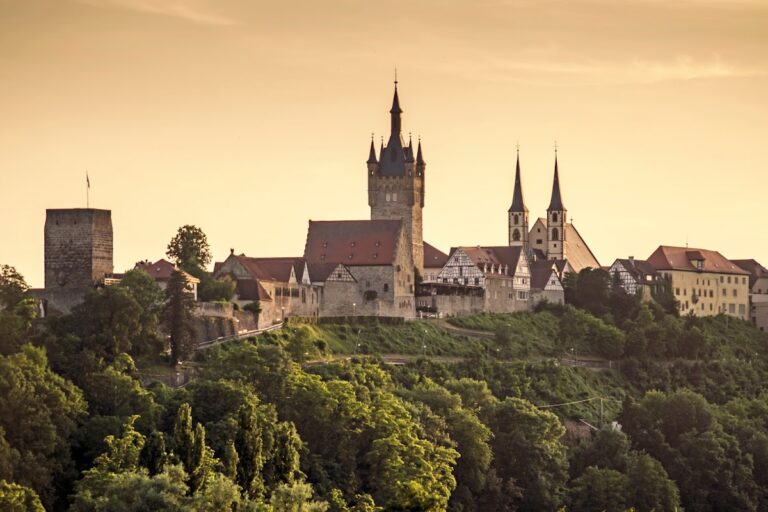
Horneck stands above the Neckar River in a dominant position overlooking Gundelsheim and the Neckar valley. The surviving complex combines defensive elements of the Teutonic Order castle with a Renaissance rebuilding after 1525 and an eighteenth-century Baroque palace. The name Horneck is thought to mean “over the Neckar.”
Fortifications and palace structure
The keep is regarded as the only surviving building element believed to date from the castle’s foundation period. After the destruction of 1525, a massive Renaissance building of several stories was raised within largely preserved defensive walls and towers. Its plan formed an irregular heptagon around the keep, with numerous towers and oriels.
Between 1720 and 1724, master builder Franz Keller remodeled the complex as a comparatively plain Baroque palace. The Renaissance towers and oriels were demolished, but the keep was retained because its planned removal was considered too expensive. Sections of the fortification walls and towers survive behind the commandery, preserving parts of the earlier defensive enclosure.
Town portal and commemorative features
A portal facing the town was built in 1730. Its decoration incorporated tomb monuments of Teutonic knights from the former fifteenth- and early-sixteenth-century castle chapel. Some of those monuments survive as plaster casts. Above the portal are allegorical figures of Fortitude, holding a column, and Christian Charity, holding a flaming urn. Between them is the heraldic achievement of Franz Ludwig of the Palatinate, who was both High Master, the supreme leader of the Teutonic Order, and German Master. Two lions support the achievement.
Interior spaces and museum collections
An interior portal bears inscriptions, and the library contains a sixteenth-century tomb slab of a German Master. The former castle chapel is now used as the treasury of the Transylvanian Museum. On the second upper storey, the banqueting hall retains a Baroque stucco ceiling and ceiling paintings.
The main building displays an extensive collection of paintings with Transylvanian motifs. The Transylvanian Museum occupies approximately 600 square meters of exhibition space within the complex, while the wider Siebenbürgen Homeland House also encompasses the collections and library of the Transylvania Institute.