Château de Meillonnas: A Fourteenth-Century Fortified Castle


Site at a Glance
- Rating
- 4.4
- Popularity
- Very Low
- Country
- France
- Primary era
- Medieval
- Eras represented
- Medieval
- Civilizations
- Duchy of Savoy
- Site type
- Military
- Remains
- Castle
On this page7 sections
History
Château de Meillonnas is a former fourteenth-century fortified castle in Meillonnas, France, built during the medieval period as the center of the lordship of Meillonnas. A lordship was a territory whose holder exercised authority over its land and inhabitants. The castle later became associated with a faience manufactory, a workshop producing tin-glazed earthenware, which helped make the village widely known.
From Coligny to Savoy
The lordship initially belonged to the lords of Coligny until the early thirteenth century. It then passed successively to the lords of La Tour-du-Pin, the Dauphins of Viennois, who ruled Dauphine, and the palatine counts of Burgundy, a high-ranking comital dynasty associated with the County of Burgundy. In 1289, the lordship was transferred to Amédée V, Count of Savoy.
Around 1325, Edward, Count of Savoy, granted Meillonnas to Humbert de Corgenon, the bailiff of Bresse. A bailiff was a territorial official entrusted with delegated administrative and judicial authority. Humbert de Corgenon passed the lordship to his second son, also named Humbert, who began constructing the castle around 1350. He also obtained the rights of high, middle, and low justice, meaning several levels of judicial jurisdiction over the territory.
The Corgenon and Seyssel succession
After the death of Jean de Corgenon, the lordship passed through Aimée de Corgenon, her husband Urbain de La Chambre, and their descendants. Bonne de La Chambre brought Meillonnas by marriage to Philibert de Seyssel, Lord of Aix. Their sons Gabriel and Louis de Seyssel subsequently held the lordship jointly.
In 1460, Gabriel and Louis de Seyssel received the right to erect a four-pillared gallows at Meillonnas. Such a permanent gallows represented a lord’s authority to exercise criminal justice. Françoise de La Chambre, Gabriel de Seyssel’s wife, later inherited the estate after the early death of her son, François-Philibert de Seyssel. By her will of 21 November 1529, she left Meillonnas to her nephew Charles de La Chambre on the condition that he adopt the Seyssel name and retain its arms without alteration.
The Marron family and later use
The land remained with the La Chambre-Seyssel family until 22 January 1740, when Victor-Amé de Seyssel Asinari sold it for 61,900 livres to Nicolas de Marron, a squire. The castle and title later passed to Nicolas de Marron’s nephew, Gaspard Constant Hugues de Marron, and to his wife, Marie-Anne Carrelet de Marron. The family still held the estate as a barony, a lordship held under the title of baron, when the Estates-General were convened. This representative assembly of the French kingdom brought together the clergy, nobility, and Third Estate.
At a later stage, the castle housed a faience manufactory, linking the medieval seigneurial residence to the industrial activity for which Meillonnas became known. The castle, its plots, adjoining land, and the former locality called Pré aux fosses were listed as historic monuments by an order of 4 July 2007. This is a formal French heritage-protection status for buildings and sites recognized for their historical or architectural importance.
Remains
Fortified medieval fabric
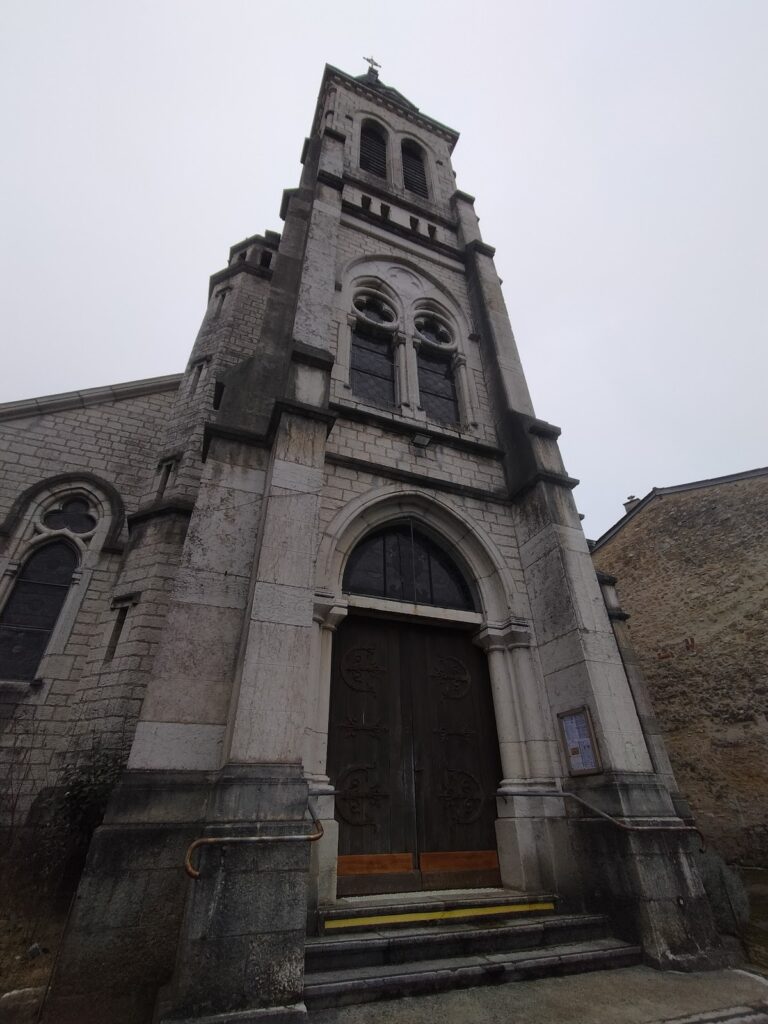
Constructed from around 1350, the castle was repeatedly altered and, before the French Revolution, comprised six towers together with numerous dependencies. Three towers and sections of the enclosing walls survive as traces of the medieval fortified complex. The church was built against one of the castle towers, preserving a direct physical relationship between the religious building and the earlier defensive structure.
Mural paintings
The building also contains mural paintings dating from the fifteenth and sixteenth centuries. These surviving painted interiors belong to the period when the castle was held by the Corgenon, La Chambre, and Seyssel lineages and provide evidence of the residence’s continued use after its medieval construction.