Keseburg: A Medieval Hilltop Castle in Germany


Site at a Glance
- Rating
- 3.6
- Popularity
- Very Low
- Country
- Germany
- Primary era
- Medieval
- Eras represented
- Medieval
- Civilizations
- Holy Roman Empire
- Site type
- Military
- Remains
- Castle
On this page7 sections
History
Keseburg is a ruined medieval hilltop castle in Germany, near present-day Ederbringhausen in Hesse. It was probably built in the eleventh century by the Counts of Ziegenhain and Reichenbach, and it later became the seat of the bailiffs of Keseberg, officials who exercised administrative, judicial, or protective authority for a ruler or religious institution.
Early records and dynastic succession
The castle first appears in written records in 1144 under the name Caseberch, when it was identified as the seat of the bailiffs of Keseberg. In 1186, the marriage of Lukardis, daughter of Count Gozmar II of Ziegenhain-Reichenbach, to Friedrich of Ziegenhain transferred Keseburg and Wildungen to Friedrich. He subsequently adopted the title Count of Wildungen.
Their daughter Sophia married Burgrave Burchard VI of Magdeburg, a noble official responsible for governing or commanding a castle and its surrounding territory. Before 1227, Burchard sold Keseburg and Wildungen to Landgrave Ludwig IV of Thuringia, known as “the Saint.” He did so without the consent of his wife or her family, creating a dispute between the Ziegenhain family and the Ludovingians, the ruling dynasty of medieval Thuringia.
Transfer to Thuringia and Mainz claims
In 1233, Count Berthold I of Ziegenhain reached an agreement with Landgrave Konrad of Thuringia, who administered the Ludovingian possessions in Hesse for his brother, Landgrave Heinrich Raspe. Keseburg consequently passed definitively to the Landgraviate of Thuringia, a medieval principality ruled by a landgrave, a territorial ruler broadly comparable to a prince.
The court district of Geismar, where Keseburg stood, remained a fief of Mainz held by the bailiffs of Keseberg. A fief was land or jurisdiction granted by a superior lord in return for service or loyalty. A legal decision in 1244 confirmed that the land on which the castle stood belonged to the landgrave, while the surrounding area belonged to Haina Monastery, a Cistercian monastery in Hesse.
After Heinrich Raspe died in 1247 and the Ludovingian male line ended, Archbishop Siegfried III of Mainz attempted to recover the landgraves’ Mainz fiefs. Burchard VI had also died, and his widow, Countess Sophia of Wildungen, transferred her rights to Keseburg and Wildungen to the archbishop, intending to sell both castles to Mainz. Burchard’s relatives rejected the transfer, however, and both castles remained in landgravial possession.
Destruction and later replacement
During the Thuringian-Hessian War of Succession, a conflict over territorial inheritance that lasted from 1247 to 1277, the bailiffs of Keseberg allied themselves with the Counts of Ziegenhain and resisted Hessian claims to feudal authority. Landgrave Heinrich I of Hesse destroyed Keseburg in 1277. He then granted the castle hill and the surviving castle remains, together with the probably also destroyed settlement known as Alte Stadt, to Haina Monastery as freehold property.
The Lords of Keseberg submitted to the landgrave and were required to move to their estate at Geismar. Between 1342 and 1348, Landgrave Heinrich II built nearby Hessenstein Castle as a replacement and as a fortified administrative seat for his local bailiffs. The Lords of Keseburg later served there as castle-men, nobles assigned to garrison and maintain a castle. In 1360, Widekind, bailiff of Keseberg, returned his fief, part of the Geismar district, to Archbishop Gerlach of Mainz. Keseburg itself remained a ruin.
Remains
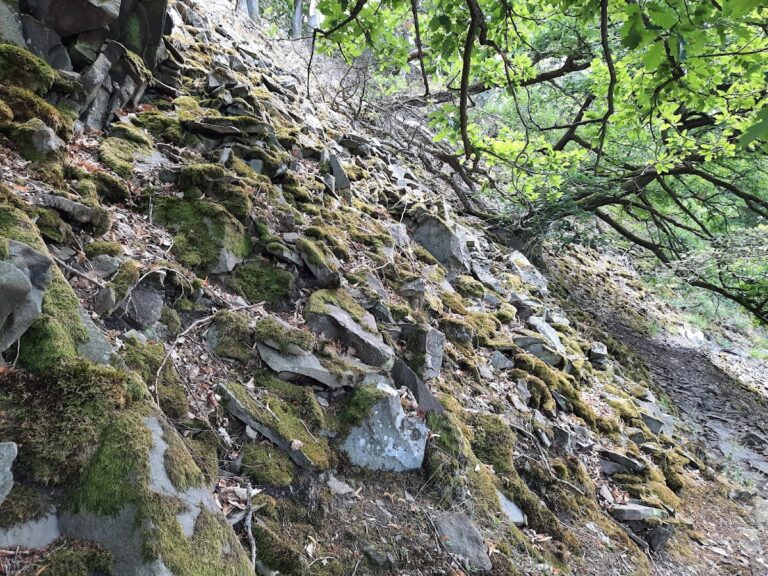
The surviving site is arranged as a hilltop fortification on a northern spur of Keseberg, with defensive earthworks and masonry remains occupying the elevated ground. Keseburg stands at approximately 385 metres above sea level, below the mountain summit at 431.2 metres, and lies on the western edge of the Kellerwald, about 1.2 kilometres east of Ederbringhausen.
Landscape setting
The ruin lies in an isolated woodland setting within the Kellerwald-Edersee Nature Park. From the spur, the castle overlooked the mouth of the Orke near Ederbringhausen, where that river joins the Eder, as well as parts of the Eder valley to the west and north. Burg Hessenstein is situated about one kilometre to the south, beyond Keseberg.
Ramparts and masonry
A clearly visible double rampart-and-ditch system survives around the castle site. The neck ditch, a defensive ditch cut across the narrow land connection between a fortification and the surrounding terrain, is especially distinct. Sections of the keep and other masonry remain above ground, preserving parts of the castle’s defensive and internal structure. An information board stands beside a surviving section of masonry.
Nearby sites