Burgstall Schlösslesberg: A High-Medieval Motte Castle Site in Germany


Site at a Glance
- Rating
- 3.1
- Popularity
- Very Low
- Country
- Germany
- Primary era
- Medieval
- Eras represented
- Medieval
- Civilizations
- Holy Roman Empire
- Site type
- Military
- Remains
- Castle
On this page6 sections
History
Burgstall Schlösslesberg is a high-medieval motte castle site in Germany, near Steinekirch within Zusmarshausen, Bavaria. Its raised-earth design belongs to the motte type, a castle centred on an artificial mound that usually carried a principal building and was paired with an adjoining bailey. The site may have served as the residence of a ministerial family, members of the service nobility who held administrative, military, or court offices for a ruler or ecclesiastical lord, or of a noble family with independent status.
Possible Medieval Functions
The castle stands about two kilometres from the large high-medieval Wolfsberg Castle. One interpretation identifies it as the residence of a sub-vassal of the Lords of Wolfsberg, the influential ministerial family known as the Fraß von Wolfsberg. Another possibility connects the site with a forestry or land-clearing estate of the Augsburg prince-bishopric, an ecclesiastical principality governed by the prince-bishop of Augsburg.
The site rises above a modern artificial fishpond on Fischerberg. The pond may have had a medieval predecessor, and a castle mentioned at Weiherloh may possibly be identified with Burgstall Schlösslesberg. That identification remains uncertain, so the site’s medieval role cannot be assigned with confidence.
Archaeological Investigation and Status
Archaeological investigations by the Augsburg Working Group for Prehistory and Early History, led by Otto Schneider, found that the main mound had held a wooden building and a gate structure. Pottery recovered from the site dates from the twelfth to the fourteenth century. The Bavarian State Office for Monument Protection lists Burgstall Schlösslesberg as a medieval castle site and archaeological monument under designation number D 7-7629-0013.
Remains
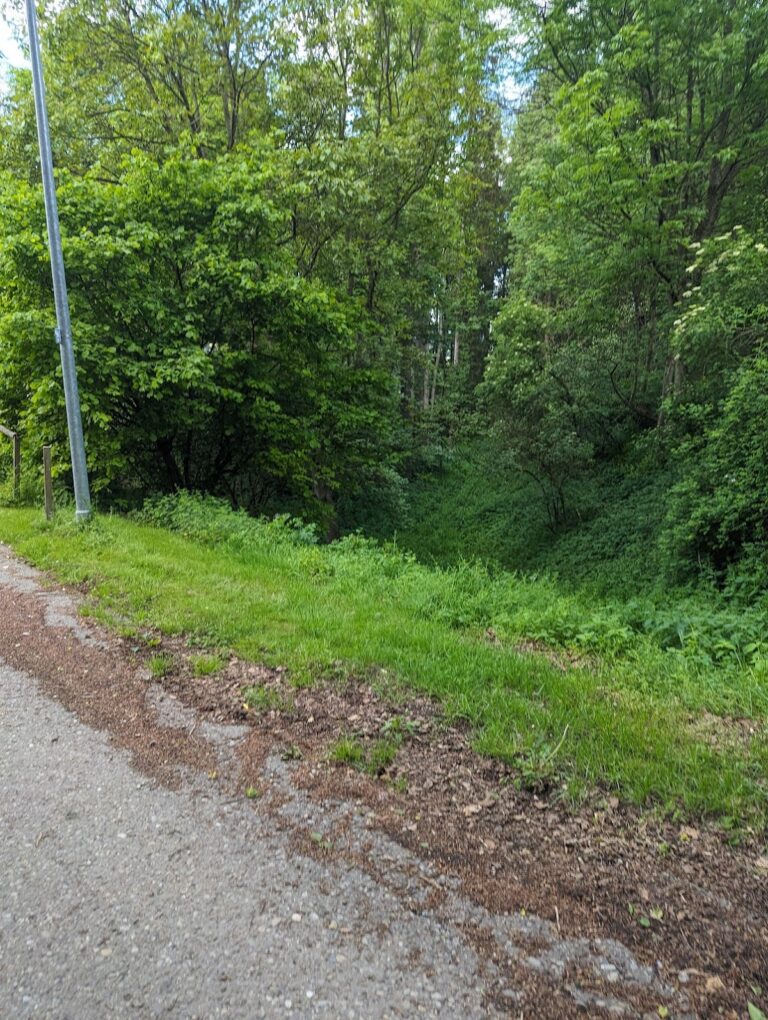
Burgstall Schlösslesberg occupies an approximately 60 by 100 metre, two-part hilltop site on a spur of Fischerberg, about two kilometres northeast of the parish church of Steinekirch. A rectangular outer bailey lies beside a large, approximately square motte. The earthworks define the surviving arrangement of the castle, while dense young woodland now makes parts of the outer-bailey area difficult to trace and traverse.
The Motte and Its Defences
The principal mound is an earthen cone about 13 metres high. A flat-bottomed ditch curves around it in a horseshoe shape and reaches up to five metres deep. The truncated summit originally measured approximately 25 by 25 metres. Archaeological evidence places a wooden building on this summit, while a gate structure formed part of the defensive arrangement. Several wind-thrown trees have damaged the mound, and erosion has caused sections of its slopes to slip.
The Outer Bailey and Ramparts
The outer-bailey plateau lies west of the motte, with artificially steepened slope edges. Two further ramparts survive in front of the castle’s northern side. The earthworks are partly obscured by young woodland, which limits their visibility and makes movement across the area difficult.
Nearby sites