Castle of Santiuste, Corduente: A Fifteenth-Century Fortified Residence


Site at a Glance
- Rating
- 4.3
- Popularity
- Very Low
- Country
- Spain
- Primary era
- Medieval
- Eras represented
- Medieval
- Civilizations
- Crown of Castile
- Site type
- Domestic
- Remains
- Castle
On this page7 sections
History
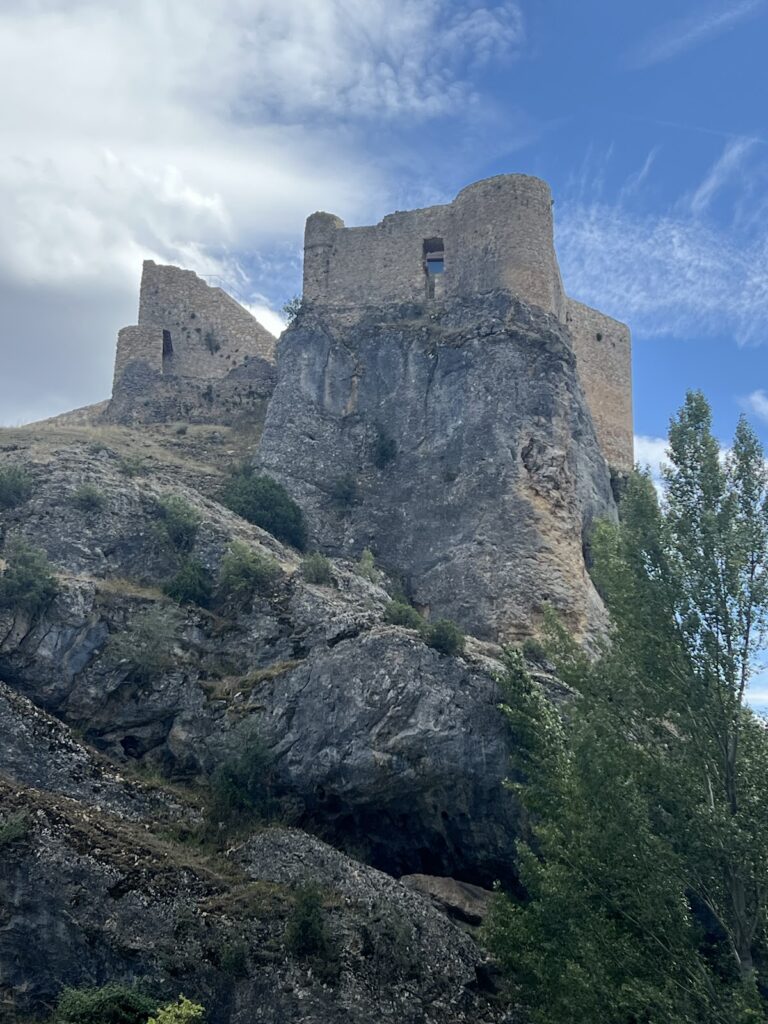
The Castle of Santiuste, Corduente, is a fifteenth-century fortification in Spain, located at Santiuste east of Corduente in Guadalajara. Its period of use extended from the fifteenth to the eighteenth century. Although its substantial form suggested a military purpose, it had limited defensive value and served mainly as a fortified residence and palace.
Foundation and Destruction
Corduente was purchased in 1410 by Juan Ruiz de Molina, a bachelor of laws also known as Juan Ruiz de los Quemadales and, most notably, the Caballero Viejo. In 1434, he received permission from Juan II of Castile, the fifteenth-century king of the Crown of Castile, to build a castle in support of the war against the Crown of Aragon, a major Iberian monarchy whose territories sometimes came into conflict with Castile during the late Middle Ages.
Diego Hurtado de Mendoza y Figueroa’s troops destroyed the castle in 1447, after which it was rebuilt. Until its later destruction, it served as the residence of the Ruiz de Molina family’s heirs, the Marquises of Embid, members of the Spanish nobility who held the marquisate of Embid.
Ruin and Reconstruction
The castle was ruined and almost destroyed after the 1755 earthquake that devastated Lisbon and affected much of the Iberian Peninsula. In 1971, a private individual acquired the property and commissioned its extensive reconstruction, which was carried out by Antonio Ruiz Alonso. The castle is protected as an Asset of Cultural Interest, the Spanish designation for a property recognized as having cultural heritage importance.
Remains
Castle Layout and Defenses
Main Castle
The castle stands on a plain and has a square plan with a perimeter of approximately 100 metres. It is built of ashlar stone, with four square corner towers. Each tower rises four storeys above a basement. Three towers retain crenellations, the alternating raised sections and openings along a parapet, while the fourth is roofed.
An enclosed courtyard occupies the centre. Semicircular arches form part of its arrangement, and a wall divides the courtyard into two sections. The principal facade faces east. Its entrance has a semicircular arch surmounted by the coat of arms of the Ruiz de Molina family. The castle has been restored following the extensive reconstruction undertaken after its ruin.
Barbican
A crenellated barbican, an outer fortified enclosure protecting a castle entrance, surrounds the castle. It includes four corner turrets and two additional turrets placed to protect the entrances, extending the site’s defensive arrangement beyond the main square building.