Burg Klingenstein: A Medieval Hilltop Ministerial Castle in Germany


Site at a Glance
- Rating
- 3.5
- Popularity
- Very Low
- Country
- Germany
- Primary era
- Medieval
- Eras represented
- Medieval
- Civilizations
- Holy Roman Empire
- Site type
- Military
- Remains
- Castle
On this page7 sections
History
Burg Klingenstein is a medieval hilltop ministerial castle in Germany, located in Klingenstein, now part of Blaustein in Baden-Württemberg. A ministerial castle was a fortified residence associated with a medieval service noble who served a higher-ranking lord or institution. Built from the eleventh century onward by the Lords of Stain zu Klingenstein, Burg Klingenstein is first documented in 1215 and was abandoned after 1588.
Three Castle Complexes
The site developed as three connected but distinct castle complexes. The Upper Castle took shape during the eleventh and twelfth centuries. The Middle Castle followed in the thirteenth and fourteenth centuries, while the Lower Castle was built in the fifteenth century. This sequence reflects the long development of Burg Klingenstein from an earlier hilltop stronghold into a more extensive complex.
Later History and Preservation
The northern Lower Castle eventually provided the foundations and vaulted cellars for the present Schloss Klingenstein. Schloss is a German term for a palace or castle residence, distinguished in name from a fortified Burg. The former castle was abandoned after 1588, but the later residence remained associated with the complex.
Since 1974, the Leube Foundation, a civil-law foundation, has been responsible for preserving the castle ruins, Schloss Klingenstein, and their associated facilities. In 2015, the German Foundation for Monument Protection supported restoration of the masonry of the Middle Castle’s shell-tower ruin. A shell tower has a curved defensive outer wall with an open or less substantial inner side.
Remains
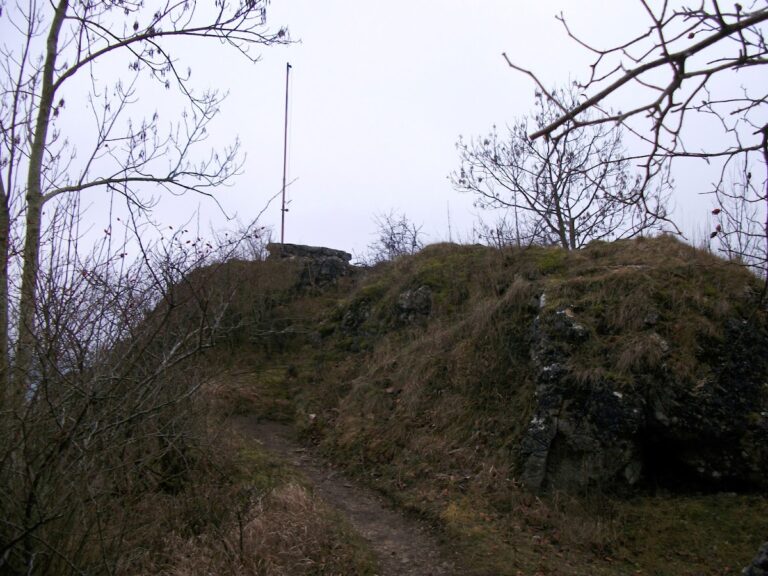
Burg Klingenstein lies at an elevation of 559 metres above sea level. The surviving castle fabric consists mainly of masonry remains above Schloss Klingenstein, while the later residence survives as a built structure connected with the former complex. The ruins preserve evidence of the Upper, Middle, and Lower Castles and their different periods of construction.
Upper Castle
The Upper Castle occupied the earliest phase of the site and included a keep, a castle courtyard, a chapel, a main building, a neck ditch, an outer bailey, and a drawbridge. A neck ditch is a defensive ditch cut across the approach to a hilltop fortification. Only the foundation walls of the keep remain from this upper complex.
Middle Castle
The Middle Castle formed the southern boundary of the larger complex. Its features included a battlement walk and a basemented main building known as the gatehouse. A shell tower also survives in a well-preserved state, although its masonry has undergone restoration. The tower’s curved outer wall reflects the defensive construction associated with this middle phase.
Lower Castle
The Lower Castle formed the northern part of Burg Klingenstein and was built in the fifteenth century. Its foundations and vaulted cellars are incorporated beneath the present Schloss Klingenstein, preserving part of the lower complex within the later building. Together, these remains show how the fifteenth-century castle was transformed into the structure that occupies the site today.
Nearby sites