Balmburg: A Medieval Cave Castle Site in Switzerland

Site at a Glance
- Rating
- 4.5
- Popularity
- Very Low
- Country
- Switzerland
- Primary era
- Medieval
- External website
- Open
- Eras represented
- Medieval
- Civilizations
- Holy Roman Empire
- Site type
- Military
- Remains
- Castle
On this page5 sections
History
Balmburg, a medieval cave castle site in Switzerland, lies near Bachs in the Canton of Zurich. Also called Balmburg Hohfluh, Grottenburg Hohfluh, and Erdmännliloch, it dates to the High Middle Ages, the central period of medieval history. The site is the only known cave castle in the canton, although its builders, social status, and precise historical role remain unknown.
Medieval Use
One interpretation places Balmburg at the center of a small community involved in clearing land. Another suggests that it formed part of a fence-built defensive barrier across the Bachsertal, a barrier mentioned around 1500. A connection with Waldhausen Castle is considered plausible and survives in local legends.
Small finds recovered during excavations in 1850 and 1878 indicate that the castle was still in use during the Late Middle Ages, the later period of medieval history. The remains were probably destroyed by fire. Soot-blackened tuff stones at the upper edge of the cave and a charcoal layer about 25 centimetres thick support this interpretation.
Remains
Rock Shelter and Defensive Wall
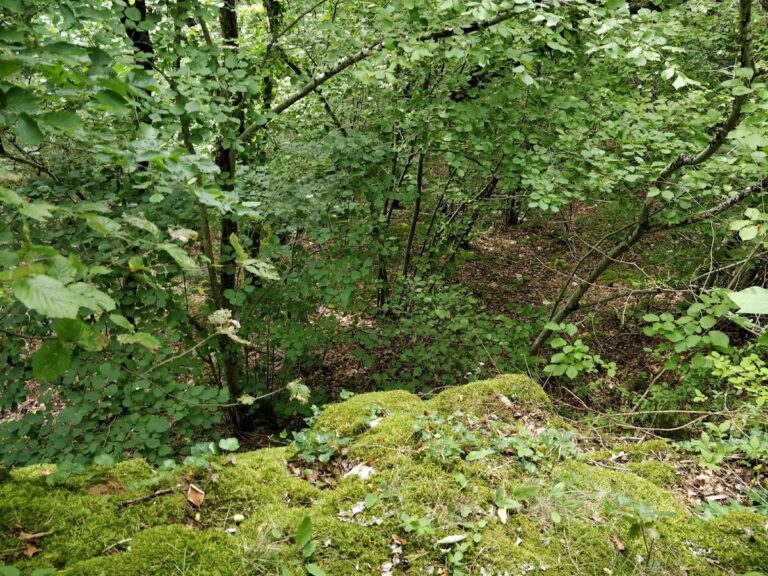
The ruins stand at about 514 metres above sea level on the western slope of the Sanzenberg, above the Bachsertal and close to the boundary between the Cantons of Zurich and Aargau. The castle occupied the base of an overhanging Nagelfluh rock face, a conglomerate formed from naturally cemented rounded stones. A steep wooded slope descends from the rock face toward the valley floor, while the cave itself extends approximately 12 metres into the rock.
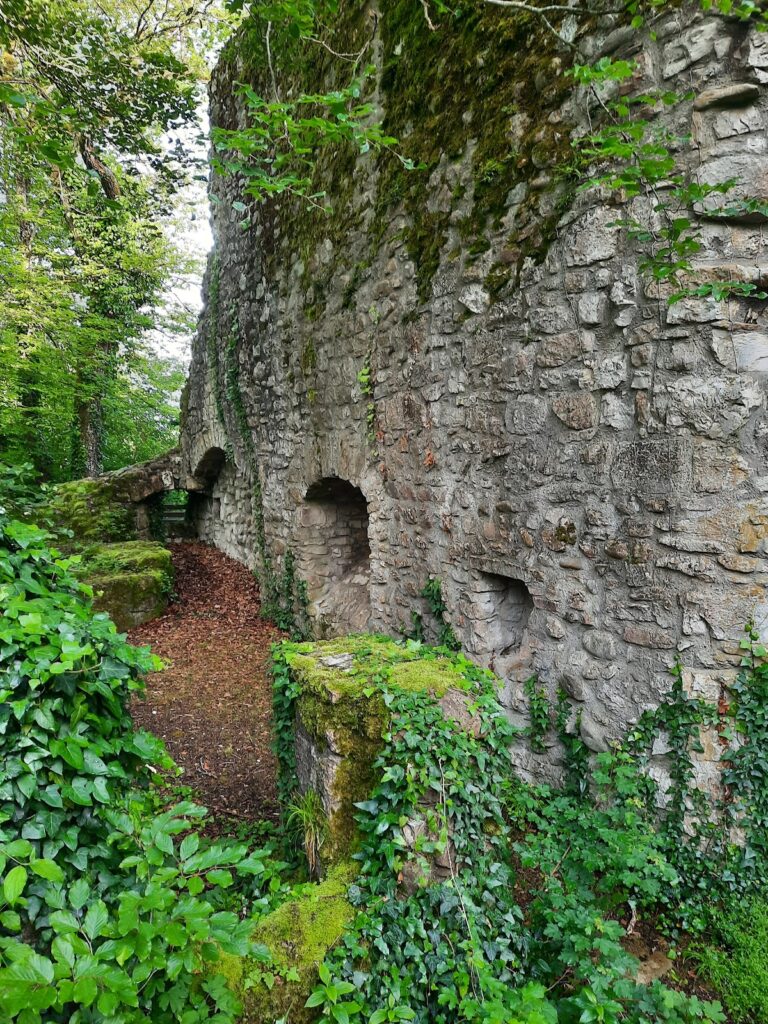
A wall of rounded stones, about 1.8 metres thick, blocked the cave entrance and followed the line of the overhang. Several metres survive at both sides of the entrance, whereas only the foundation remains across the front section. The wall incorporated the natural shelter into the castle’s defensive and habitable structure.
Vault and Lookout
Tuff blocks, a relatively porous stone formed through mineral deposition from water, remain above the entrance in the soot-blackened area. They indicate that a former vault closed the upper part of the cave. Traces of beam supports are preserved in the rock, providing further evidence of the former construction.
A projecting section of rock south of the cave probably served as a lookout post. The arrangement resembles the Riedfluh cave castle near Eptingen in the Canton of Basel-Landschaft, which was rediscovered in 1968 and later archaeologically investigated and restored.