Halidzor Fortress: A Historic Armenian Stronghold near Kapan


Site at a Glance
- Rating
- 5
- Popularity
- Very Low
- Country
- Armenia
- Primary era
- Early Modern
- Eras represented
- Early Modern
- Civilizations
- Armenian
- Site type
- Military
- Remains
- Castle
On this page17 sections
History
Halidzor Fortress is an Armenian fortified complex in Armenia, about 1 km northeast of Kapan in Syunik Province. The present fortress was built during the first half of the seventeenth century, when it initially served as a convent for nuns before becoming the family castle of the influential Melik Parsadanian family of Beh. Its history also reaches back to the tenth century, when the settlement associated with Halidzor was transferred to Tatev Monastery.
From settlement to convent and castle
The name Halidzor derives from the settlements of Ale and Alis. In the tenth century, Princess Hamasaspui transferred the settlement to Tatev Monastery, a major Armenian religious institution in Syunik. The monastery used it as a fortress until the fourteenth century, preserving the site’s connection with both ecclesiastical and defensive life.
The present complex took shape much later, in the first half of the seventeenth century. It was established as a convent for nuns and later served for a period as the family castle of the Melik Parsadanian family of Beh. This combination of monastic and aristocratic use formed the setting for its later military transformation.
David Bek and the eighteenth-century resistance
During the eighteenth century, David Bek, an Armenian military commander and resistance leader, rebuilt the castle as a fortress. With Mkhitar Sparapet, his principal lieutenant and successor, he used Halidzor as his main headquarters and as an administrative center of Syunik during the struggle against Ottoman and Persian forces. The monastery continued to function within the military stronghold, and the Church of Saint Astvatsatsin, whose name means Holy Mother of God, was reconstructed in 1723.
In 1727, an Ottoman army besieged Halidzor for seven days. David Bek, about 300 soldiers, 13 bishops, and three priests took part in the defense, while the nuns also joined the fighting. The fortress’s difficult defensive position helped the smaller force withstand the siege. When the defenders were exhausted and short of food, they launched a desperate attack down the slope. The Ottoman army reportedly withdrew, leaving about 12,000 Ottoman dead on the battlefield.
Death, capture, and destruction
David Bek died at Halidzor in 1728 after falling ill. Oral tradition says that an elderly bishop from Tatev arranged a large funeral and that Bek was buried in the cemetery outside the fortress walls. The same tradition holds that his gravestone carried a single carved flower on its lower side, intended to prevent enemies from recognizing the burial place.
After Bek’s death, the Ottoman army captured and destroyed Halidzor in 1729. Mkhitar Sparapet and Father Avetis had gone out to negotiate after being promised safety for the garrison and residents. They were killed after the fortress gates opened, and some defenders also died. Civilians and a small group of soldiers were reportedly allowed to leave.
Restoration and protection
Restoration and reconstruction between 2006 and 2010 rebuilt the Church of Saint Astvatsatsin, three walls, and the southern entrance. Halidzor is now a state-protected cultural heritage monument in Armenia.
Remains
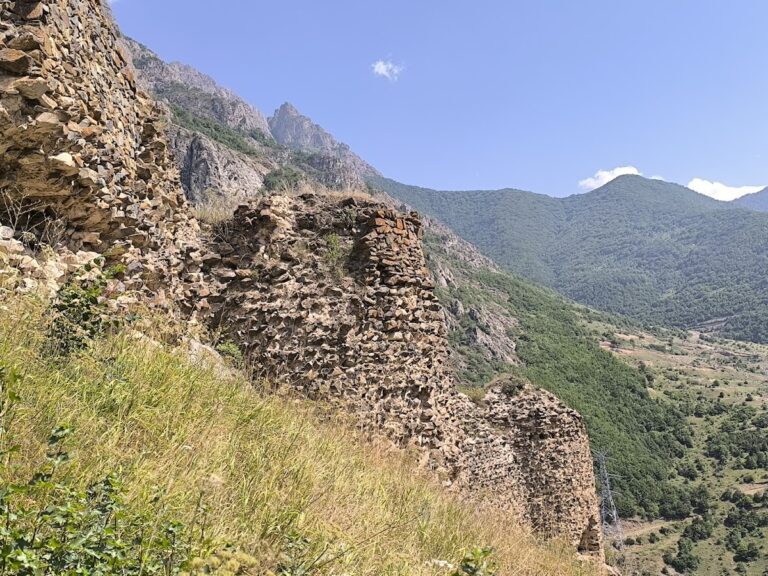
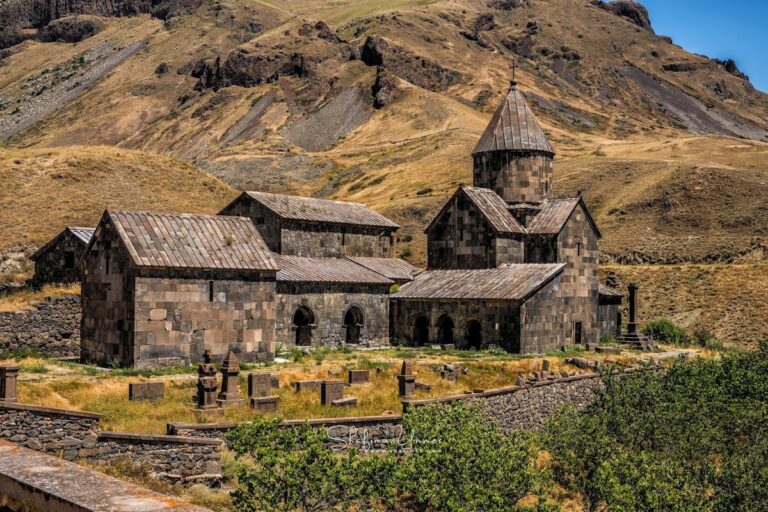
Halidzor occupies a hill above the right bank of the Voghdji River, at about 1,051 metres above sea level. Kapan lies approximately 1 km southwest of the fortress. The complex follows an irregular quadrilateral plan enclosed by a powerful wall about 50 metres long and approximately 1 metre thick. Towers strengthen the enclosure, including a rounded tower at the southwestern corner. Two arched portals pass through the fortification walls, while a steep slope descends from the eastern side toward the river. A terrace extends along the northern and eastern sides of the fortified area.
Fortifications and monastic buildings
Walls, towers, and entrances
The enclosing wall and its towers define the fortress’s irregular plan. The two arched portals provided passage through the defenses, and the steep eastern slope added to the site’s protection. The southern entrance and three sections of wall were rebuilt during the restoration carried out from 2006 to 2010.
Northern and southern buildings
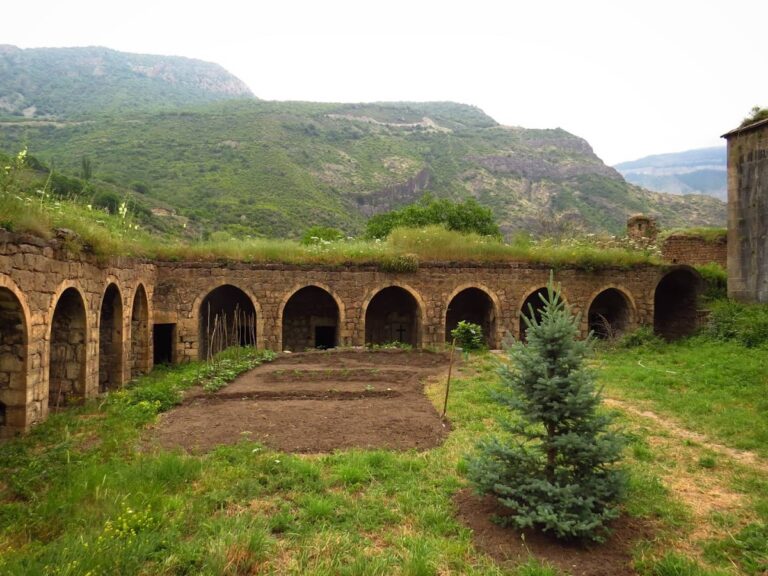
Two-storey buildings stood along the northern and southern sides of the enclosure. They served as parish or monastic buildings, and their roofs could be used to fire on attackers. A rectangular building adjoining the southern wall functioned as a guardroom for the monastery.
Churches and internal structures
Church of Saint Astvatsatsin
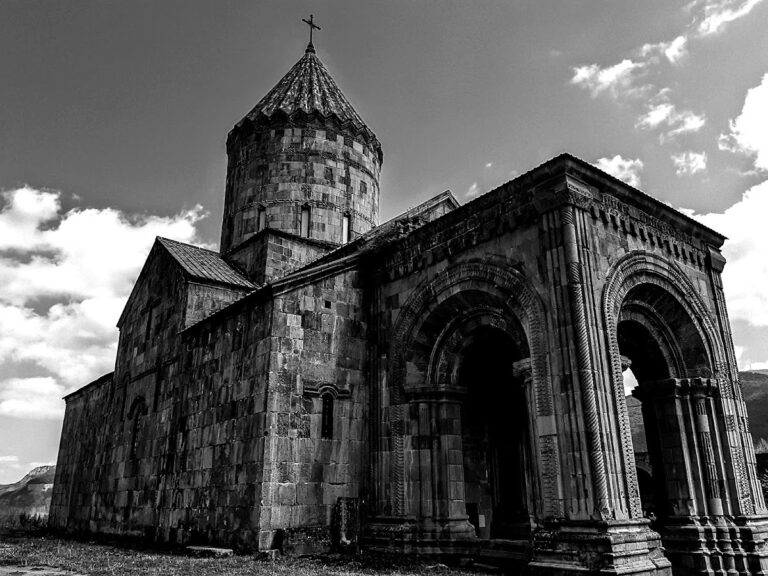
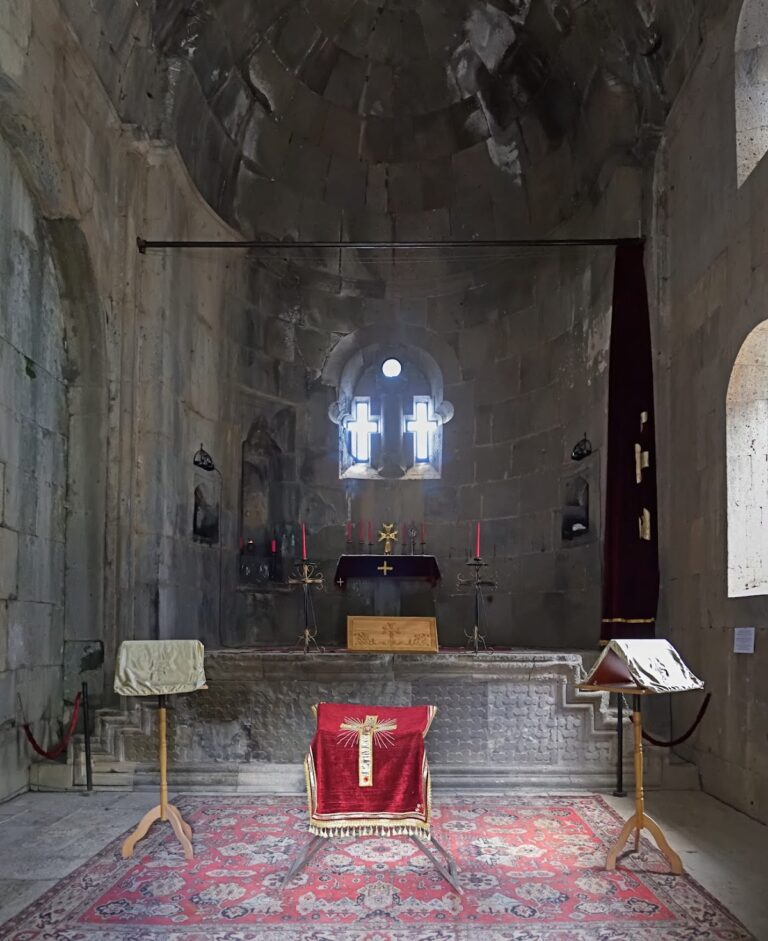
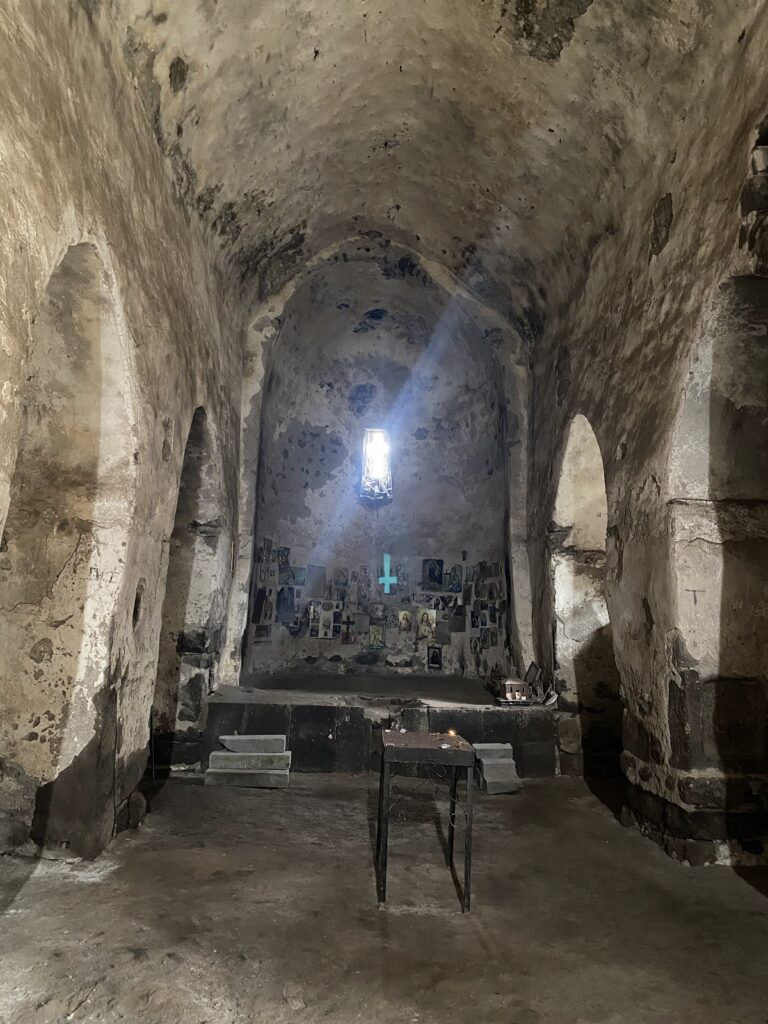
The Church of Saint Astvatsatsin is a vaulted hall, meaning that its interior is covered by one continuous vault rather than separate domes. It is built of rough basalt and forms part of the ecclesiastical group within the fortress. The building was reconstructed in 1723 and rebuilt again during the modern restoration.
Eastern church
Another church on the eastern side has a similar composition and comparable dimensions. It is a vaulted hall constructed from large rubble masonry. Sacristies stand beside its apse, the semicircular sanctuary end, and remains of two-storey porticoes survive along its northern and southern walls.
Church of Saint Minas and chapel
The remains of the Church of Saint Minas and a chapel survive within the fortress. Saint Minas was built with a technique similar to that used for the eastern church, and its eastern courtyard was enlarged.
Refectory and monastic cells
A refectory, or communal dining hall, stands on the northern side. Monastic cells remain beside the western wall, alongside foundations and fragments of other internal buildings and former residential structures.
Water access and cemetery
Secret tunnel
A reportedly 500-metre secret tunnel led from the fortress to the bank of the Voghdji River. It provided access to fresh water during a siege. The tunnel is now covered, and parts of it are ruined.
Old cemetery
An old cemetery survives outside the fortress walls. Its gravestones form part of the setting associated with Halidzor’s religious community and with the tradition concerning David Bek’s burial.
Nearby sites