Johnstone Castle: A Former Mansion and Surviving Tower in Scotland


Site at a Glance
- Rating
- 4.3
- Popularity
- Very Low
- Country
- United Kingdom
- Primary era
- Early Modern
- External website
- Open
- Eras represented
- Early Modern, Modern
- Civilizations
- British, Kingdom of Scotland
- Site type
- Domestic
- Remains
- Castle
On this page7 sections
History
Johnstone Castle is a former mansion and ruin in Johnstone, Scotland, United Kingdom. Its construction date is uncertain: the house is associated with 1560, while another description identifies it as an eighteenth-century building. The estate later became associated with the Houstons of Milliken and developed into a substantial country residence.
The Houston estate
The Houstons of Milliken acquired the Easter Cochrane estate in 1773. The house had already been enlarged in 1771, and George Houston extended it again in 1812. This later remodelling gave the mansion a castellated appearance and added a turret to the left of the front elevation. The design may have been by James Gillespie Graham, a Scottish architect known for historicist and castellated buildings.
The continued growth of Johnstone gradually reduced the estate. By the beginning of the twentieth century, most of its grounds had disappeared. Much of the house was demolished in 1950, and the local authority bought most of the remaining grounds in 1956 for housing development.
Chopin’s visit in 1848
Frédéric Chopin, the nineteenth-century Polish composer and pianist, visited Johnstone Castle in 1848 during his tour of Scotland. Anne Houston, the wife of Ludovick Houston, the fifth laird of Johnstone, invited him. Her sister, Jane Wilhelmina Stirling, had arranged the tour. A laird was a Scottish landowner associated with an estate and residence.
Chopin initially admired the property, describing the house as handsome and opulent, with life conducted on a grand scale. When the weather worsened, however, he wrote that he felt ill and depressed and was exhausted by the excessive attentions of those around him. During the visit, one of the two horses pulling his carriage reared and broke loose. The carriage struck a tree and broke apart while Chopin was inside, but he escaped from the wreckage.
Survival and protection
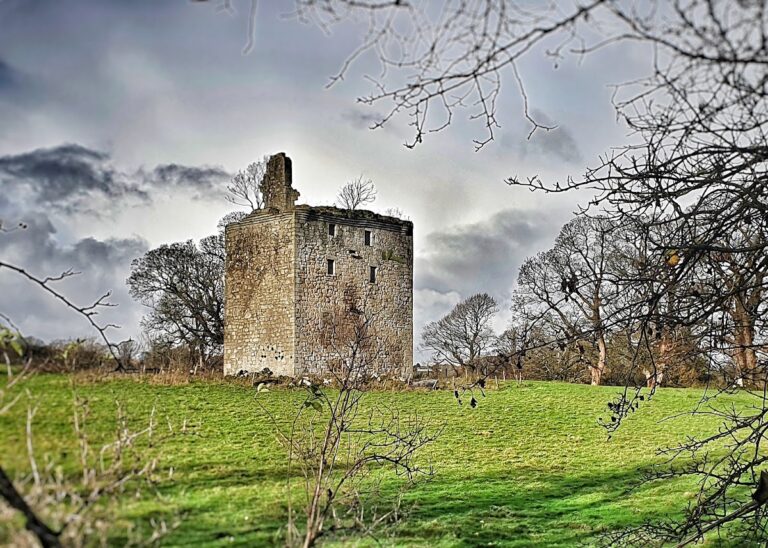
The remaining tower fell into disrepair before its purchase in 2001 and conversion into a private residence. Johnstone Castle is a Category B listed building protected by Historic Scotland.
Remains
The principal surviving feature is a central square tower, while most of the former mansion and estate has been lost. The tower incorporates an older section with a crow-stepped gable, whose sloping edges are formed by stepped masonry, and a bartizan, a projecting turret-like defensive feature attached to a building.
Surviving tower
The tower preserves elements from more than one phase of the building’s development. Its square plan and older crow-stepped section belong to the surviving fabric, while the bartizan contributes to its defensive-looking character. The tower is now maintained as a private residence.
Remains of the mansion
The enlarged mansion had ground-floor rooms with barrel-vaulted ceilings. Its exterior was decorated with battlements and other castellated details, including a rope-patterned band beneath the roofline. These features belonged to the larger house that was substantially demolished in 1950.
Nearby sites