Eresburg: An Old Saxon Refuge Castle in Germany


Site at a Glance
- Rating
- 4.5
- Popularity
- Very Low
- Country
- Germany
- Primary era
- Medieval
- External website
- Open
- Eras represented
- Iron Age, Medieval
- Civilizations
- Unclassified
- Site type
- Military
- Remains
- Castle
On this page11 sections
History
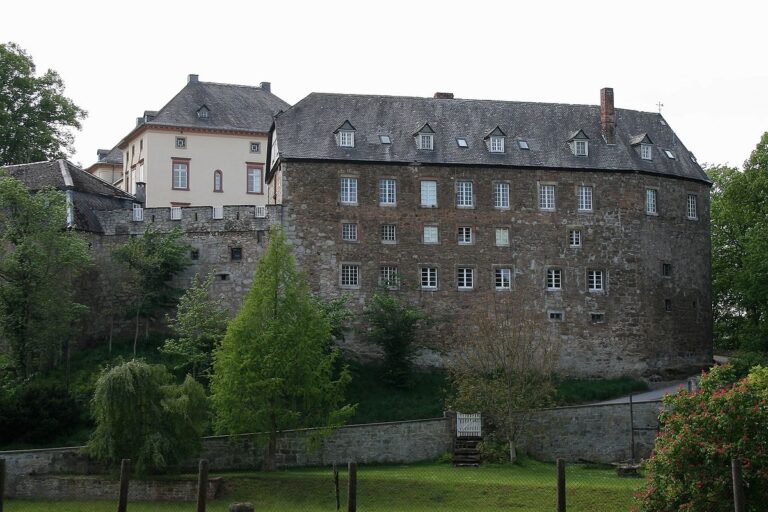
Eresburg is an Old Saxon hill castle at Obermarsberg in Germany, occupying a strategic position on the southern edge of the Saxon gau of Engern, near the border with the Duchy of Franconia. Built as a large Volksburg, or fortified refuge for a wider community, it was repeatedly attacked and contested because of its location.
Prehistoric occupation and Saxon control
The hill was occupied in prehistoric times. Earlier interpretations identified Eresburg as a Cherusci border fortress and the stronghold of Segestes, where he was supposedly holding his daughter Thusnelda. The Cherusci were a Germanic group known from Roman-era accounts, while Segestes and Thusnelda appear in those traditions as a nobleman and his daughter. This identification of Eresburg has not been supported by later evidence.
During the Saxon Wars, a series of campaigns in which the Frankish kingdom conquered and incorporated much of Saxony, Charlemagne captured Eresburg in 772. He also destroyed the Irminsul, a major pagan Saxon religious symbol or sanctuary traditionally described as a pillar or sacred tree. The exact form and location of the Irminsul remain uncertain. The Royal Frankish Annals and the Annales Petaviani describe the conquest of Eresburg followed by Charlemagne’s arrival at a place called Ermensul. Their plural wording for the locations may indicate that the two sites were separate, although other traditions place Charlemagne near Bullerborn, an intermittent spring near Altenbeken, before the sanctuary was destroyed. More than one Irminsul may also have existed.
Christian transformation
In 779 Charlemagne assigned Sturmius, the abbot of Fulda and a leading missionary in the Christianization of the region, to undertake missionary work in the area and directed him to Eresburg. Charlemagne spent the winter of 784–785 there and ordered a church to be built, probably on the site of the former Saxon sanctuary. Pope Leo III, who was pope from 795 to 816, may have stayed at Eresburg in 799 while traveling to Paderborn.
Conflicts in the tenth century
In 915 Eresburg was the scene of a violent conflict between the Saxon duke Henry the Fowler and Eberhard, the future duke of Franconia. Eberhard had been sent by his brother, Conrad, the East Frankish king. The Saxons won the encounter, and the bishop of Paderborn, Theoderic, may have taken part personally. In the same year, invading Hungarians defeated a German army at Eresburg.
In July 938, Otto I besieged Eresburg after his older half-brother Thankmar had taken refuge there during a rebellion. On 28 July, the garrison opened the gates voluntarily because it feared the besieging army, after which the castle was plundered. Thankmar escaped to St Peter’s Church and surrendered by laying his sword on the altar. He was nevertheless killed from behind by Maincia, a retainer of his half-brother Henry. Otto regretted the killing but did not punish Maincia, while Thankmar’s followers were sentenced to hanging.
Remains
Hilltop fortifications
Ramparts and ditches
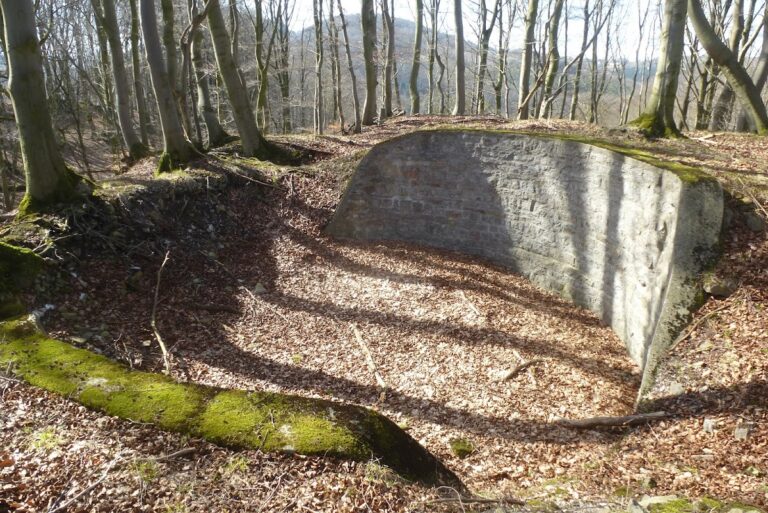
Eresburg occupied the plateau of the Eresberg, a low table hill rising 130 to 150 metres above the Diemel, a tributary of the Weser, and reaching 390 metres above sea level. The surviving physical remains include ramparts and traces of the former fortification. Excavations near the present collegiate church exposed ditches, embankments, and postholes. Radiocarbon dating places these features in the pre-Roman Iron Age, while the wooden posts came from trees dated to approximately 420–370 BC.
Pottery finds
Pottery fragments from the Michelsberg culture have also been found on the hill. Together with the early fortification features, these finds demonstrate occupation of the Eresberg before the Roman period.
Churches and later memorials
Charlemagne’s church
The church ordered by Charlemagne during the winter of 784–785 was probably established on the site of the former Saxon temple. Its position connected the Christian transformation of Eresburg with the earlier religious use of the hill.
St Peter’s Church memorial
Thankmar sought refuge in St Peter’s Church during the siege of 938. The present collegiate church of the former Obermarsberg monastery preserves a crowned head carved on a pillar as a memorial of that episode.