Dough Castle: An O’Connor Stronghold at the Inagh Estuary


Site at a Glance
- Rating
- 4
- Popularity
- Very Low
- Country
- Ireland
- Primary era
- Early Modern
- Eras represented
- Early Modern
- Civilizations
- Irish
- Site type
- Military
- Remains
- Castle
On this page7 sections
History
Dough Castle is a ruined tower house in Ireland, near Lahinch in County Clare. The O’Connors of Corcomroe, a medieval Gaelic ruling family of the region, established it in 1306 at the strategically important mouth of the Inagh River. Its position allowed the lords of Corcomroe to control movement by land and water.
O’Connor stronghold
The site had a castle by 1422, although the structures visible today do not belong to the original foundation. In 1471, an O’Connor chieftain was murdered there by his nephews. He was buried at the end of what is now Lahinch’s main street, where a memorial cairn was later raised. This gave Lahinch its Irish name, Leacht Ui Chonchuir, meaning “O’Connor’s Cairn.”
O’Brien ownership and the Cromwellian period
By 1584, Dough Castle was held by the family of Sir Donal O’Brien. During the Irish Rebellion of 1641, Daniel O’Brien sheltered English settlers threatened by the uprising. When the Cromwellian army, the Parliamentarian force involved in Oliver Cromwell’s conquest and settlement of Ireland, advanced through the country, this action helped spare the castle from slighting, the deliberate demolition or disabling of a fortification. In 1654, the Cromwellian officer Colonel Stubber saved Dough Castle from destruction.
A separate fortress known as O’Brien’s Castle was built nearby by Turlough O’Brien in 1588 as a defence against the Spanish. It formed a distinct stronghold rather than a later phase of Dough Castle.
Collapse and tradition
In 1675, Dough Castle still possessed a complete tower and an attached two-storey dwelling. Its position on unstable sandbanks then became a continuing structural problem. One side had fallen before 1839, and a major collapse in 1883 carried away a substantial section of the building, including its chimney.
Local tradition associated the sandbanks with Donn Dumhach, a sí prince from Gaelic supernatural tradition, believed to inhabit the otherworldly landscape beneath hills and burial mounds. The sandhill near the bridge was also reputed to be haunted. Another tradition tells of an underground passage from Dough Castle toward Liscannor, supposedly containing valuables.
Remains
The surviving tower house
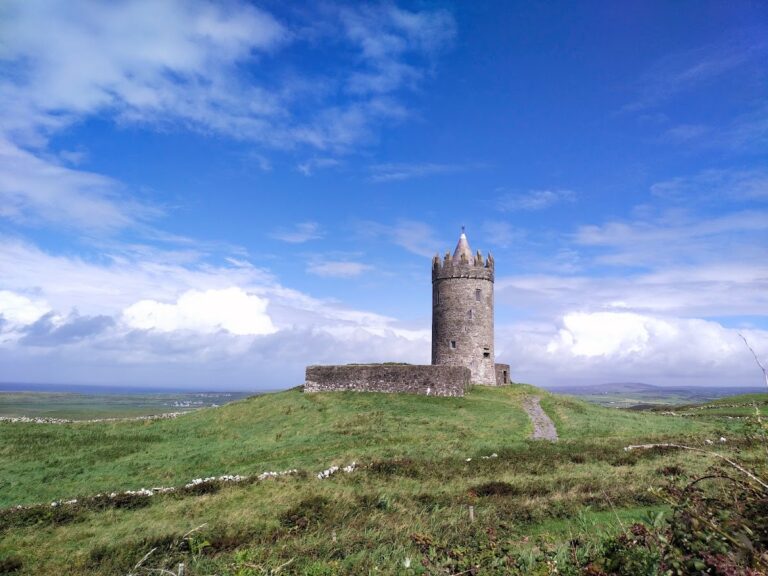
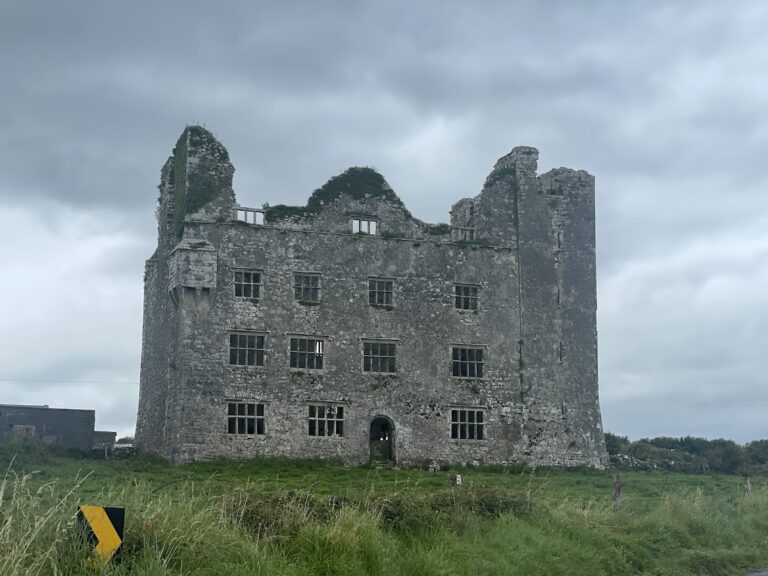
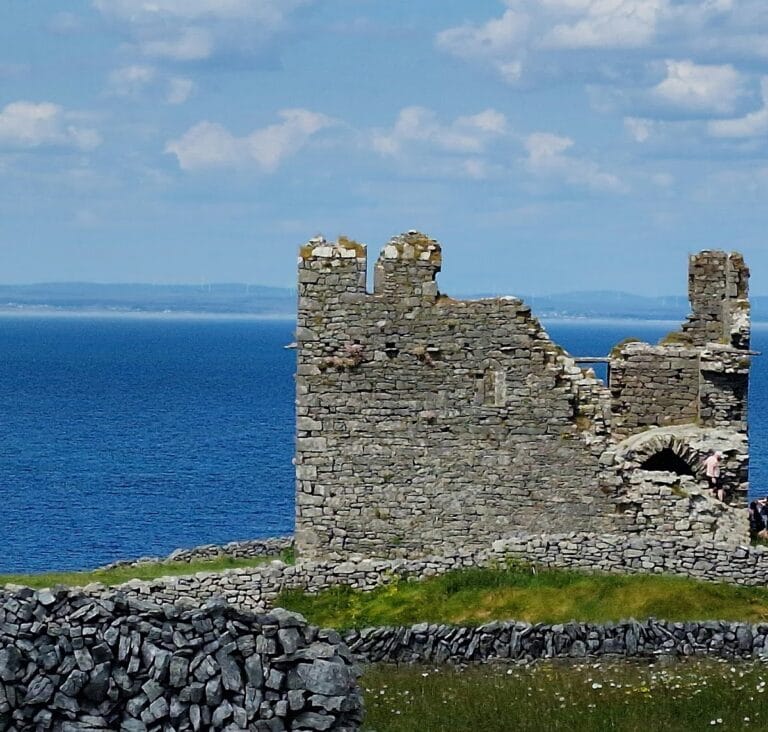
Dough Castle stands in the townland of Dough, in the civil parish of Kilmacrehy, south of the combined Inagh and Dealagh estuary and near the point where the Dealagh joins the Inagh. The ruined complex lies on or beside Lahinch Golf Course. Its surviving fabric consists chiefly of the O’Brien tower, a tower house, meaning a fortified residential building centred on a tall masonry tower that combined domestic accommodation with defensive features.
The castle was built with rubble masonry on sandbanks that provided poor foundations. The surviving tower was once tall and battlemented, with a large two-storey dwelling attached to one side. Large windows with flat arches and slab lintels had replaced the earlier slit windows. Repeated failures of the sandbank foundations altered the building, and the 1883 collapse removed part of the structure and its chimney. The castle now survives in a ruined condition.
Associated features and traditions
O’Brien’s Castle, the separate fortress erected nearby in 1588, is not part of the surviving Dough Castle complex. The traditional passage toward Liscannor belongs to the castle’s local lore, alongside stories of buried valuables and the supernatural presence of Donn Dumhach.