Castle of Pellegrino Parmense: A Medieval Hilltop Fortress in Italy


Site at a Glance
- Rating
- 4.3
- Popularity
- Very Low
- Country
- Italy
- Primary era
- Medieval
- Eras represented
- Medieval
- Civilizations
- Duchy of Milan, Holy Roman Empire
- Site type
- Military
- Remains
- Castle
On this page9 sections
History
Castle of Pellegrino Parmense is a medieval hilltop fortress in Italy, probably founded around 981 by Adalbert of Baden of the Obertenghi, a powerful northern Italian noble family. Adalbert had received the margraviate of Pellegrino from Holy Roman Emperor Otto II and established the castle to defend the nearby settlement. His sons Umbertino and Bertoldo became the founders of the Pallavicino family, which later shaped the castle’s history.
The Pallavicino stronghold
During the following centuries, Parma and Piacenza contested control of Pellegrino. In 1198, Cardinal Petrus Capuanus, a church official and deacon of Santa Maria in Via Lata, was attacked and robbed by Guglielmo Pallavicino while travelling through the Stirone Valley. Pallavicino used the resulting booty to rebuild the castle completely. Its renewed defences gave it a long-standing reputation as an impregnable fortress.
That reputation was tested during the struggles between Guelphs and Ghibellines, rival political groupings in medieval Italy. Guelphs generally supported the papacy, while Ghibellines generally supported the imperial side. The Ghibelline marquis Oberto II Pallavicino subdued Parma’s Guelphs. Unable to take his fortress, they were forced to pay him a pension of 1,000 imperial lire, although they later attacked and destroyed the nearby Castle of Ravarano, also owned by Oberto.
Sieges and Visconti conquest
In 1304, when Manfredino Pallavicino held the castle, Francesco Scotti, lord of Piacenza, besieged it for 15 days. He was supported by Ghiberto da Correggio and troops from the Comune of Parma under Niccolò da Fogliano. Pellegrino resisted the assault, and Scotti withdrew to attack and destroy the Rocca di Belvedere instead.
Further attacks followed the rebellions at Pellegrino and Bardi against Alberto Scotti’s authority. In 1307, Piacenza captured Bardi, Borgotaro, and Castell’Arquato, but Pellegrino resisted every assault and forced the Piacentine troops to withdraw. The fortress finally lost its reputation for impregnability in 1428, when Filippo Maria Visconti, Duke of Milan, sent troops against it under Niccolò Piccinino, a condottiere, or professional military commander serving under contract. Marquis Manfredo Pallavicino was captured, tortured into confessing an alleged conspiracy against the duke, and sentenced to death.
Piccinino and the Sforza period
In 1438, the fief of Pellegrino was reduced to a county and granted to Piccinino. He strengthened the fortress by extending its circuit wall around the settlement’s houses and church. His sons Francesco and Jacopo later succeeded him. Alessandro Sforza conquered the castle in 1449, and Gabriella Gonzaga, the wife of Corrado Fogliani and maternal half-sister of Duke Francesco Sforza, purchased it in 1472.
Duke Galeazzo Maria Sforza restored Pellegrino to margravial status and granted it to his cousin Ludovico Fogliani. Ludovico was permitted to add “Sforza” to his surname, linking the family directly to the ruling house of Milan. The castle thus remained tied to the political struggles of northern Italy as its ownership and title changed.
End of feudal rule and modern use
Giovanni Fogliani Sforza d’Aragona, the last marquis and viceroy of Sicily from 1755, renounced his fiefs in 1759 in favour of his nephew Federico Meli-Lupi di Soragna. After Federico’s death, the margraviate passed to his son Carlo. He was forced to abandon Pellegrino in 1805, when Napoleon abolished feudal rights in the Duchy of Parma and Piacenza.
The castle then passed to the Boccoli family, who sold it to the Pettenati family in 1817. During the First World War, Pettenati descendants sold the property. Stripped of its furnishings, it was used as a carpentry workshop. German forces requisitioned it during the Second World War, using the fortress as an observation tower and accommodation for soldiers.
After further changes of ownership, Carlo Raggio was followed by the Bottego and Tomelleri families. The Tomelleris began the first major restoration campaign. After 1990, the entrepreneur Camillo Catelli purchased the castle and completed the restoration, including work on the chapel and tower.
The White Lady tradition
A tradition preserved in official documents holds that the castle’s “White Lady” was first seen in 1827. Residents reportedly testified under oath that they had witnessed a white-clad apparition. The story attracted an average of about 300 visitors each day for a period, until government authorities stationed a corps of Ducal Dragoons, mounted troops serving the ducal government, to control the gatherings. The public appearances then ceased completely.
Remains
Fortress layout and defences
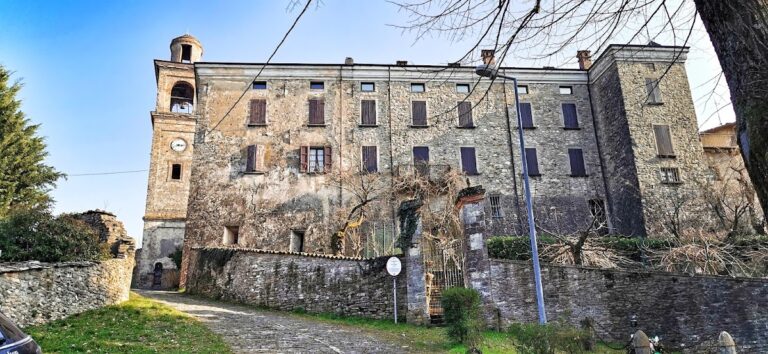
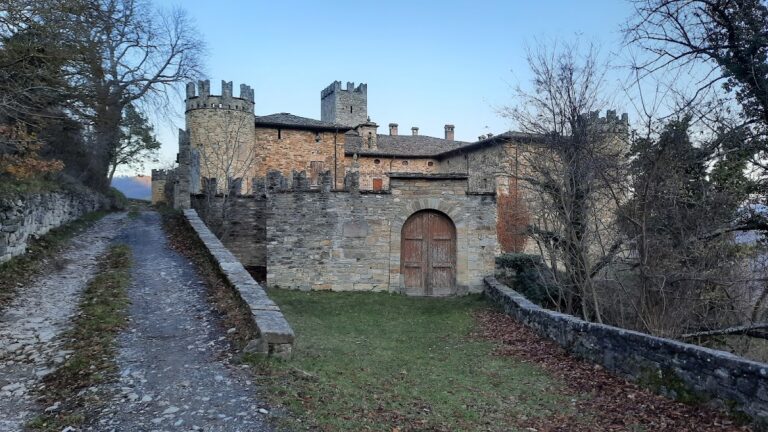
The restored fortress stands on the summit of a hill near the village of Pellegrino Parmense, at about 500 metres above sea level. Built in rubble masonry, it is organized around a tall rectangular principal block with a large square-plan tower attached to its eastern short side. Remnants of the surrounding wall circuit remain visible outside the main building, and the circuit follows a rectangular plan.
The original enclosure had four corner towers. The two eastern towers survive intact and are cylindrical in form. The austere stone façades have thick, strongly sloping walls at the lower levels and only a small number of windows, features that express the fortress’s defensive purpose. Some paired-arched windows remain visible, while former crenellations, or battlements, can still be distinguished along the upper perimeter of the main building, although they are now blocked.
Interior spaces and restored structures
Inside, numerous rooms contain antique furniture, alongside former service rooms and prison spaces. One prison cell is associated with the torture and strangulation of Manfredo Pallavicino after his capture in 1428. The chapel and the tower were restored during the work undertaken after 1990, preserving these elements within the surviving medieval complex.